Step outside on a clear, dark night and look straight up. You will immediately spot hundreds of twinkling stars. But if you watch the sky carefully, you might notice that a few of those bright dots don’t twinkle at all. They shine with a steady, solid light. Those aren’t stars; they are entirely different worlds wandering through the dark ocean of space.
Space is a mind-boggling place, but learning about our cosmic neighborhood doesn’t have to be complicated. Let’s put together the ultimate solar system planets for kids guide! We will dive into what these massive globes are made of, figure out what order they sit in, and share some truly wild secrets about our closest cosmic neighbors.
The Basics: Understanding Our Cosmic Neighbors
Before we launch our imaginary rocket ship, let’s write a short note on planets. What exactly are they?
A planet is a massive cosmic body that orbits a star (like our Sun). To officially earn the title, it must be huge enough that its own gravity squishes it into a round ball, and it must have a strong enough gravitational pull to clear its orbital path of random space rocks. If you love learning about planets, you might just grow up to be a scientist. Specifically, the study of planet is called planetary science, and it involves looking at everything from frozen moons to giant storms millions of miles away.
Read More – Planet Names in Our Solar System with Order for Kids
Inside and Out: How Are They Built?
Not every world in the sky is a solid rock. If we look closely at the types of planets in our solar system, we can divide them into two very distinct families: the Terrestrial (rocky) worlds and the Gas or Ice Giants.
The characteristics of planets completely depend on how close they are to the Sun. The inner worlds are solid, warm, and made of heavy materials. The outer worlds are freezing cold, violently windy, and made almost entirely of swirling gases and icy liquids.
But what about the actual parts of planet? Think of a rocky world like a giant, round cake with different layers. At the very center is the core (usually made of super-hot metal). Wrapped around the core is a thick layer of rock called the mantle. The very outside shell that we walk on is the crust. Finally, the blanket of floating gases trapping the air around the globe is called the atmosphere. Gas giants are totally different; they have a tiny, dense core surrounded by bottomless oceans of liquid gas! These unique features of planets guarantee that no two worlds are exactly alike.
The Grand Lineup
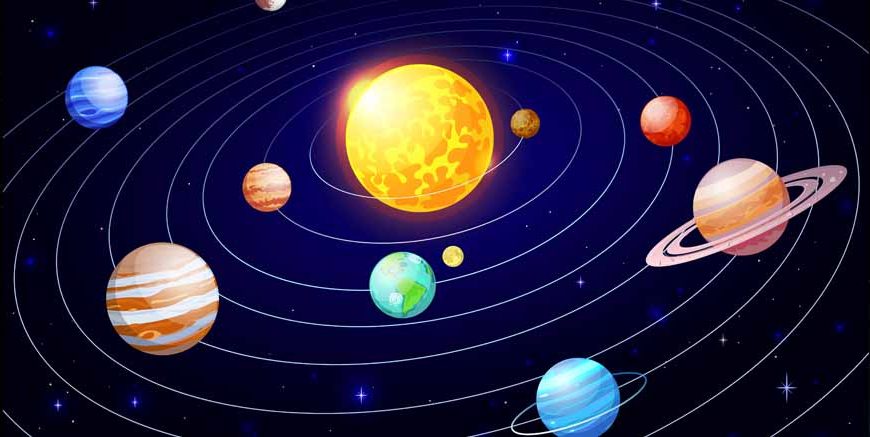
If you want to memorize all the planets in order starting from the blazing hot Sun, just remember this silly sentence: My Very Educated Mother Just Served Us Noodles. The first letters perfectly match the order of our system: Mercury, Venus, Earth, Mars, Jupiter, Saturn, Uranus, and Neptune. Now that we know where all planets sit, let’s dive into some awesome planet facts for kids!
5 Facts About Each Planet
To keep our space journey moving, here are exactly 5 facts about each planet to share with your friends today:
1. Mercury
- It is the closest world to the Sun, but surprisingly, not the hottest!
- It zips around the Sun faster than any other object in our solar system.
- Because it has no thick atmosphere, it is boiling hot by day and freezing cold at night.
- Its surface looks exactly like our Moon, completely covered in deep craters.
- It has absolutely zero moons of its own.
2. Venus
- This is officially the hottest planet, trapped in a runaway greenhouse effect.
- It spins backward compared to Earth, meaning the Sun rises in the west!
- It is completely covered in a thick, toxic layer of yellowish clouds.
- The surface is loaded with thousands of active volcanoes.
- It is often called Earth’s “evil twin” because it is almost the exact same size.
3. Earth
- This is our beautiful home, perfectly positioned in the “Goldilocks Zone.”
- It is the only known place in the universe with liquid water on its surface.
- It has one large, rocky Moon that controls our ocean tides.
- Our atmosphere is the perfect mix of nitrogen and oxygen to let us breathe.
- It is the only planet we know of that is absolutely crawling with life!
4. Mars
- It is famous for being the “Red Planet” because its dirt is full of rusty iron.
- It is home to Olympus Mons, the largest volcano in the entire solar system.
- It has two tiny, lumpy moons named Phobos and Deimos.
- Scientists believe ancient rivers and oceans used to cover its surface.
- Right now, human-made robot rovers are driving around exploring its craters!
5. Jupiter
- This is the undisputed king; it is the largest planet in our solar system.
- It is a Gas Giant, meaning you couldn’t actually stand on its surface.
- It features the “Great Red Spot,” a massive storm that has raged for hundreds of years.
- It has a very faint set of rings made of dust.
- It acts like a giant vacuum cleaner, using its massive gravity to pull dangerous asteroids away from Earth.
6. Saturn
- It is instantly recognizable for its massive, spectacular, and sparkling ice rings.
- It is the least dense planet—if you found a bathtub big enough, Saturn would actually float!
- It experiences wild winds that blow hundreds of miles per hour.
- There is a bizarre, giant hexagon-shaped storm spinning perfectly at its North Pole.
- It is orbited by over 100 wildly different moons!
7. Uranus
- This Ice Giant is knocked completely sideways and spins on a tilted axis.
- It has a beautiful, pale blue-green color because of methane gas.
- It is one of the absolute coldest places in the entire solar system.
- Like Saturn, it also has a system of rings, though they are very dark and thin.
- According to scientists, the upper clouds of Uranus probably smell like rotten eggs!
8. Neptune
- It is the furthest official planet sitting at the dark edge of our system.
- It boasts a gorgeous, deep ocean-blue color.
- It has the fastest, most violent winds anywhere in the solar system.
- It was the very first planet to be discovered using math before anyone actually saw it through a telescope.
- It is named after the ancient Roman god of the sea!
Read More – Facts About Saturn Planet
Summary
When we zoom out and look at our cosmic neighborhood, it is absolutely mind-blowing. From the rusty red dirt of Mars to the sideways ice storms of Uranus, the diversity of our solar system is incredible.
Yet, for all their extreme differences, they all share one beautiful thing in common: they are all locked in a permanent, silent dance around the exact same star. It really makes you realize that our precious, watery Earth is just one tiny, fragile piece of a much larger, magnificent puzzle. Keep looking up, stay curious, and never stop exploring the night sky.
To read more fun, engaging, and educational articles, check out the EuroKids Blog, and visit our website for details on EuroKids Preschool Admission.
FAQs
Why isn’t Pluto on the list anymore?
Pluto is still out there, but scientists reclassified it as a “dwarf planet” because it hasn’t cleared its orbital path of other large space rocks and icy debris.
Can humans ever land on a Gas Giant like Jupiter?
No! Because Gas Giants do not have a hard, rocky crust, a spaceship trying to land would just sink endlessly into the crushing, swirling gases.
How long does it take to travel to Mars?
With our current rocket technology, it takes a robotic spaceship about seven to nine months to fly from Earth to Mars.
Which planet is the easiest to see from my backyard?
Venus is usually the brightest object in the night sky (other than the Moon) and is very easy to spot right after sunset or just before dawn!