“Daddy, can we go to the moon?” If your little one is fascinated by the night sky, you are not alone! Children are naturally curious about space, planet names, and everything beyond our Earth.
Planet names are commonly taught in elementary classes, but many students feel confused about the correct order of planets or how many planets are actually in our solar system. Why wait until your kid gets to elementary school? You can build a strong foundation for your little one by introducing them to the solar system early, right at home, before they even start primary school.
In this blog, we will share all the planet names in our solar system with colourful pictures and fun facts that will captivate your little explorer’s imagination.
What is the Solar System?
Before teaching planet names, help your child understand the solar system in the simplest way.
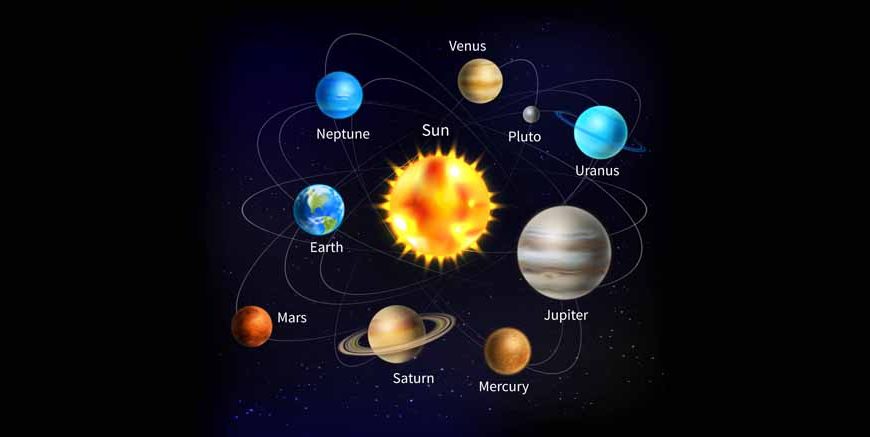
Our solar system is like a big space family. At the centre is the Sun, and all the planets move around it in their own paths called orbits.
Along with the Sun and planets, the solar system also includes moons, asteroids, comets, and stars. Scientists believe it formed more than 4 billion years ago.
Read More – Solar System for Kids
What is a Planet?
A planet is a large object in space that moves around the Sun, is round in shape, and has cleared its path in space. There are 8 planets in our solar system, and each one is unique. Here is the correct order of planets you can teach your child:
- Mercury
- Venus
- Earth
- Mars
- Jupiter
- Saturn
- Uranus
- Neptune
Planet Names With Pictures (Interesting Facts)
Here are the planet names with pictures and some interesting facts:
1. Mercury
- Mercury is the closest planet to the Sun and also the smallest planet.
- A year on Mercury lasts only 88 Earth days.
- It moves very fast around the Sun.
- Temperatures here are extremely hot during the day and freezing at night.
2. Venus
- Venus is often called Earth’s twin because it is similar in size.
- It is the hottest planet in the solar system.
- Venus spins in the opposite direction compared to most planets.
- The Sun would rise in the west on Venus.
3. Earth
- Earth is the third planet and the only one known to have life.
- It takes 365 days to orbit the Sun.
- One rotation (day and night) takes 24 hours.
- Earth has one moon.
4. Mars
- Mars looks red because of iron dust on its surface.
- Scientists have sent robots called rovers to explore Mars.
- Gravity is weaker, so you could jump higher on Mars.
5. Jupiter
- Jupiter is the largest planet in our solar system.
- More than 300 Earths could fit inside Jupiter.
- Jupiter is made mostly of gas.
- A day on Jupiter lasts less than 10 hours.
6. Saturn
- Saturn is famous for its beautiful rings made of ice and rock.
- Saturn is the second-largest planet.
- It is so light that it could float on water (if there were a big enough ocean).
7. Uranus
- Uranus spins on its side, which makes it unique.
- It is one of the coldest planets.
- Its extreme tilt causes very long seasons.
8. Neptune
- Neptune is the farthest planet from the Sun.
- It has the strongest winds in the solar system.
- It looks bright blue because of the gases in its atmosphere.
- A year on Neptune lasts 165 Earth years.
Read More – Strangest Planet in Our Solar System
Why Should Kids Learn Planet Names Early?
Teaching planets early helps children:
- Develop curiosity about science
- Understand Earth and the environment better
- Build vocabulary related to space
- Improve memory and imagination
Fun Activities to Teach Planet Names
- Planet Flashcards: Print pictures of planets and show them one by one. Later, quiz your child by asking the planet names.
- Draw and Colour Planets: Ask your child to draw their favourite planet and colour it.
- Sing a Planet Song: Songs help children remember the order easily.
- “Name the Next Planet” Game: Say a planet name and ask your child what comes next.
Conclusion
In the end, introducing planet names early turns curiosity into learning. With colourful visuals, fun facts, and simple activities, your little explorer can start their space journey right at home. Who knows? Today’s bedtime planet lesson might inspire tomorrow’s astronaut.
You can also check out EuroKids Blogs for more insightful and fun articles on your baby’s growth, health, and learning. Don’t forget to check out Eurokids Preschool Admission for the perfect foundation to kickstart your little one’s learning journey.