Summer holidays started just a few days back, and already the house feels… different.
The dining table has this permanent layer of things now, crayons, one half-eaten biscuit, yesterday’s homework still open under something, I think a comic book. The fan is making that slightly ticking sound again, I keep telling myself I’ll call someone to fix it.
So yesterday evening, Meera was just lying there, bored in that very specific way kids get, not wanting to read, not wanting to draw, just flipping things and sighing loudly… and I remembered we had an old box of dominoes somewhere.
I don’t even know why we bought it back then.
I pulled it out, half expecting missing pieces, but surprisingly everything was there. A little dusty, though.
“Appa, what is this?” she asked, already picking up one tile.
And that’s how we ended up sitting there, figuring out how to play dominoes together… and honestly, I didn’t realise how nicely it would turn into one of those slow, quiet evenings.
What Happened When We Started Playing
At first, I had to remind myself also how to play dominoes properly. It’s funny how these small things just disappear from memory.
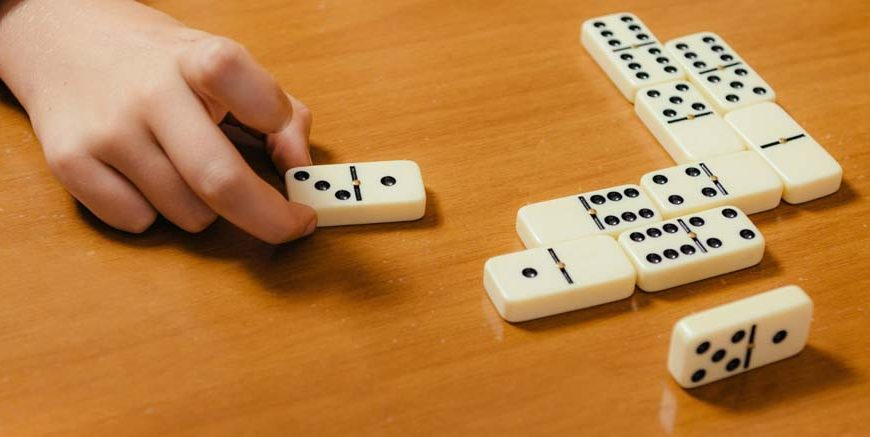
So I told her, okay see, each tile has numbers, and we just have to match the same numbers. Simple.
She nodded like she understood, but then immediately tried to place a 3 next to a 5.
I didn’t correct her immediately. I just said, “Look properly… does that match?”
She stared at it for a few seconds, then quietly changed it.
That moment… I remember smiling.
That’s when I realised domino games for kids are not just about playing. There’s this small thinking happening, very natural, not forced like homework.
Read More – Best Indoor Games for Kids
How We Slowly Figured Out How To Play Dominoes
I didn’t sit and explain rules like a teacher. That never works at home.
We just started.
I placed one tile in the centre and said, “Now your turn.”
She kept looking at all her pieces, taking time, rejecting some, trying others. Once she even tried to sneak in a wrong match and then looked at me to see if I noticed. I did, but I just raised my eyebrow a little.
She laughed and fixed it.
So that’s how it went. Very slow. Slightly messy. Sometimes she would get distracted midway and start telling me about something random from school, and I’d have to bring her back to the game.
If you’re wondering how to play dominoes with kids, honestly, this way works best. Not too many rules at once. Just let them discover it while playing.
Why Domino Games For Kids Work So Well
I didn’t think about “benefits” in that moment, but later when I was clearing the table, it struck me.
There are so many small things happening quietly.
She was:
- Matching numbers without realising it’s math
- Waiting for her turn, which is a whole separate skill
- Thinking ahead, sometimes even saying, “If I put this, then I can put this later…”
I didn’t teach that. It just came.
That’s why I feel domino games for kids are such a simple but effective thing to have at home. No screens, no noise, just… thinking and playing together.
And also, they slow things down a bit. Which I think we all need.
Read More – Fun and Exciting Number Activities for Children
Different Ways We Started Playing (Without Planning To)
After a while, she got bored of just matching numbers. Typical.
So we changed it slightly.
We started building patterns instead of just lines. Then we tried making a long chain across the table. At one point she even said, “Let’s make a bridge,” and tried standing the tiles.
Half of it fell, obviously. She got annoyed for a second, then started again.
That’s another thing with domino games for kids. You can keep changing the way you play. It doesn’t have to be strict.
Some simple ways we ended up playing:
- Just matching numbers in a line
- Building shapes with tiles
- Creating a long chain and knocking it down
- Mixing numbers and colours
Honestly, when you play domino games for kids, the game itself keeps evolving.
That Small Moment I Didn’t Expect
At one point, I was about to get up to make tea, and she said, “Wait Appa, one more round.”
I sat back down.
She played faster this time. More confident. Less hesitation.
And then she said, “This is easy now.”
That line… I don’t know why, but it stayed with me.
Because ten minutes before that, she was confused and guessing.
Kids do this sometimes. They just need that little bit of time to settle into something.
When It Gets Messy (And That’s Okay)
Of course, not everything was smooth.
She dropped a few tiles. One went under the table, and we both had to bend down and search for it. At some point, she started stacking them instead of playing properly.
For a second, I thought I should bring her back to the “correct” way.
Then I didn’t.
Because maybe the point wasn’t to play perfectly.
If you’re planning to play domino games for kids, this part is important to remember. It will not go exactly as you imagine. And that’s okay.
Read More – Group Exercise Games for Daycare Playtime
Why I Think We’ll Keep Coming Back To This
Later that night, after she slept, I saw the domino box still on the table.
Didn’t feel like putting it away immediately.
There’s something about these small games. They don’t feel like effort. You don’t need to convince your child to sit and do it.
It just… happens.
And in between, you get these small windows where you see how your child is thinking, how they are figuring things out.
That’s quite nice to watch.
Ending Thought That Stayed With Me
Today morning she asked again, “Can we play that thing again?”
She didn’t even say dominoes.
Just “that thing.”
And I knew exactly what she meant.
We’ll probably play again today evening. Or maybe not for a few days and then suddenly again.
That’s how these things go.
I remember when she was at EuroKids Preschool, they used to do these simple activities like matching, sorting, and small games… nothing big, but I think that’s where this comfort comes from. This willingness to sit with something and figure it out slowly. It’s one of the reasons parents exploring Eurokids Preschool Admission often look for play-based learning environments that encourage problem-solving and independent thinking from an early age.
Anyway, the domino box is still on the table. I should probably clear it before lunch… but I might just leave it there for a bit.