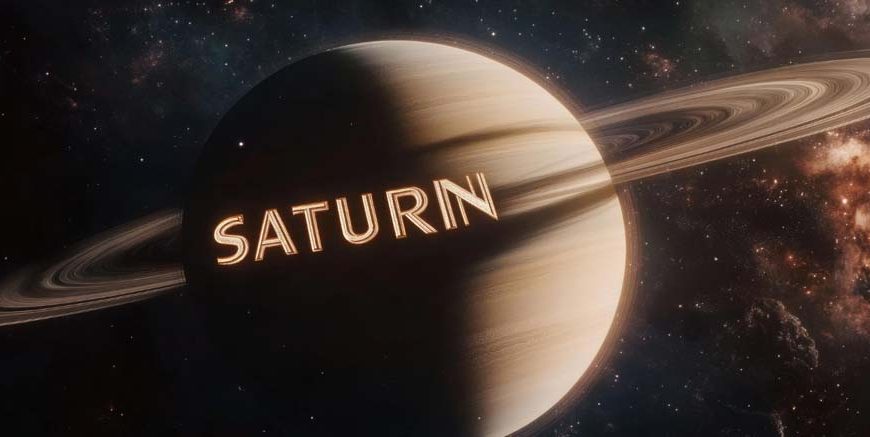
Space is filled with billions of floating rocks, burning stars, and giant spheres of swirling gas. Yet, out of all the incredible sights scattered across the Milky Way galaxy, one specific world always steals the spotlight. If the solar system held a cosmic beauty contest, the winner would undoubtedly be the magnificent ringed giant sitting in the outer edges of our neighborhood.
For hundreds of years, astronomers have pointed their telescopes at the night sky just to catch a glimpse of its glowing, golden halos. Today, we are going to leave Earth behind and take a deep dive into the cosmos. We will gather essential saturn planet information, explore its wild weather, and uncover the science behind its most famous features.
The Giant Balloon: Basic Characteristics of Saturn
To understand this massive world, we must first look at where it lives and what it is made of. The Saturn planet is the sixth planet from our Sun and the second-largest planet in our entire solar system (right behind Jupiter).
When we study the physical characteristics of Saturn, the most surprising detail is that it does not have a solid surface. You cannot land a spaceship on it, and you certainly cannot walk around on it. It is classified as a “gas giant.” This means it is essentially a massive, spinning ball made almost entirely of two light gases: hydrogen and helium.
Because it is made of gas, the atmosphere is incredibly hostile. The sky is filled with thick yellow and gold clouds, driven by violent winds that blow at speeds of up to 1,100 miles per hour!
Read More – Surprising Facts About Space
The Spectacular Hula Hoops
You cannot look for information about Saturn without talking about its crown jewels: the rings. While other planets like Jupiter and Uranus have rings, none are as massive, bright, or complex as the ones found here.
From far away on Earth, these rings look like a few solid, flat hula hoops spinning around the planet’s waist. However, close-up photographs from robotic spacecraft reveal the truth. The rings are actually made of billions of individual pieces of crushed ice, rock, and space dust. Some of these icy pieces are as tiny as a grain of sand, while others are as massive as a tall mountain. Because they are mostly made of shiny ice, they act like giant mirrors, perfectly reflecting the sun’s light and making the planet glow brightly in the dark vacuum of space.
Comparing Two Worlds
To make this saturn planet information easier to grasp, it helps to compare this gas giant directly to our own home. Here is a quick table showing a few amazing differences:
|
Feature |
Earth |
Saturn |
|
Solid Ground |
Yes, made of rock and dirt. |
No, made entirely of swirling gas. |
|
Length of a Day |
24 hours. |
10.7 hours (It spins very fast!). |
|
Length of a Year |
365 days. |
29 Earth years (It takes a long time to orbit the Sun). |
|
Number of Moons |
Exactly 1. |
Over 140 known moons! |
Read More – Planet Names in Our Solar System
A Crowded Family of Moons
Speaking of moons, one of the most fascinating things about saturn is its massive, crowded family. Because the planet has such strong gravity, it has pulled in dozens and dozens of moons over billions of years.
The most famous moon in this family is called Titan. Titan is actually bigger than the planet Mercury! It is a bizarre, freezing world with a thick orange sky. Even crazier, scientists have discovered that Titan has real liquid lakes and rivers on its surface. However, instead of being filled with water, these lakes are filled with freezing liquid methane gas.
10 Facts About Saturn to Ace Your Science Quiz
If you are preparing for a school project and need a quick list of saturn planet facts, here is a countdown of the absolute best ones. Memorizing these 10 facts about saturn will make you a certified space expert!
1. It could float in a bathtub:
Even though it is massive, its gas composition makes it incredibly light. If you could build a bathtub big enough to hold it, the entire planet would bob on the water like an apple.
2. The rings are super thin:
While the rings stretch out for hundreds of thousands of miles wide, they are shockingly thin, usually only about 30 feet thick!
3. It has a mysterious shape on top:
At the planet’s North Pole, there is a massive, permanent storm shaped exactly like a perfect six-sided hexagon.
4. It is highly squashed:
Because it spins so incredibly fast on its axis, the planet bulges out at the middle and looks flattened at the top and bottom.
5. The rings are slowly disappearing:
Scientists believe the planet’s gravity is slowly pulling the icy ring particles down as “ring rain,” meaning the rings might completely vanish in 100 million years.
6. It was named after a farmer:
The ancient Romans named the glowing yellow dot in the sky after their god of agriculture and wealth.
7. Galileo was confused by it:
When the famous astronomer Galileo first looked at it through a primitive telescope in 1610, the rings looked blurry. He wrote down that the planet had “ears.”
8. It is freezing cold:
Because it sits nearly 900 million miles away from the warming Sun, the average temperature is a bitter -288 degrees Fahrenheit.
9. We have visited it four times:
Humans have sent four robotic spacecraft to study it: Pioneer 11, Voyager 1, Voyager 2, and the Cassini mission.
10. Saturday belongs to it:
The English day of the week “Saturday” is directly named after this exact planet!
These interesting facts about Saturn prove that the deeper we look into the dark sky, the more bizarre and wonderful the universe becomes.
Read More – How do you make science interesting for kids?
Conclusion
To wrap up our astronomical journey, the sixth planet from the Sun is a true masterpiece of nature. It is a gigantic, fast-spinning sphere of gas surrounded by a dazzling, icy ring system and orbited by over a hundred unique moons. From its squashed shape to its mysterious hexagon storms, it breaks all the rules we are used to here on solid Earth.
Knowing that a massive, stormy ball of hydrogen surrounded by glittering crushed ice is floating silently in the dark void of space reminds us of how incredibly wild and diverse our universe truly is. It proves that nature is the ultimate artist, working on a canvas much larger than our human minds can fully comprehend.
FAQs
Can humans ever travel to this planet?
Currently, it is impossible. It is much too far away, the journey would take many years, and because there is no solid ground, a spaceship would have nowhere to land.
Does the planet have gravity like Earth?
Yes! Surprisingly, because the planet is so huge but made of such light gas, the actual pull of gravity you would feel near its cloud tops is almost exactly the same as the gravity you feel walking around on Earth.
How did the famous rings form?
Scientists strongly believe the rings were created when comets, asteroids, or even old moons wandered too close to the planet and were completely ripped apart by its massive gravity.
Are the rings solid enough to walk on?
No, they are not a solid track. If you tried to step on a ring, you would just float right through a messy, fast-moving cloud of cold ice chunks and space dust.