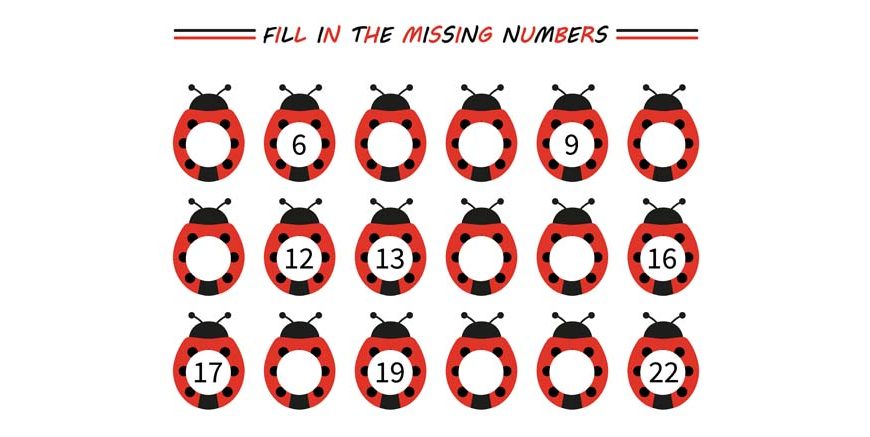
Most young children learn to excitedly recite numbers exactly the same way they learn to sing their favourite nursery rhymes. They can loudly chant from one to ten without taking a single breath. While this vocal repetition is a wonderful early milestone, it does not actually prove that they understand how mathematics works. Reciting a song is simply memory; true numerical comprehension only begins when a child can confidently identify exactly what is missing from a sequence.
When a sequence gets broken, the brain is forced to stop running on automatic pilot. It has to pause, look at the surrounding clues, and actively calculate the gap. Let us break down how turning a basic counting lesson into a logical detective game completely transforms how a young child understands numerical values.
The Power of a missing number activity
To a developing brain, numbers initially seem like a strict, rigid set of rules forced upon them by adults. A carefully designed missing number activity completely changes this dynamic. It turns mathematics into a physical puzzle waiting to be solved.
Instead of asking a child to passively stare at a long list of digits, you present them with a broken pattern. For example, if you lay out a row of wooden building blocks numbered one, two, four, and five, the child immediately notices the glaring physical gap in the middle. They are naturally drawn to fix the broken line.
This process forces them to understand that numbers are not just floating, random sounds. They represent strict quantities that always live in a very specific neighbourhood. By solving the puzzle, the child learns that the number three will always logically exist directly between the two and the four.
Mastering the Concept of missing counting
Once a child understands that numbers sit in a specific order, you can introduce the slightly more complex concept of missing counting. This involves looking at a sequence that does not necessarily start at the number one.
Many children panic if you ask them what comes after seven, simply because they feel the urge to start counting from the very beginning to find the answer. Practising gap recognition entirely stops this reliance on starting from zero. You can start a sequence at six, leave a blank space, and then place an eight. The child must use their immediate knowledge of the number line to bridge that specific gap.
This highly logical, independent problem-solving forms the absolute core of the Heureka curriculum. Instead of drilling children with boring worksheets, they are actively encouraged to manipulate their physical environment to understand where a sequence begins, where it ends, and what crucial pieces have been taken away.
Read More – Importance of Math in Everyday Life
Creative Ways to fill in the missing numbers
You do not need to buy expensive workbooks or flashcards to practice this vital skill at home. The absolute best educational games use items you already have lying around the house.
A brilliant method to help your child fill in the missing numbers is to create a simple ‘washing line’ across your living room using a piece of string. Write the numbers one through ten on separate pieces of folded paper and hang them on the string using clothes pegs.
Ask your child to close their eyes tightly, and then quickly remove two or three of the numbers. When they open their eyes, they have to physically clip the correct numbers back into their rightful spots.
This game is incredibly effective because it is highly tactile. The child is physically holding the number, visually scanning the broken line, and clipping it into the correct gap. It builds heavy fine motor skills while permanently locking the numerical sequence into their working memory.
Helping Children to write the missing number
Once your child is highly confident in verbally identifying the gaps using physical toys or paper cards, it is time to transition that knowledge onto a flat surface. Learning to write the missing number bridges the gap between active play and formal classroom mathematics.
However, this transition should never feel like a strict, stressful test. Instead of handing them a dry pencil and a piece of paper, use sensory materials to make the writing process enjoyable. Pour a thin layer of dry flour or clean play sand onto a baking tray. Draw a simple sequence in the sand with your finger, such as ‘3, 4, _, 6’, and ask your child to trace the correct missing digit directly into the sand.
If they make a mistake, they can simply shake the tray to wipe the slate clean and try again without leaving any permanent, frustrating eraser marks. This method completely removes the anxiety of getting the answer wrong. It allows them to safely practice the complex physical curves and straight lines of digit formation while simultaneously solving the logical mathematical puzzle.
Read More – Fun Number Activities for Kids
Conclusion
Stripping away the boring, repetitive nature of rote counting and replacing it with interactive gap puzzles completely alters a child’s academic trajectory. We are not simply teaching them how to count to ten; we are actively handing them the mechanical tools to dissect patterns, observe their environment, and confidently solve complex problems.
When a young child realises that they can independently figure out a broken sequence without an adult handing them the answer, their academic self-esteem massively grows. It is genuinely thought-provoking to realise that a simple game involving numbered paper clips or a sandy tray actively builds the exact neural architecture required for advanced algebra and computer coding later in life.
By making early maths a playful, tactile investigation, we guarantee they will never view numbers as a terrifying chore. To uncover more ways to shape your child’s early logic and support their daily development, read the latest articles on the EuroKids Blog and secure their next big step through EuroKids Preschool Admission.
FAQs
At what age should a child start playing gap-filling number games?
Children between the ages of three and four are usually ready for basic gap games, provided they can already confidently count out loud from one to ten and recognise the basic shapes of the numbers.
What should I do if my child keeps guessing the wrong number?
Do not immediately correct them or show frustration. Instead, gently prompt them to count out loud from a few numbers before the gap. Hearing the sequence vocally almost always helps them naturally identify the correct missing digit.
Are these activities better than using educational maths apps on a tablet?
Yes, physical, hands-on activities are significantly better for early brain development. Moving actual objects and writing in sensory materials builds much stronger, permanent neural connections than passively tapping a flat, glowing glass screen.