Look closely at the coat of a zebra grazing in the wild, or observe the rhythmic splash of raindrops hitting a puddle outside the classroom window. Nature does not do things randomly; it operates on a beautiful, invisible grid of repetitions. Long before young children learn to add numbers together or memorise the spelling of their names, their brains are already highly tuned to seek out these regularities. Recognizing a sequence is a foundational mathematical skill that underpins everything from coding software to musical composition.
Instead of sitting four-year-olds down with dry worksheets and plastic counters, the most effective modern teaching practices in 2026 merge early numeracy with sustainable exploration. By pulling materials directly from the world around us, we turn a basic maths lesson into an interactive sensory experience. Let us look at the mechanics of pattern building and explore the top twelve hands-on activities that use everyday resources to sharpen young minds.
Redefining Maths Through Green Thinking
When we look for fresh, engaging environment activity ideas, we often think of planting seeds or sorting recycling bins. However, the natural world is actually the ultimate mathematics laboratory. A simple walk through a local park reveals fallen leaves, uniquely shaped pinecones, and smooth river pebbles that are perfectly suited for sequencing games.
Using organic or repurposed objects instead of factory-made plastic toys introduces a brilliant layer of tactile discovery. A child does not just see a pattern; they physically feel the rough texture of tree bark contrasted against the smooth skin of a shiny chestnut. This hands-on method forms the absolute core of the Heureka curriculum. By encouraging children to actively sort and arrange real-world objects, we bypass abstract memorisation. They learn to independently identify the structural logic of their environment, building a genuine, lasting comprehension of mathematical rhythms.
Read More – Simple Preschool Activities For Learning At Home
The Cognitive Power of Sustainable Art
Integrating numeracy with environmental crafts for preschool classrooms creates a highly potent, multi-sensory learning experience. Patterns are inherently visual, and when children are given the freedom to glue, stamp, or tie objects into repetitive lines, the mathematical concept shifts from temporary memory into permanent cognitive understanding.
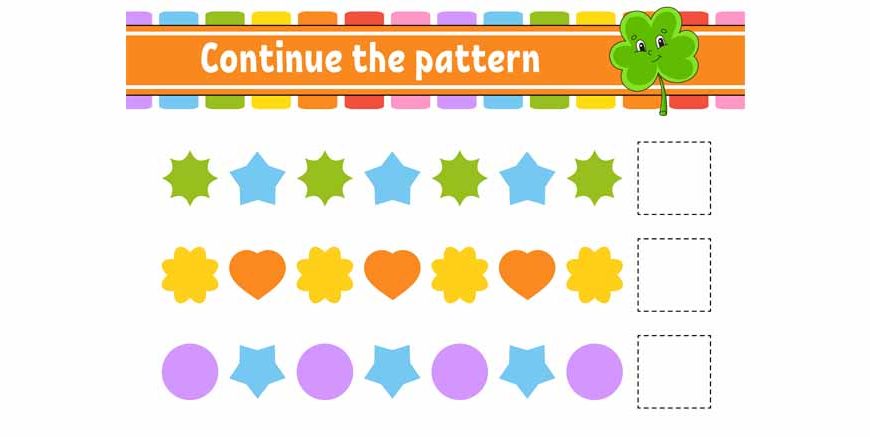
When executing these environmental crafts for preschool, we teach children to identify the core unit of a sequence, such as a simple AB pattern (red, blue, red, blue) or a more advanced ABC structure (big, medium, small). This process trains their developing brains to predict future events based on current evidence. It sharpens their spatial reasoning, upgrades their fine motor control as they manipulate small objects, and fosters a deep, subconscious respect for material lifecycles and sustainable creation.
12 Creative Pattern Activities to Try Now
1. Leaf and Twig Linear Trails
Gather a large basket of fallen green leaves and short wooden twigs from the garden. Instruct your child to place them in a straight line on the ground, alternating strictly between one leaf and one twig. To make it a descriptive game, have them say the pattern out loud as they build: “Crunchy leaf, smooth twig, crunchy leaf, smooth twig.”
2. Bottle Cap Mosaic Ribbons
Instead of discarding plastic milk and juice caps, collect them in a massive jar. Draw a long, winding chalk snake on the driveway. Let your child fill in the snake’s body by repeating color sequences, such as two blue caps followed by one bright yellow cap, creating a vibrant, recycled mosaic.
3. Painted Pebble Rhythms
Collect smooth, flat river stones and use non-toxic poster paint to decorate them. Paint half of the stones with bold white stripes and the other half with bright red dots. Children can arrange these custom weights into complex numerical sequences, testing their ability to track visual variations.
4. Pinecone and Acorn Grids
Set out a simple wooden picture frame on the table with the glass removed. Give your child a collection of large pinecones and tiny acorns. Challenge them to build a border pattern inside the frame, alternating between the giant, rough textures of the cones and the smooth, miniature shapes of the acorns.
5. Scrap Fabric Weaving Boards
Cut a piece of thick, discarded cardboard into a square and slice parallel slits along the top and bottom edges. Thread plain kitchen twine through the slits to create a basic loom. Have your child weave colorful strips of old, torn clothing or bedding through the twine, alternating over and under to create a beautiful textile pattern.
6. Egg Carton Seed Counters
Take a standard cardboard egg carton and write numbers or color codes inside the cups. Provide a bowl of large dried broad beans and pumpkin seeds. Preschoolers can practice fine motor precision by dropping two white pumpkin seeds and one brown bean into the cups sequentially down the line.
7. Potato Stamp Borders
Slice a raw, slightly old potato completely in half. Carve a simple triangle into one half and a clean square into the other. Dip the pieces into washable paint and let your child stamp a repetitive geometric border along the edges of old newspapers or brown paper packaging bags.
8. Seashell Counting Chains
If you have a collection of shells from a beach holiday, sort them by shape or size. Have your child construct an escalating pattern chain: one fan-shaped scallop shell followed by two spiral snail shells. This activity beautifully introduces the concept of growing patterns.
9. Cardboard Tube Ring Threading
Slice empty cardboard kitchen rolls into thin, circular rings. Let your child dye the rings using watery paint or food coloring. Once dry, they can thread these lightweight rings onto a piece of old clothesline cord, repeating a specific color code to create a giant classroom garland.
10. Pressed Flower Mandalas
Collect fallen petals and daisies from the lawn. On a flat piece of cardboard, show your child how to build a circular pattern starting from the dead centre, radiating outwards symmetrically. One ring of yellow petals, followed by a ring of white daisies, teaches circular patterning and balance.
11. Geometric Cardboard Tower Stacks
Cut clean scraps of delivery boxes into squares and triangles. Challenge your child to build a vertical tower by alternating the physical shapes: square base, triangle roof, square body, triangle top. This activity tests their balance while reinforcing three-dimensional shape sequencing.
12. Mud Brick Border Tracks
Out in the garden mud kitchen, let your child press wet mud into empty matchboxes to manufacture small bricks. Lay them out in the sun to dry. Once solid, they can use these rustic blocks alongside green clover leaves to build a decorative border pattern around a flower bed.
Read More – Fun Literacy Activities for Preschoolers
Conclusion
Numeracy is never about staring at flat symbols on a whiteboard; it is about recognizing the inherent order, symmetry, and beauty of our living planet. When we strip away the synthetic toys and encourage preschoolers to build sequences using twigs, shells, and recycled cardboard, we bridge the gap between abstract mathematics and tangible reality.
This comprehensive guide highlights how simple, repetitive play builds the exact neural architecture required for advanced logic, scientific observation, and creative problem-solving. It is deeply thought-provoking to consider that a child learning to balance leaves and twigs in a simple kitchen-table sequence today is actively developing the precise spatial reasoning skills they will use to understand the complex challenges of tomorrow.
Giving them the freedom to explore these patterns through physical, eco-conscious play ensures their education remains joyful, sustainable, and completely grounded in the world they inherit. To discover more innovative learning strategies and support your child’s cognitive milestones, read the latest insights on the EuroKids Blog and secure their next great educational step through EuroKids Preschool Admission today.
FAQs
What is the difference between an AB pattern and an ABC pattern?
An AB pattern repeats two distinct elements sequentially (such as leaf, twig, leaf, twig). An ABC pattern introduces a third distinct variation into the sequence before the pattern repeats itself (such as leaf, twig, stone, leaf, twig, stone).
Why should we use recycled items instead of standard plastic counters?
Recycled items offer diverse weights, sizes, and textures that engage a child’s sensory processing far better than uniform plastic shapes. It also practically demonstrates the concept of reuse, building early eco-awareness.
How do I know if my child is ready for advanced patterning?
If your child can easily identify what comes next in a simple alternating line and can comfortably point out mistakes you purposefully make in their sequence, they are ready to try growing or three-element patterns.