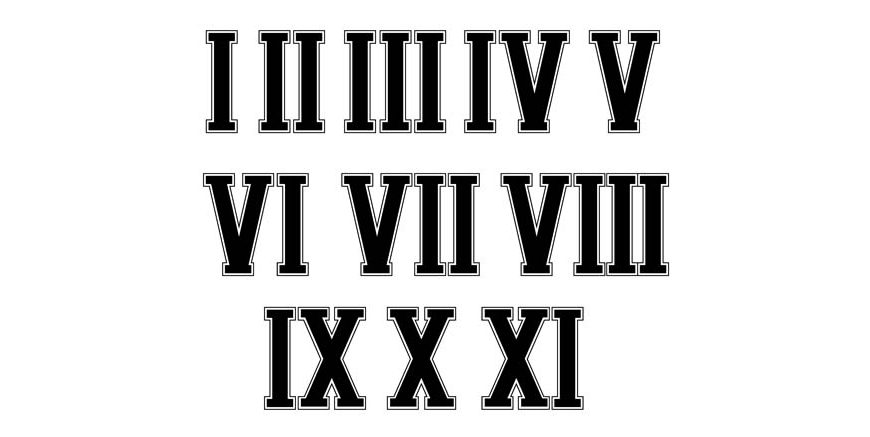
Maths can sometimes feel a bit like a secret code, especially when letters suddenly pretend to be numbers. You might be flicking through an old dusty storybook, staring at a building’s cornerstone, or trying to read the face of an antique grandfather clock, only to find a strange jumble of letters staring back at you. That is the ancient Roman counting system at work. It feels completely backwards to us today, but centuries ago, this was exactly how people kept track of everything from gold coins to cattle.
Today, we are looking at one very specific string of letters: CXXVI. At first glance, it genuinely looks like someone just smashed their hand on a typewriter. But there is a strict, clever logic hiding behind these symbols. We are going to strip away the confusion and show you exactly how to translate this ancient text into a normal number you can actually use in everyday life.
The Building Blocks of Roman Maths
To figure out what CXXVI actually means, we first need to know what each letter stands for. The Romans didn’t bother with numbers like 1, 2, or 3. They didn’t even have a symbol for zero. They built their entire mathematical world using just seven letters pulled straight from their alphabet. For our specific puzzle today, we only need to worry about four of them.
- C: This stands for one hundred (100). The easiest way to remember this is to think of modern words that mean a hundred, like ‘century’ or ‘centimetre’. They all come from the same ancient Latin root.
- X: This represents the number ten (10).
- V: This means five (5). If you hold your hand up and separate your thumb from your fingers, the space between them forms a perfect V shape.
- I: This is the easiest one of the bunch. It stands for one (1), and it looks exactly like a single straight tally mark you might scratch into a piece of paper.
Read More – Teaching Kids About Roman Numerals
The Left-to-Right Adding Rule
Knowing the letters is only half the battle. You also need to know how to stick them together. Thankfully, the Romans kept things incredibly straightforward most of the time. You simply read the letters from left to right, exactly the same way you read a normal English sentence.
If the biggest letters are sitting at the very front of the line, and they slowly get smaller as you move to the right, you are doing a basic addition sum. You don’t have to multiply or divide anything. You just grab the value of each letter and add them all up in a row. It really is that simple.
Breaking Down CXXVI
Let’s look at our main target. The letters are perfectly arranged from the biggest value down to the smallest. That means we just follow the basic adding rule we just learned.
Let’s pull the sequence apart piece by piece:
- First up is the letter C. We already know that equals 100.
- Right after that is an X. That adds another 10 to our total.
- Then, we hit a second X. That is another 10. (Two tens sitting together naturally make 20).
- Next in line is the V. We add 5.
- Finally, sitting at the very end is the I. We add 1.
When you write all of that out as a standard school maths problem, it looks like this:
CXXVI = C + XX + VI
CXXVI = 100 + 20 + 6
CXXVI = 126
There you have it. You have successfully translated the code. If someone asks you to write CXXVI in normal numbers, the answer is always 126.
Read More – Roman Numerals 1 to 10000
Why Do We Still Care About These Letters?
It is totally fair to wonder why we still force kids to learn this stuff. The Roman Empire fell a very long time ago, and we have a much easier system of counting now. Why bother?
The simple truth is that this ancient system never really went away. We still use it to make things look important or historical. Kings and queens use these letters in their royal titles. Think of King Charles III or Queen Elizabeth II. You will find them marking the chapters in your favourite fantasy novels, and they are stamped on the faces of expensive watches. Learning to read them means you can quickly understand the historical markers scattered all over modern life. It gives you a little extra grip on how our world was built.
Making Maths Physical
Kids often struggle when concepts are trapped on a piece of paper. If you want a child to truly understand Roman numerals, you have to get the letters off the page. Have them use wooden popsicle sticks to physically build the letters X, V, and I on the kitchen table. Once they can physically move the numbers around, abstract maths suddenly becomes a tangible puzzle they can solve with their own hands. It stops being a stressful test and starts being a fun, interactive game.
Solved Examples
Example 1
Convert CXXVI into numbers.
Solution:
C = 100
XX = 20
VI = 6
100 + 20 + 6 = 126
Answer: 126
Example 2
Convert 126 into Roman numerals.
Solution:
100 = C
20 = XX
6 = VI
126 = CXXVI
Answer: CXXVI
Read More – Importance of Math in Everyday Life
How EuroKids Helps Children Learn Number Concepts
At EuroKids, children are introduced to mathematical concepts through engaging and age-appropriate learning experiences. It helps children develop strong foundational skills while making learning enjoyable and meaningful. Teachers encourage curiosity and problem-solving through hands-on experiences that build confidence and understanding. By creating a positive learning environment, EuroKids helps children develop essential numeracy skills that support their academic growth and prepare them for future success in learning.
Conclusion
Teaching children how to read ancient numbering systems does a lot more than just prepare them for a random maths quiz. It shows them that human beings have been solving the exact same problems for thousands of years, just using slightly different tools. When a child realises they can look at a confusing jumble of letters like CXXVI and easily translate it into 126, they get a massive confidence boost. It proves they have the brainpower to crack ancient codes and understand history. It turns them into active explorers of knowledge rather than just passive listeners waiting for the right answer.
To find more engaging ways to support your child’s learning adventures, check out the fantastic resources over on the EuroKids Blog and explore the next steps with EuroKids Preschool Admission.
FAQs
What number does CXXVI stand for?
It translates exactly to the number 126 in our modern everyday counting system.
Why are there two Xs in this specific number?
Because the Roman system didn’t have a dedicated letter for the number twenty. To write twenty, they just put two tens together (X + X).
Can I write 126 a different way using these letters?
No. The rules of Roman numerals are very strict. There is only one mathematically correct way to build the number 126, and this is it.