You have probably noticed how quickly children move from one screen to another. Facts come easily to them, but meaning often slips through. What truly stays with a child is not a list of dates or definitions, but a story that makes them pause and think. This is where the Taj Mahal finds its place in early learning. It is not a monument that asks children to memorise. It quietly invites them to look closer, ask questions, and feel something real. Through its story, children begin to understand time, emotions, craftsmanship, geography, and culture in a way that feels natural rather than forced.
As learning in 2026 becomes increasingly digital and fast-paced, the Taj Mahal reminds you that some of the strongest lessons still come from observation and imagination. When children wonder why it was built, how long it took, or who inspired it, they are already learning deeply. This blog helps you walk them through that journey with clarity, care, and explanations that respect both their curiosity and their ability to understand.
About Taj Mahal in English
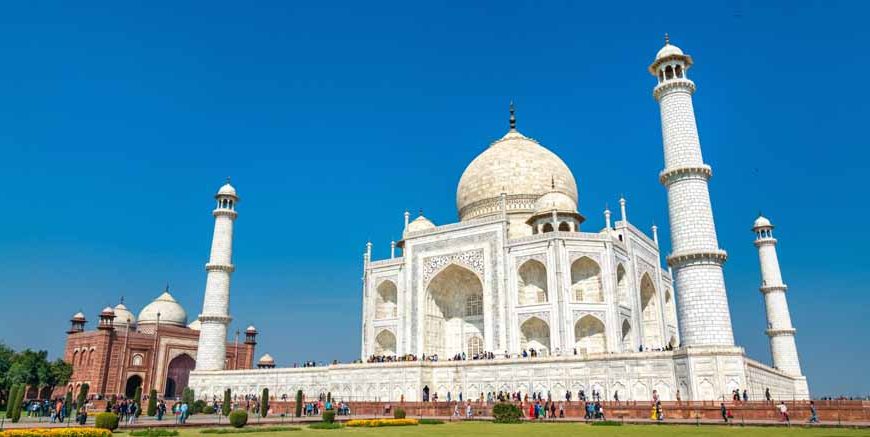
When you explain the Taj Mahal to a child, you are not just describing a building. You are introducing an idea. The Taj Mahal is a white marble monument in India that people across the world recognise as a symbol of love and beauty. It was built many centuries ago, yet it continues to inspire artists, architects, historians, and students even today.
The Taj Mahal was built as a memorial, which means it was created to remember someone special. It reflects careful planning, artistic skill, and emotional expression. When children learn about Taj Mahal in English, they learn how stories can take physical shape. They also understand that history is not distant or boring. It is made of real people, real emotions, and real decisions. This understanding builds empathy and imagination, two skills that support emotional development and communication in early learners.
Read More – Best places to visit in Agra
Taj Mahal Location and Taj Mahal State
The Taj Mahal stands in the city of Agra, which lies on the banks of the Yamuna River. This explains the taj mahal location clearly and accurately. Agra is located in northern India and belongs to the taj mahal state, Uttar Pradesh. This geographical placement played an important role in the monument’s construction and design.
Agra served as a major centre of the Mughal Empire. The Yamuna River provided water, transport access, and natural beauty. When children understand where the Taj Mahal stands, they also learn how geography influences history. Rivers supported trade, travel, and settlement long before modern roads existed.
This connection between location and history helps children build spatial awareness. It also teaches them that important decisions often depend on environment and resources.
Read More – Best Places to Visit in Uttar Pradesh
Who built Taj Mahal?
The Taj Mahal was commissioned by Emperor Shah Jahan, one of the most powerful Mughal rulers. This answers clearly who taj mahal was built by. Shah Jahan ruled during a time when art, architecture, and culture flourished. He believed that buildings could express ideas and values, not just power.
Shah Jahan ordered the Taj Mahal to honour his wife Mumtaz Mahal. He brought together skilled craftsmen, architects, and artisans from India and other regions. The project required teamwork, patience, and long-term planning. Children learn that great achievements rarely happen overnight.
This story helps students understand leadership in a meaningful way. Leadership is not only about authority. It is about vision, responsibility, and collaboration.
Mumtaz Taj Mahal History
Mumtaz Mahal was not only a queen. She was a trusted companion and advisor to Shah Jahan. The mumtaz taj mahal history helps children see her as a real person with influence and presence. She supported charitable work and accompanied the emperor on important journeys.
Her death deeply affected Shah Jahan. He wanted to honour her memory in a way that would last beyond generations. The Taj Mahal became that expression of remembrance. This teaches children that love and respect do not disappear with time. By learning Mumtaz Mahal’s story, students develop emotional understanding. They see how care, memory, and respect shape human actions.
In Which Year Taj Mahal Was Built?
Construction of the Taj Mahal began in 1632. This clearly answers in which year taj mahal was built. The work continued for about twenty-one years and reached completion in 1653. Thousands of workers contributed to its creation, including masons, sculptors, and calligraphers.
This timeline helps children understand the value of patience and dedication. The monument did not appear instantly. It grew slowly through effort and skill. When students connect dates with real work and human effort, history becomes meaningful instead of abstract. Learning timelines also strengthens logical sequencing, which supports academic development in reading and reasoning.
Taj Mahal Facts
Many taj mahal facts surprise students and spark curiosity. The monument uses white marble brought from distant regions. Precious stones decorate its surfaces using a technique called inlay work. The structure maintains perfect symmetry, which means both sides match exactly.
One interesting fact explains how the minarets tilt slightly outward. This design prevents damage to the main tomb during earthquakes. Such details show children how science and creativity work together. These facts do not exist to impress. They exist to encourage observation. When children learn to notice details, they develop critical thinking and analytical skills.
Architectural Brilliance of the Taj Mahal
The Taj Mahal reflects careful mathematical planning. Architects used geometry to ensure balance and harmony. The central dome rises gracefully, while gardens mirror the structure’s symmetry. Even the calligraphy grows larger at the top so it appears equal in size from below.
Children often struggle to understand why they learn mathematics. The Taj Mahal provides a real-world answer. It shows how numbers, measurements, and angles create beauty and stability. This connection helps children appreciate subjects beyond textbooks and builds curiosity for STEM learning.
Read More – Best Places to Visit in Aurangabad With Kids & Family
Cultural and Global Importance of the Taj Mahal
The Taj Mahal holds the status of a UNESCO World Heritage Site. This recognition protects the monument for future generations. People from different countries visit it to learn about Indian history and culture. Children learn that heritage belongs to everyone. Protecting monuments teaches responsibility and respect for shared history. This global perspective encourages inclusivity and cultural awareness from an early age.
Learning Through Monuments at an Early Age
When children learn through monuments, they absorb information naturally. Stories create memory. Visual imagery strengthens understanding. Discussion builds communication skills. Monument-based learning supports observation, questioning, and emotional intelligence. It aligns perfectly with early education goals that focus on holistic development rather than rote learning.
How EuroKids Encourages Curiosity-Driven Learning
At EuroKids, learning happens through exploration, conversation, and storytelling. Children do not simply hear facts. They experience ideas. Visual learning, guided discussion, and age-appropriate explanations help concepts stay with them longer. EuroKids follows the Heureka Curriculum, which encourages children to ask questions, discover answers, and build understanding through guided exploration.
Conclusion
When you introduce children to the Taj Mahal, you give them more than historical knowledge. You give them perspective. You teach them patience, empathy, observation, and curiosity. These skills support academic success and personal growth.
EuroKids believes that early education shapes lifelong learners. Through thoughtfully designed lessons and engaging stories, children develop confidence and curiosity every day. If you are considering EuroKids Preschool Admission, you choose a learning environment that values understanding over memorisation. Explore the EuroKids Blog to discover more stories that turn learning into an enriching experience for your child.
FAQs
Where is the Taj Mahal located?
The Taj Mahal is located in Agra, Uttar Pradesh, on the banks of the Yamuna River.
Who built the Taj Mahal and why?
Emperor Shah Jahan built the Taj Mahal to honour his wife Mumtaz Mahal.
In which year was the Taj Mahal built?
Construction began in 1632 and was completed in 1653.
Why is the Taj Mahal important for students?
It teaches history, architecture, empathy, and critical thinking through a real-world example.
How does learning about monuments help children?
It improves memory, observation, emotional understanding, and cultural awareness.