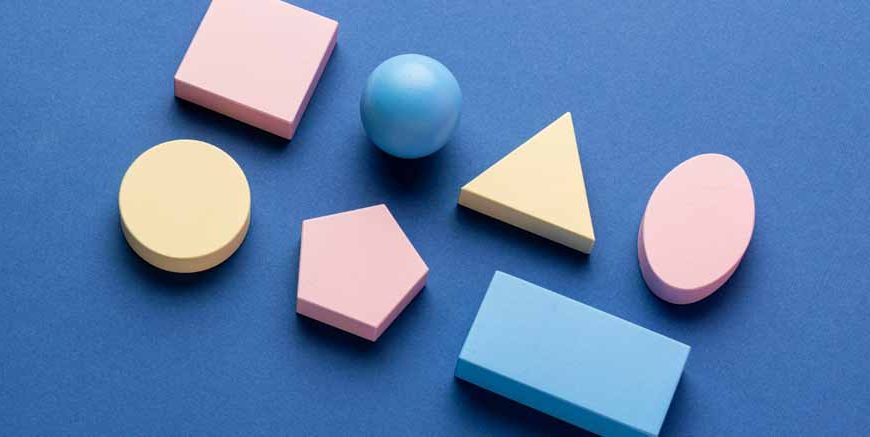
Imagine holding a rubber bouncy ball in your hand, or stacking wooden blocks on the living room rug to build a towering castle. If you were to trace a drawing of a ball on a piece of paper, it would lie entirely flat on the desk. But the actual rubber ball takes up physical space, you can hold it, roll it, and throw it.
This is the magnificent difference between flat, paper drawings and the physical items we interact with every single day. Understanding this fundamental difference is the perfect starting point for learning about solid shapes in maths. Let us explore the wonderful world of three-dimensional geometry and see exactly how it builds the universe around us.
What Exactly Are These Figures?
To begin our journey, we must answer a very important question: what are solid shapes? Unlike flat, two-dimensional drawings (like a square or a circle drawn on a page) that only have length and width, these figures have a third, crucial measurement called depth, or thickness.
The most accurate solid shapes definition is that they are three-dimensional (3D) objects that take up actual physical space. Because they possess length, width, and depth, you can pick them up with your hands, fill them with water, or pack things securely inside them. In the classroom, teachers and mathematicians often refer to them simply as solid figures.
Read More – Fun Ways to Teach Shapes to Kids
Understanding the Building Blocks
Before we start identifying them around the house, we need to know exactly how to describe them. When we talk about the properties of solid shapes, we are looking at three specific parts that make up the overall structure of the object:
- Faces: This is the flat or curved surface of the object. If you run your open hand over a closed cardboard delivery box, the flat brown side you touch is the face.
- Edges: An edge is the straight line where two flat faces perfectly meet. It is the sharp crease on the side of that cardboard box.
- Vertices: This is the proper mathematical word for corners. A vertex is the pointy spot where several edges join together.
Meeting the Famous Five
If you look closely around your child’s playroom, you will quickly notice that almost every toy can be broken down into basic geometric categories. Here is a look at 5 solid shapes that form the absolute foundation of early geometry:
- The Cube: A perfectly balanced, sturdy object featuring six identical square faces, twelve straight edges, and eight vertices.
- The Cuboid: This looks very similar to the cube, but stretched out. It has six rectangular faces, twelve edges, and eight vertices.
- The Sphere: A completely round object with one continuous, smooth curved face. It has absolutely zero edges and zero vertices.
- The Cylinder: A highly useful shape with two flat circular faces (one sitting on top and one on the bottom) and one curved face wrapping around the middle.
- The Cone: This structure features a flat circular base that curves elegantly upwards into a single, sharp point at the very top.
Read More – Musical Adventures with Shapes for Preschoolers
Spotting Them in the Real World
Learning becomes much more exciting when children can connect maths to their own toys and favourite snacks. Identifying solid figure shapes hiding in the kitchen or the bedroom is a fantastic, interactive learning game. Here are some brilliant solid shapes examples to help your child recognise them on a daily basis:
Cube Examples
- A numbered dice from a family board game
- A colourful Rubik’s Cube
- A sugar cube waiting for a cup of tea
- A wooden alphabet building block
Cuboid Examples
- A thick, heavy reading book
- A cardboard cereal box
- A loaf of sandwich bread
- A heavy red brick from a garden wall
Sphere Examples
- A bouncy tennis ball
- A sweet, juicy orange
- A tiny glass playing marble
- The beautiful planet Earth
Cylinder Examples
- A tin of baked beans
- A tall drinking glass
- A fresh battery for the television remote
- A cardboard kitchen roll tube
Cone Examples
- A crunchy wafer holding strawberry ice cream
- A bright orange traffic cone on the pavement
- A paper party hat
- A sharpened pencil tip
Read More – Best Shape Activities for Preschoolers
Why Do We Need to Learn This?
You might wonder why pointing out these solid figures examples matters so much for young learners. When children understand how these physical structures work, they develop excellent spatial awareness. They begin to instinctively understand why a sphere rolls away down a hill but a cube stays firmly put, or why builders use cuboids to build strong, stable houses instead of wobbly round balls. Grasping these physical concepts early on helps them tackle much harder maths problems, engineering tasks, and logical puzzles as they grow older and enter higher education.
Summary
Geometry is certainly not just a boring chapter hidden in a school textbook; it is the fundamental blueprint of our entire physical world. Every single object you can touch, hold, or build is made up of these fascinating three-dimensional structures.
By teaching children how to count the flat faces, carefully trace the straight edges, and point out the sharp corners of their favourite toys, you are handing them the keys to understand how the universe is constructed.
It transforms a simple walk in the park or a routine trip to the supermarket into an engaging, real-life maths lesson. So, the next time you unpack the weekly shopping, ask your child to identify the structures they see. Who knows what brilliant structural designs they might spot hiding right on the kitchen counter?
To discover more wonderful ways to nurture your child’s bright mind and set them up for a lifelong love of learning, read the EuroKids Blog and find out all the essential details regarding EuroKids Preschool Admission today.
FAQs
Can a shape have both flat and curved faces?
Yes, it certainly can! A cylinder is a perfect example, as it has flat, circular faces on the top and bottom, but a smooth, curved face wrapped right around the middle.
Why is a piece of paper not considered a solid object?
A standard piece of paper is considered a two-dimensional (2D) object because it primarily features length and width, but it is so incredibly thin that it lacks any meaningful depth or volume.
What is the absolute easiest way to teach these structures to a toddler?
The best way is through hands-on, tactile play. Let them handle wooden building blocks, sort different household objects into matching piles, and physically trace the edges with their little fingers.