Ever sent your kid to school in a massive, heavy winter coat, only for them to come dragging it across the floor in the afternoon because they are sweating? That is the absolute classic, undeniable sign that the earth is up to something. It is physically moving. We tend to forget that we are living on a giant, spinning rock zooming through the freezing vacuum of space.
Our planet doesn’t just spin perfectly straight up and down. It leans. It actually tilts over like a wobbly spinning top losing its momentum. That single, slight lean is the only reason we don’t freeze solid all year round. For primary school kids sitting in their EVS class, figuring out how this planetary tilt physically wakes up the whole world is usually the most exciting part of the science syllabus.
Figuring out the exact spring season definition
Let’s look at the actual science for a minute. If we want the proper spring season definition, we have to talk about a specific day called the vernal equinox. That is just a fancy space term for the exact moment the sun parks itself right over the Earth’s equator.
On this one specific day, the daytime and the night-time are split almost perfectly down the middle. You get roughly twelve hours of daylight and twelve hours of total darkness. It acts like a massive cosmic switch being flipped on. It tells the planet that the brutal, miserable winter is officially over. As the days tick by after the equinox, our half of the tilted earth starts leaning closer and closer to the sun. The days get noticeably longer, the evenings stay lighter, and the direct solar rays start baking the frozen mud in our back gardens.
Read More – What Are the Four Seasons?
The messy, noisy spring season meaning
But if you ask a primary school student, the real spring season meaning has absolutely nothing to do with equinoxes, the equator, or space. For them, it is all about the mud, the weird bugs, and the sudden noise.
Think about your local park in late December. It is dead quiet. The trees look like bare wooden sticks, the ground is rock hard, and you can see your breath in the air. But when that planetary tilt happens, the ground heats up from the inside. This rising warmth acts like a giant, blaring alarm clock for nature. Hedgehogs, dormice, and frogs finally wake up from months of deep winter sleep. They are usually incredibly grumpy and very hungry. Green shoots literally punch their way through the hard dirt. Sap starts violently rising up the trunks of the trees. It is nature’s massive reset button, turning a quiet, frozen landscape into a chaotic, noisy buffet for local wildlife.
Exactly in which month spring season comes
Things get a bit confusing for kids when they ask exactly in which month the spring season comes. The answer entirely depends on where your muddy boots are currently planted.
The earth acts like a giant, reversing mirror. If you live in the Northern Hemisphere, like in the UK, Europe, or North America, this messy, beautiful season generally rolls in during March, April, and May. If your boots are firmly planted in India, you are also in the Northern Hemisphere, but the beautiful blooming period (traditionally known as Vasant Ritu) kicks off just a tiny bit earlier. The chilly winter starts fading away in late February, leaving behind a wonderfully vibrant and colourful March and April before the intense summer heat truly takes over.
But if you hop on a long flight down to the Southern Hemisphere, to places like Australia, New Zealand, or South Africa, they are doing the exact opposite. While we are packing away our heavy winter coats, they are just getting theirs out of the wardrobe. Down there, they experience their own bright, blooming awakening much later in the calendar, usually around September, October, and November.
Read More – Teaching Kids About Weather and Seasons
Brilliant spring information for kids
Kids love facts they can actually see on their walk to school. Ditch the dry textbooks for a minute. Here is some brilliant, easy-to-spot spring information you can point out to them on the pavement:
- The crazy morning birds: Have you noticed the birds suddenly getting incredibly loud right at the crack of dawn? They are shouting at the top of their lungs to claim their territory and find a mate before building their messy nests in the neighbourhood hedges.
- Frogs and ponds: If you look in a local pond, you will suddenly see giant clumps of clear jelly with black dots inside. This is frogspawn, and those dots will quickly turn into swimming tadpoles as the water warms up.
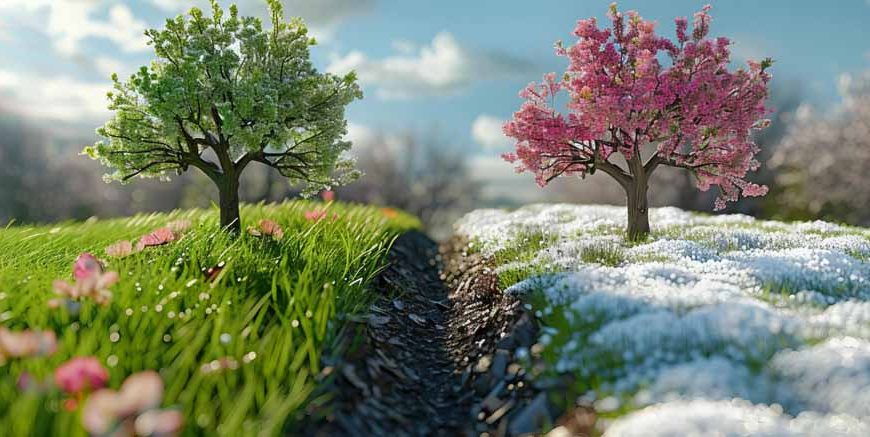
- Pink trees everywhere: Bare, boring branches suddenly explode with bright pink and white blossoms. Those flowers aren’t just there to look pretty; they are desperate to catch the attention of the very first, sleepy bumblebees looking for a sweet sugar hit.
- Farmyard babies: Farmers get absolutely no sleep right now. Wobbly lambs, little calves, and fluffy chicks are born during this specific window simply because the air is finally warm enough for them to survive outside the barn without freezing.
Surviving the spring season weather and spring temperature
Now, let’s talk about the absolute chaos of the spring season weather. You can literally experience four totally different seasons on a single Tuesday. It might be pouring with freezing rain at breakfast, completely sunny by lunchtime, and hailing by the time the school bell rings. You need sunglasses, an umbrella, and a woolly hat all at the same time.
These heavy, sudden rain showers are incredibly annoying for the morning school run, but the dry winter soil desperately needs that water. Without those massive downpours, the new crops simply wouldn’t grow. While the rain does its thing, the spring temperature slowly creeps up. The sharp morning frost on the car windscreen finally disappears. The garden thermometer climbs steadily from shivering single digits into the highly comfortable mid-teens. You can finally throw the heavy winter scarves into the back of the wardrobe, open the kitchen windows, and actually feel the warm sun on your face again.
Read More – Types of Weather for Kids for Kids
Conclusion
It is a pretty wild thought that a tiny, invisible tilt of our massive planet in the dark vacuum of space causes a tiny yellow daffodil to pop up in your local park. Understanding this delicate, messy, and loud natural cycle teaches children to actually respect the dirt under their feet. It proves that no matter how long and brutally dark the winter gets, the warmth always manages to fight its way back to the surface. Building this exact type of raw, hands-on curiosity about the natural world is exactly what drives the Heureka Curriculum. It pushes kids to look closely at the bugs, the rain, and the mud, rather than just reading about them on a whiteboard. When they understand how the planet works, they naturally want to protect it. To find more ways to get your kids genuinely excited about their environment, have a read through the latest guides on the EuroKids Blog and lock in their next big learning adventure through EuroKids Preschool Admission.
FAQs
Why do we have daylight saving time?
We change the clocks forward specifically to make better use of the natural daylight. Because the sun sets much later in the evening during these months, shifting the clocks gives us an extra hour of light to play outside after school.
Do all countries get a spring season?
Not really. Countries located right on the equator experience a very steady, hot climate all year round. They don’t get snow or frost, so they usually just split their calendar into a dry season and a wet monsoon season instead of four distinct phases.
Why are there so many muddy puddles right now?
The combination of fast-melting winter ice and those sudden, heavy rain showers means the hard ground simply struggles to soak up all the extra water fast enough, leaving massive, splashy puddles on the grass.