Learning multiplication tables is an important milestone in a child’s mathematical journey. While times tables may seem simple to adults, they can feel challenging for children who are just beginning to work with numbers abstractly. Unlike addition or subtraction, multiplication often requires children to memorise patterns and recall answers quickly. However, with the right approach, learning times tables can become enjoyable and engaging. Through games, songs, and creative activities, children can build confidence and develop strong number skills. In this blog, we explore fun and effective ways to help kids learn times tables easily.
Why Times Tables Are Important
Times tables are the foundation of many mathematical concepts. They help children perform calculations quickly and build number fluency. Once children become comfortable with multiplication tables, they can solve more complex mathematical problems, such as division, fractions, and algebra, with greater ease.
Multiplication tables can be difficult to introduce to children, as till now they have probably been using actual objects to help them with addition and subtraction. Multiplication is the first skill in Maths where children have to deal with abstract numbers.
Developing quick recall of multiplication facts also improves a child’s overall confidence in mathematics.
However daunting a task it may seem, the fact is that after the initial hiccups, learning times tables gets much easier. Times tables are something that every child has to commit to memory and eventually master. They need to be able to recall any time tables and answer within a second or two, which means there is no time for counting up to the answer. However unfair it may sound for a child, number fluency is the basic foundation required for any child.
Read More – Easy Ways to Teach Multiplication to Kids
The Order Kids Should Learn Times Tables
- Always start with the easy tables first, which are the 2x, 5x and 10x times tables.
- The 10x tables are the easiest, as just a 0 has to be added after the number.
- The 2x tables are simple because of doubling even numbers and are simple to recite as well, 2, 4, 6, 8… and so on.
- The 5x tables become easier because of knowing the 10x tables and because we have 5 fingers. Tell them that with the 10x table, all numbers end in 0, and in the 5x table, all the numbers end in 5 or 0.
- Usually, the 4x, 9x tables are considered to be the easiest to learn after this. The 4x tables are double of the 2x tables, and there are a few shortcuts to learn the 9x tables.
- After this kids could learn the 3x tables followed by the 6x tables.
- Then come the 8x and 7x tables, which are usually considered difficult.
Times Tables and Language
There are several ways of learning tables fast, and none of them is wrong, but it really helps if you stick to the language your child uses at school. Any of the below can be used, but be careful not to confuse your child. When teaching multiplication, it is helpful to use consistent language. Children may hear multiplication expressed in different ways, such as:
- three multiplied by
- three times eight is . . .
- Threeeighths are.
- Three lots of four are.
Read More – What Is Multiplication for Kids?
How To Remember Tables Easily
- Minimise confusion by sticking to one table at a time.
- Start with reciting them and writing them out slowly in order.
- Then move on to completing the answers quickly, either by writing or verbally, in order.
- Then, move on to completing the answers in any order.
- Reminding your child that 5 x 4 is the same as 4 x 5, as it effectively reduces the number of table facts by half.
- Emphasise that each table has a square number 2×2, 6×6, etc., and these are special ‘foot holds’ that can act as a memory hook.
- You can create other memory hooks as you come across them: “5 x 7 = 35, that’s daddy’s age”, “3 x 4 = 12, that’s our house number.”
- You can try introducing some games and tricks to speed up recalling tables.
Tricks to Learn Tables Quickly
- Use Double Patterns
- The times tables of 2, 4 and 8 are doubles of each other and so have many common answers — 2×8=16, 4×4=16, 8×2=16
- Use the 9 Times Table Trick
- The 9x tables can use the 10x tables and work back or compensate, so for 9×4, think ( 10 x 4) – 4 = 36. Also, point out to them that the digits in the answer always add up to 9.
- Practice the Tough Tables
- The 3 and 6 times tables can be a bit tricky, so it might require more time. Start with the 3s and then do the 6s.
- The 7x tables are hard, but once all the other tables are done, you will find you have covered most of the 7s already.
- 7×8=56 is by far the toughest, but make a big deal about it, and your child will never forget it.
Mastering the Times Tables
Once your child has learned the times tables, the next stage involves being able to recall them in random order in about 3 seconds. Here are some fun ways to practice:
1. Hang up a times table sheet
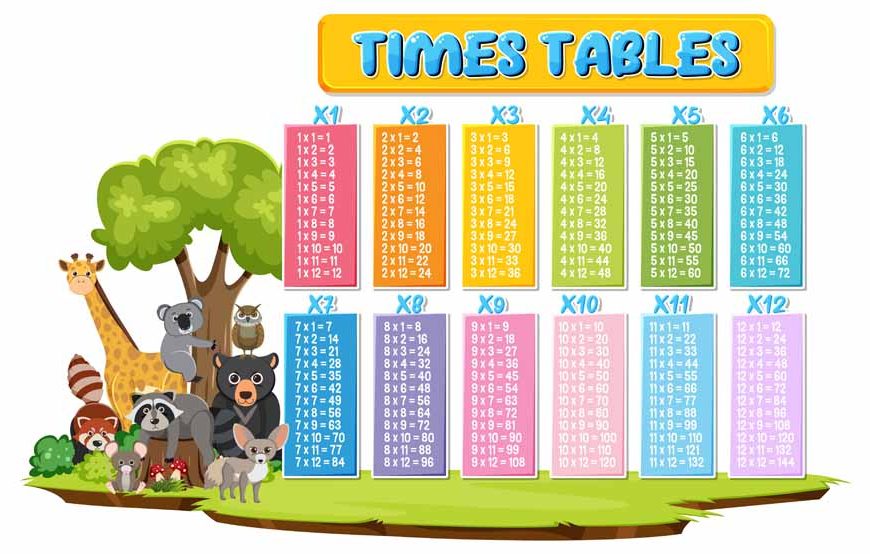
This is an old but very easy method to learn tables. Hang a times table sheet where your child will see it regularly, like next to the computer or on their bedroom door. Set a regular time to sit down with your child and have a casual run through of a particular set of times tables. The more often they see and practise their times tables, the better their mastery over them will be.
2. Play Some Fun Number Songs
Catchy music is one of the most effective ways to help kids master the times tables. There are several clever and fun parodies of pop numbers to teach kids their times tables.
3. Stage a Multiplication War
There’s a great card game that makes learning times tables really easy and fun. Two players draw a card from a deck and flip their cards over. The first person to correctly give the answer of the 2 cards multiplied together gets to put the cards among their winnings. For example, if a 4 of spades and an 8 of hearts are flipped over, the first person who says 32 gets to keep the 2 cards. Whoever has the most cards in their winning pile is the winner.
4. Draw a Waldorf Multiplication Flower
This especially works well for creative kids. Children first draw the centre of the flower and write a number between 2 and 12 in it. They then draw 12 petals around the centre, and each petal has a number from 1 through 12 written in it. Finally, they draw another set of 12 petals in which they write the total centre number multiplied by each petal in the inner circle.
5. Quiz Them Regularly
Once your child has learnt their times tables, you can keep quizzing them for practice when they are not doing anything. You could also allocate a specific time to quiz them rather than suddenly springing it on them, as some kids might find that stressful.
6. Reward their efforts
When encouraging children to learn the times tables, you could motivate them with a little reward. Don’t just reward them for getting the answers right; also reward them if you see they have been trying hard.
7. Recite the Times Tables Forwards and Backwards
Once your child has finished learning their times tables, ask them to read them aloud both forwards and backwards. They can then work in pairs to practise reciting the multiplication tables to one another.
8. Practise Skip-Counting
Skip-counting is also an easy method to learn tables. You start with the number you’re counting by, and then continue to add that same number. Skip-counting by 4 would be 4, 8, 12, 16, etc. Skip-counting by 3 would be 3, 6, 9, 12, etc.
Read More – 9 Times Table with Patterns & Tips
Making Maths Fun For Children
Children learn best when mathematics is connected to games, creativity, and everyday activities. These tips on how to learn tables easily will definitely make things simpler and more fun for your kid. Mathematical skills are not something they should be scared of. By turning multiplication practice into playful experiences, parents can help children overcome fear and build confidence in numbers.
How EuroKids Makes Learning Times Tables Fun and Engaging
At EuroKids, children are introduced to multiplication and times tables through playful and engaging methods. Young learners often find numbers more enjoyable when they are connected to games, stories, and everyday experiences. Teachers use creative strategies to help children understand how multiplication works and why it is useful in daily life.
For example, while learning times tables, children might clap in rhythms, sing counting songs, or use colourful objects to group numbers together. Activities like arranging blocks in equal rows or sharing snacks among friends naturally introduce the idea of multiplication. These playful exercises help children see patterns in numbers and understand times tables more easily.
By learning through fun activities, children build confidence with numbers and develop a positive attitude towards mathematics from an early age.
Conclusion
Learning times tables is an essential step in developing strong mathematical skills. While multiplication may seem challenging at first, using creative techniques such as games, songs, and patterns can make the process enjoyable. By practising regularly and learning tables step-by-step, children can master multiplication with confidence. Encouraging a positive attitude toward math helps children see numbers as exciting rather than intimidating.
To explore more learning ideas, environmental topics, and early childhood resources, parents can visit the EuroKids Blog. Those who wish to enrol their child in a joyful and responsible learning environment can find complete details on the EuroKids Preschool Admission Page, where learning goes hand in hand with care for the future.
FAQs
1. At what age should children start learning times tables?
Children usually begin learning basic times tables around ages 6–7.
2. Which times tables should children learn first?
The 2, 5, and 10 times tables are the easiest to start with.
3. Why do children struggle with multiplication tables?
Multiplication introduces abstract number patterns that require memorisation and quick recall.
4. What is the easiest way to learn times tables?
Using games, songs, patterns, and regular practice helps children learn faster.
5. What is skip counting in multiplication?
Skip counting means repeatedly adding the same number, which helps children understand multiplication patterns.