Multiplication is one of the most important and useful operations in mathematics. It helps us count faster, solve problems quickly, and understand quantities in groups. From calculating the total number of chocolates in boxes to finding the cost of multiple items, multiplication is used everywhere in daily life.
For young learners, understanding multiplication, what it means, and how to multiply step by step builds a strong math foundation. In this blog, we will explore the multiplication definition, formulas, methods, and many multiplication examples in a simple and child-friendly way.
What Is Multiplication?
Multiplication is a mathematical operation used to find the total when equal groups are combined.
In simple words, multiplication means repeated addition. If you add the same number again and again, multiplication gives you the answer faster.
Example:
3 + 3 + 3 + 3 = 12
Instead of adding 3 four times, we multiply: 3 × 4 = 12
So, multiplication is a quicker way to add equal numbers.
Read More – Easy Ways to Teach Multiplication to Kids
Multiplication Definition in Math
Multiplication is the process of adding a number to itself a certain number of times.
Each multiplication sentence has three parts: Number × Number = Product
Example: 5 × 6 = 30
Where 5 is the multiplicand, 6 is the multiplier, and 30 is the product. The answer in multiplication is always called the product.
Multiplication Formula
The basic multiplication formula is:
Multiplicand × Multiplier = Product
Or simply:
a × b = product
Where:
- a = number of items in each group
- b = number of equal groups
Example:
If there are 7 baskets and each basket has 4 apples: 7 × 4 = 28 apples
Understanding Multiplication with Groups
Multiplication becomes easier when children visualise groups.
Example:
There are 4 plates. Each plate has 3 cookies.
Groups = 4
Cookies in each group = 3
Total cookies = 4 × 3 = 12
Drawing groups or using objects helps children understand multiplication clearly.
Read More – Simple Steps to Learn Multiplication
Multiplication as Repeated Addition
Repeated addition is the easiest way to introduce multiplication to kids.
Example:
6 × 5 means add 6 five times:
6 + 6 + 6 + 6 + 6 = 30
So:
6 × 5 = 30
This method is very helpful for beginners learning how to multiply.
Multiplication Using a Number Line
A number line can also show multiplication.
Example: 3 × 4
Start at 0 and jump 3 steps forward four times:
0 → 3 → 6 → 9 → 12
Answer = 12
Number line jumps visually show repeated addition.
Multiplication Table Method
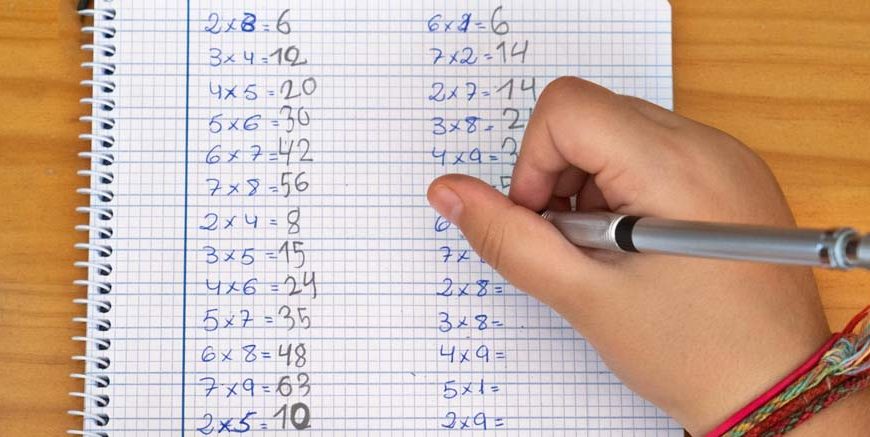
Multiplication tables help children multiply quickly without repeated addition.
Example:
From the table of 8:
8 × 7 = 56
Memorising tables from 1 to 12 makes multiplication faster and easier.
Properties of Multiplication
1. Commutative Property
Changing the order does not change the answer.
4 × 6 = 6 × 4 = 24
2. Associative Property
Grouping does not change the product.
(2 × 3) × 5 = 2 × (3 × 5)
3. Identity Property
Any number multiplied by 1 remains the same.
9 × 1 = 9
4. Zero Property
Any number multiplied by 0 equals 0.
7 × 0 = 0
These rules help simplify multiplication problems.
Read More – Fun Ways to Learn Times Tables
How to Multiply Larger Numbers
Example: 23 × 4
Step 1: Multiply ones
4 × 3 = 12 → write 2, carry 1
Step 2: Multiply tens
4 × 2 = 8 → add carry 1 → 9
Answer = 92
So:
23 × 4 = 92
How to Multiply Two-Digit by Two-Digit
Example: 34 × 12
Step 1: Multiply by 2
34 × 2 = 68
Step 2: Multiply by 10
34 × 10 = 340
Step 3: Add results
340 + 68 = 408
Answer = 408
Multiplication Examples for Practice
Here are simple multiplication examples:
- 2 × 5 = 10
- 9 × 3 = 27
- 6 × 7 = 42
- 8 × 4 = 32
- 12 × 5 = 60
Word problems:
- A box has 6 rows of candies. Each row has 8 candies.
6 × 8 = 48 candies
- There are 9 bags with 7 apples each.
9 × 7 = 63 apples
- A class has 5 groups with 10 students each.
5 × 10 = 50 students
Real-Life Uses of Multiplication
- Shopping totals
- Classroom grouping
- Cooking measurements
- Time calculation
- Area measurement
- Counting items in packs
Examples:
4 packets × 6 biscuits = 24 biscuits
7 days × 4 weeks = 28 days
Multiplication makes repeated counting faster.
Common Mistakes in Multiplication
Children often make these mistakes:
- Forgetting carry numbers
- Confusing tables
- Skipping steps
- Misplacing digits
- Mixing addition and multiplication
Tips to Learn Multiplication Faster
- Memorize tables daily
- Practice 10 problems a day
- Use visual grouping
- Learn patterns in tables
- Practice word problems
- Use games and worksheets
- Revise weak tables more often
Consistency builds speed and confidence.
How EuroKids Helps Children Learn Multiplication with Confidence
Early multiplication concepts are introduced through concrete and playful methods, so children understand grouping before memorising tables. Teachers use beads, blocks, picture cards, and real objects to show repeated addition and grouping. Children learn multiplication through activities like grouping toys, counting sets, and interactive board games. Multiplication is taught through understanding patterns, skip counting, and visual models. This helps children grasp what multiplication is and how to multiply naturally and confidently.
The HEUREKA Curriculum Approach to Learning Multiplication
The HEUREKA Curriculum focuses on discovery-based, experiential learning where children learn math through exploration and action.
Multiplication learning under this approach includes:
- Learning through grouping activities
- Skip counting with music and rhythm
- Visual array building with objects
- Story-based multiplication problems
- Peer collaboration games
- Hands-on worksheets and math labs
This approach ensures children understand the meaning before memorising formulas, making learning joyful and long-lasting.
Conclusion
Multiplication is a powerful and essential math operation that helps us calculate totals quickly using equal groups. Understanding the multiplication definition, formula, and step-by-step methods helps children build strong arithmetic skills. From repeated addition to tables and real-life applications, multiplication is everywhere around us. With regular practice, visual learning, and playful activities, children can master multiplication easily. A strong multiplication foundation supports future learning in division, algebra, and higher math concepts.
To explore more learning ideas, simple explanations, and early childhood resources, parents can visit the EuroKids Blog. Those who wish to understand the preschool journey better or explore enrolment options can find complete information on the EuroKids Preschool Admission Page, where learning is designed to be joyful, engaging, and child-friendly.
FAQs:
1. What is multiplication?
Multiplication is the repeated addition of equal numbers to find a total.
2. What is the multiplication formula?
Multiplicand × Multiplier = Product.
3. What is the answer in multiplication called?
The answer is called the product.
4. How to multiply easily for kids?
Use repeated addition, tables, grouping objects, and skip counting.
5. Why is multiplication important?
It helps calculate totals quickly and is used in daily life and advanced math.
6. What are some multiplication examples?
Examples include 6 × 7 = 42, 8 × 5 = 40, and 9 × 4 = 36.