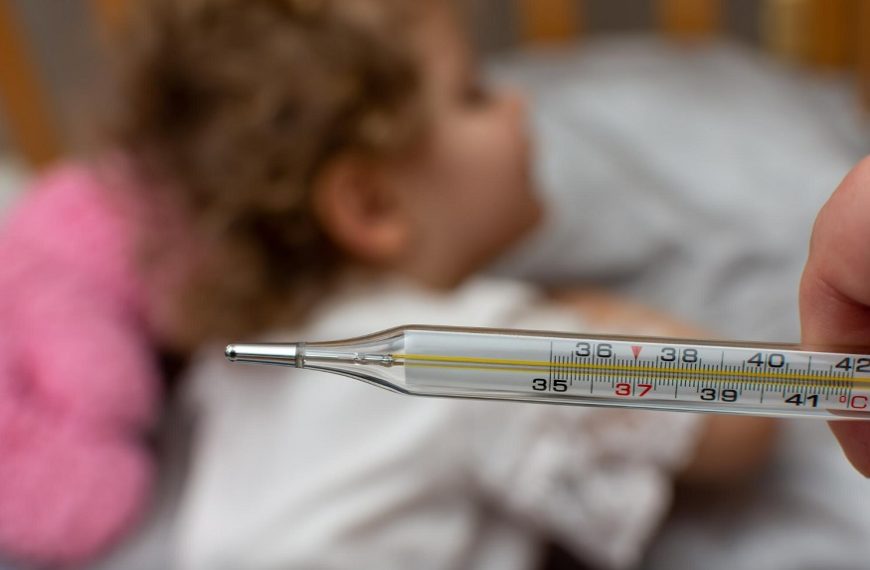
Think back to a time when you were tucked up in bed with a nasty winter chill. To check if you had a fever, your parents might have gently placed a delicate, cool glass tube under your arm. If you looked closely at that fragile tube, you would have noticed a beautifully shiny, silver thread resting inside. As you waited, that tiny silver line magically crept up the glass.
For decades, this simple, silent instrument was the absolute staple of every family medicine cabinet and school science laboratory. But what exactly is that shiny liquid, and why does it move all on its own? Today, we are going to explore the fascinating science behind the mercury thermometer. We will decode how it works, discover its many applications, and learn exactly how scientists use it to understand the invisible heat around us.
Define Mercury Thermometer
Before we can use a tool, we must first understand exactly what we are holding in our hands. If a science teacher asks you to define mercury thermometer, the simplest explanation is that it is a traditional measuring instrument used to find out the exact temperature of a body, a liquid, or the surrounding air.
When people ask, “what is mercury thermometer exactly made of?”, we can look at its construction. It is famously known as a mercury in glass thermometer. It consists of a very narrow, sealed glass tube with a small bulb at the very bottom. This bulb is filled with mercury, which is a highly unique element. Mercury is a heavy metal, but unlike the hard iron or solid copper we are used to, mercury is completely liquid at normal room temperature. Because it is a dense, shiny liquid metal, it is the absolute perfect material for measuring heat.
Read More – Unveiling Mercury: Facts, Colours, Size, Symbol
The Brilliant Physics: How Does a Mercury Thermometer Work?
The secret behind this brilliant tool lies in a basic rule of physics: thermal expansion.
So, how does a mercury thermometer work? When things get hot, they tend to expand and take up slightly more space. When the glass bulb of the thermometer is placed in a warm place, like under a patient’s tongue or inside a beaker of hot water, the heat transfers through the glass and warms up the liquid metal sitting inside.
As the liquid metal gets warmer, it expands. Because the glass bulb is fully sealed and very small, the expanding silver liquid has absolutely nowhere else to go but straight up the tiny, hollow channel inside the glass tube. The hotter the temperature gets, the further up the tube the silver thread climbs! When the temperature cools back down, the metal shrinks and slides quietly back down into the bulb.
To help you visualise this fascinating physical reaction, try experimenting with our interactive simulator below!
The Correct Technique: How to Use Mercury Thermometer
Reading a digital screen is incredibly easy, but using a traditional glass instrument requires a bit of specific technique and care. If you want to know how to use mercury thermometer correctly, there are a few vital steps to follow.
Firstly, you must hold the top of the glass tube securely and give it a few sharp, downward flicks with your wrist. This forces all the liquid metal back down into the bottom bulb, resetting the instrument to a low temperature.
Next, you place the bulb exactly where you need to measure the heat. If you are checking for a fever, it goes safely under the armpit or tongue for about two to three minutes. Finally, you carefully pull it out and hold the glass tube completely flat at your eye level. You look for the exact point where the shiny silver line has stopped. The number printed on the glass right next to the top of that silver line is your final temperature reading.
Read More –Temperature Explained for Students
Beyond the Medicine Cabinet: Uses of Mercury Thermometer
While most of us only ever saw them when we were feeling poorly, the uses of mercury thermometer instruments extend far beyond the family home.
In the world of science, lab thermometer uses are incredibly varied. Chemists rely on them heavily during experiments. Because the silver line is so clear and responds very consistently to heat, scientists use them to monitor the temperature of bubbling chemical reactions, to check the exact freezing point of different mixtures, and to ensure that delicate scientific processes are kept perfectly stable. They were also the trusted tool for meteorologists tracking the daily weather, helping to record the hot summer highs and the freezing winter lows for many decades.
Pushing the Heat: Limits of the Instrument
You might be wondering just how much heat this fragile glass tube can actually handle before it fails. Every measuring tool has its absolute limits.
If you are curious about the extremes, a standard mercury thermometer can be used to measure temperature upto around 356 degrees Celsius! This is the exact temperature point where the liquid metal itself begins to boil and turn into a gas. Because it can measure such incredibly high heat without boiling away, far hotter than a pan of boiling water, it remained the absolute favourite tool for heavy industrial laboratories and high-heat chemistry experiments for generations.
Summary
Today, if you visit a hospital or a modern science classroom, you will likely see people using plastic digital thermometers that beep loudly when they are finished. Because mercury is toxic if the fragile glass accidentally breaks, the world is slowly moving away from these traditional instruments to keep everyone perfectly safe.
However, looking back at the silver liquid trapped in glass teaches us a profoundly beautiful lesson about human ingenuity. We did not need batteries, microchips, or complex electrical wires to understand the world around us. Instead, early scientists simply observed the natural rules of the Earth, noticing that metals expand when they are warm—and captured that raw physical reaction inside a tiny glass tube. It is a brilliant reminder that sometimes the most elegant and reliable solutions are the ones that work in perfect, silent harmony with the natural laws of physics.
To discover more enriching educational insights and spark your child’s boundless curiosity, step into the EuroKids Blog, and easily find all the essential information you need to begin a wonderful learning journey through EuroKids Preschool Admission.
Read More – Laboratory Apparatus and Their Uses for Kids
FAQs
1. Why do we not use water inside the thermometer instead of mercury?
Water acts very strangely! If it gets too cold, water freezes solid into ice and expands, which would completely shatter the fragile glass tube. Mercury stays smoothly liquid across a massive range of freezing and boiling temperatures.
2. How long should I leave a traditional glass thermometer under my arm?
To get a completely accurate reading of your body heat, it is usually recommended to leave the glass bulb securely under your arm for at least three full minutes before checking the silver line.
3. What should I do if a glass mercury thermometer drops and breaks?
You must never touch the silver droplets with your bare hands, as mercury is toxic. You should open the windows to let fresh air in, wear rubber gloves, use stiff cardboard to scoop up the tiny silver beads, and dispose of it at a proper hazardous waste centre.