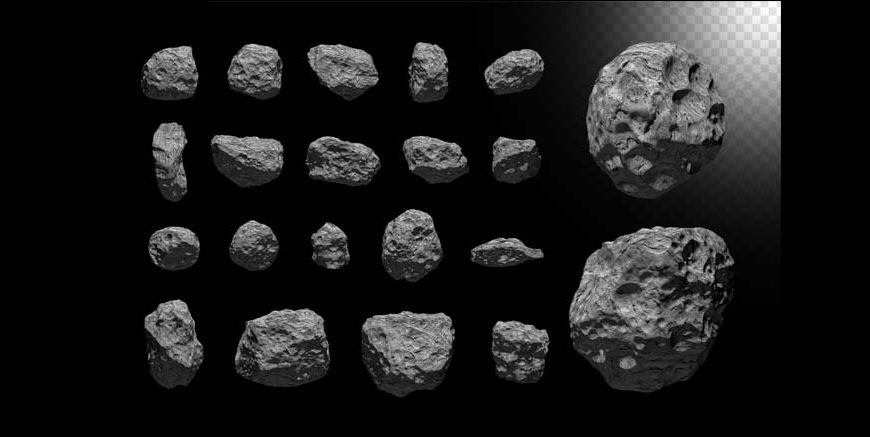
Look up at the clear night sky. Most people immediately search for glowing, twinkling stars, the bright, silvery moon, or perhaps a passing satellite. But hiding in the dark, silent gaps of our vast solar system is a chaotic, fascinating collection of ancient, tumbling rocks. These are not shooting stars, and they certainly are not alien spaceships; they are the original, rugged building blocks of our universe.
While the big planets usually get all the attention in science class, these smaller, travelling stones hold the deepest secrets of how our world came to be. Let us take a journey into deep space to uncover the truth about these flying rocks, exploring what they are, where they live, and the amazing stories they tell.
What is an Asteroid?
When scientists talk about space, they use a lot of complicated words. If you ask an astronomer to define asteroid, they will likely tell you it is a ‘minor planet’ or a ‘planetesimal’. But for a much simpler asteroid definition, you can just think of them as the solar system’s leftover construction rubble.
So, exactly what is the meaning of an asteroid? The word itself actually comes from the ancient Greek word asteroeides, which beautifully translates to ‘star-like’. Hundreds of years ago, when early astronomers first spotted these objects through their old, brass telescopes, the rocks just looked like tiny, dim stars slowly moving across the sky. However, they are completely different from stars. They do not burn, and they do not produce any light of their own. They are simply rocky, airless worlds that are far too small to be classified as true planets. Some are as tiny as a family car, while others, like the famous Ceres, are so incredibly massive that they are officially called dwarf planets!
Read More – How do you make science interesting for kids?
How are Asteroids Formed?
To truly understand these rocks, we have to travel back in time. how are asteroids formed? Rewind the clock roughly 4.6 billion years. Before the Earth even existed, our solar system was just a massive, swirling, chaotic cloud of thick gas and boiling hot dust.
As this giant cosmic cloud eventually cooled down and spun around, the heavy materials began to crash into each other and stick together. These growing clumps of material eventually built the sun and the major planets we know today, like Earth, Venus, Mars, and Jupiter. Think of it like baking a massive batch of cookies; you roll the dough to make the big cookies, but there are always little crumbs and bits of flour left over on the kitchen counter.
Not all the dust and rock in space managed to stick together to form a planet. The incredibly strong gravity from the giant gas planet Jupiter constantly pulled, tugged, and disrupted the remaining rocks, stopping them from ever joining together into a brand-new world. These battered, leftover pieces of cosmic “dough” are the exact same asteroids we see floating in space today.
Where Do They Live?
You might be wondering where all these flying rocks actually travel. While a few of them wander close to Earth, the vast majority of asteroids have their orbits between the planets Mars and Jupiter.
This massive, doughnut-shaped ring of space is known as the Main Asteroid Belt. Imagine a giant, circular superhighway in space where millions of rocks are constantly zooming around the sun. In science fiction movies, you often see spaceships dodging and weaving through a tightly packed field of crashing rocks. In reality, space is so unbelievably huge that the rocks in the asteroid belt are actually spaced millions of miles apart from one another. A spacecraft can easily fly straight through the belt without ever bumping into a single thing!
Read More – Science Quiz Questions and Answers for Kids
Different Types of Space Rocks
Just like cars driving on a motorway, these space rocks come in several different models. They are not all made of the exact same material. Scientists heavily study the light reflecting off these rocks to figure out what is hidden inside them. They carefully organise them into three main categories based on their unique ingredients.
Here is a list of the primary types of asteroids found in our solar system:
- C-Type (Chondrite): These are by far the most common type of space rock you will find. They are very dark, almost like charcoal, and are made mostly of ancient clay and silicate rocks. They are incredibly old and hold the original, unchanged dust from the very beginning of the solar system.
- S-Type (Stony): These rocks are a bit brighter and much heavier. They are made up of stony silicate materials and a mixture of nickel and iron. You will usually find these hovering a little closer to the inner solar system.
- M-Type (Metallic): These are the absolute heavyweights of the group. They are made almost entirely of solid nickel and iron, looking very much like giant, flying cannonballs! Scientists believe these might actually be the broken, leftover metallic cores of ancient planets that were smashed to pieces billions of years ago. Some people even dream of mining these specific rocks for valuable metals in the distant future.
Read More – Surprising Facts About Space For Your Little Astronaut
Conclusion
We often look up and view space as an empty, quiet void, but these ancient, travelling rocks tell a completely different and vibrant story. They are not just dead stones; they are flying time capsules, safely holding the very original ingredients that built our Earth, our moon, and everything around us.
Studying them does not just give us a history lesson about the distant past; it actively helps us understand the delicate, gravitational balance of the universe we live in today. The next time you look up at the twinkling stars, take a moment to remember the millions of silent, rocky travellers making their endless, quiet journey around the sun.
To explore more brilliant educational topics and gently nurture your child’s boundless love for learning, visit the EuroKids Blog and find out everything you need to know about EuroKids Preschool Admission today.
FAQs
What is the simplest asteroid definition?
An asteroid is a small, rocky, airless object that orbits the sun, acting as a leftover piece from the early formation of our solar system.
Where are most of these space rocks located?
The vast majority of them live in the Main Asteroid Belt, which is a massive, circular orbit located right between the planets Mars and Jupiter.
Are comets and asteroids the exact same thing?
No, they are different. Asteroids are mainly made of dry rock and heavy metals, whereas comets are made of ice, dust, and rock, which melt and create a glowing tail when they get too close to the hot sun.