The steady clinking sound of a stirring rod, the vibrant sight of bubbling, colourful liquids, and the quiet hiss of rising steam are the classic hallmarks of any bustling science room. These exciting reactions usually happen safely contained within oddly shaped, transparent vessels sitting neatly along the workbenches. These delicate, sparkling tools are the absolute backbone of human scientific discovery.
Long before a life-saving medicine is developed, a new fuel source is tested, or a complex chemical reaction is fully understood, scientists spend countless, meticulous hours working with these specific tools. Today, we are exploring the brilliant, practical science behind these transparent containers, learning their proper names, and understanding exactly why they remain so incredibly important to modern research.
The Glassware Meaning
If an inquisitive student asks for the exact glassware meaning, the simplest dictionary definition refers to any everyday object or article manufactured from glass, like a living room window or a kitchen vase. However, when we step inside a rigorous academic environment, the definition becomes much more specific and demanding.
In the realm of science, it refers to the highly specialised, incredibly durable equipment created exclusively for experimental work. Unlike the standard drinking cups in your kitchen cupboard, which would crack instantly if placed near an open flame, these scientific tools are expertly built from a special, heavy-duty material called borosilicate glass. This unique, reinforced material effectively ensures that the containers can easily survive extreme thermal shock, meaning they do not suddenly shatter when moved rapidly from a freezing ice bath to a boiling hot burner.
Read More – Easy Preschool Science Experiments at Home for Kids
Why We Rely on Laboratory Glassware
You might naturally wonder why modern scientists do not simply use tough, unbreakable plastics or heavy, solid metal bowls to conduct their daily experiments. The historical and continued reliance on laboratory glassware comes down to three massive, undeniable advantages.
Firstly, it is completely, perfectly transparent. This allows a busy chemist to constantly observe a subtle colour change, quickly spot a dissolving solid, or carefully watch tiny bubbles form during a delicate reaction. Secondly, glass is remarkably unreactive. This means if you pour a highly corrosive, sour acid into a glass bottle, the container itself will not melt, rust, or actively interfere with the sensitive chemical process occurring inside. Finally, it is incredibly easy to clean and rigorously sterilise at high temperatures, ensuring that the stubborn, sticky leftovers from yesterday’s messy experiment do not accidentally contaminate and ruin today’s hard work.
Exploring the Different Types of Glassware in Laboratory
Because researchers perform a vast, unpredictable variety of jobs every single day, they require an equally vast variety of specialised tools. The types of glassware in laboratory settings are beautifully diverse, with each unique physical shape expertly designed to solve a very specific physical problem.
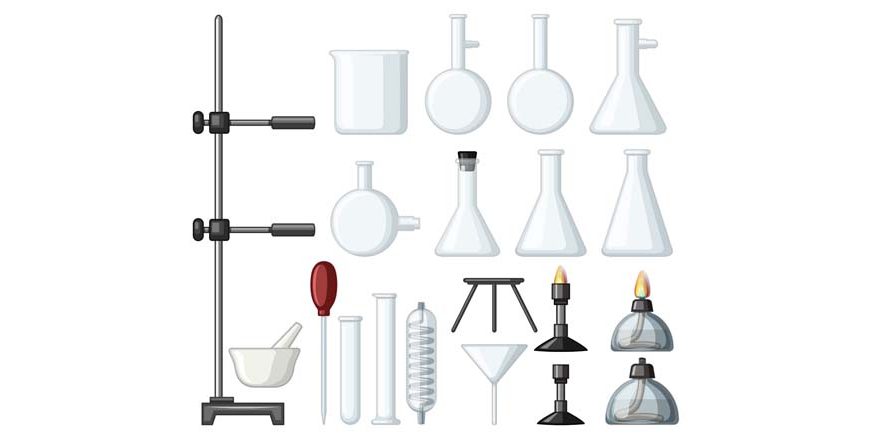
Here is a helpful, descriptive list of the most common shapes you will spot resting on a busy lab bench:
- Beakers: These look very much like large, flat-bottomed drinking cups equipped with a tiny, helpful pouring lip at the rim. They are absolutely fantastic for holding messy materials, stirring thick mixtures, and roughly measuring large amounts of liquid.
- Erlenmeyer Flasks: These unique containers feature a wide, flat bottom that sharply narrows into a tall, thin neck. This brilliant, iconic shape allows a scientist to aggressively swirl liquids around by hand without accidentally splashing dangerous, hot chemicals onto their skin.
- Volumetric Flasks: When scientists need to be perfectly accurate, they use these tear-drop-shaped containers. They feature one single, precise line etched onto their long neck, designed to measure one exact, specific volume of liquid with absolutely flawless accuracy.
- Test Tubes: These are small, finger-length tubes featuring a completely rounded bottom. They are perfect for holding tiny, inexpensive amounts of material, allowing students to compare multiple small reactions side-by-side in a wooden holding rack.
- Measuring Cylinders: Tall, highly stable, and very thin, these clear cylinders are completely covered from top to bottom in tiny, precise measurement lines, making them the absolute best everyday tool for measuring the exact volume of a poured liquid.
Read More – How do you make science interesting for kids?
Glassware Used in Laboratory Settings
The physical shape of a scientific tool heavily dictates exactly how it is ultimately utilised in a real-world scenario. When we look closely at the glassware used in laboratory settings, we can easily group their daily jobs into a few key, distinct categories.
The primary uses of glassware include:
- Safe Storage: Dark brown, thick-walled glass bottles are frequently used to securely store highly sensitive chemicals that might naturally degrade or be slowly ruined if exposed to bright, natural sunlight.
- Intense Heating: Round-bottom boiling flasks are routinely placed directly over the open, roaring flames of a Bunsen burner. Their perfectly curved shape helps to distribute the intense heat evenly across the liquid, preventing the mixture from boiling too aggressively and dangerously spilling out of the top.
- Precise Transferring: Delicate tools like pipettes, which strongly resemble long, thin glass straws, are carefully used to pick up and move just a single, tiny drop of liquid from one large container to another.
Essential Handling Tips for Young Scientists
Working confidently with these tools requires a focused, calm mind and very steady hands. Always remember to handle them incredibly gently, as even heavy-duty borosilicate material can aggressively shatter if dropped onto a hard, tiled floor. You must never use a beaker or flask that has a visible, hairline crack or a sharp chip on the rim, as the building pressure from a hot burner could easily cause it to break completely. Finally, always let your heated containers cool down thoroughly on a heatproof mat before attempting to tidy them away; hot glass looks exactly identical to cold glass!
Read More – Science Quiz Questions and Answers for Kids
Conclusion
The next time you watch a dedicated scientist holding up a bubbling, smoking flask in an exciting television documentary, you will know that the container itself is a brilliant, silent piece of engineering. These sparkling, transparent tools do so much more than just hold messy, colourful liquids; they physically provide a clear, safe, and reliable window into the invisible, complex mechanics of our universe.
Without them, understanding the intricate, life-saving details of modern medicine, biology, and chemistry would be nearly impossible for humanity. They teach us a beautiful lesson: sometimes, making the most profound and massive discoveries simply requires us to look very closely, safely, and clearly at the tiny world around us. To uncover more fascinating, family-friendly educational topics and to actively support your child’s brilliant academic journey, dive into the EuroKids Blog and find out all the vital details you need regarding EuroKids Preschool Admission today.
FAQs
What is the simplest glassware meaning in a scientific context?
In a professional or educational setting, it directly refers to the specialised, heavily heat-resistant glass containers and tools safely used to perform chemical and biological experiments.
Why is laboratory glassware generally better than standard plastic?
Glass remains completely clear for closely observing reactions, can easily withstand extreme temperature changes without melting, and does not negatively react with harsh, corrosive chemicals.
What are the main types of glassware in laboratory work?
The most common, everyday types include flat-bottomed mixing beakers, swirling Erlenmeyer flasks, highly precise measuring cylinders, and small test tubes.