Have you ever caught your child staring up at the night sky, eyes wide with wonder, pointing a tiny finger at a bright star? It is a universal moment of childhood curiosity. Space is vast, mysterious and incredibly exciting for young minds. It sparks questions that are seemingly simple but profound: “Where does the sun go at night?” or “Is the moon made of cheese?”. These aren’t just cute questions; they are the beginnings of scientific inquiry.
Introducing the solar system for class 3 students or even younger is about more than just memorising names of planets. It is about understanding our place in the universe. It teaches perspective, that our earth and our solar system are part of a much larger, dynamic family. This blog will guide you through the cosmos, breaking down what is meant by the solar system, sharing mind-blowing facts and offering practical ways to bring the magic of space into your living room.
What is the Solar System? Defining the Neighbourhood
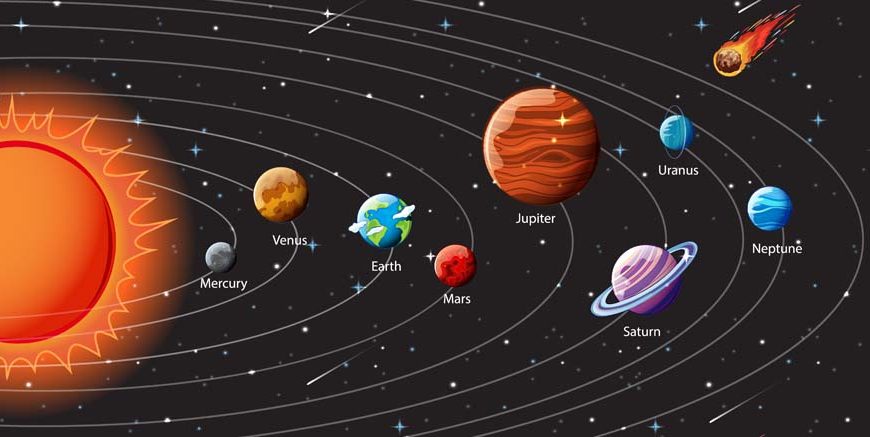
When a child asks “What is the solar system?”, the best way to explain it is by using the analogy of a family. The solar system definition isn’t just a list of rocks and gas balls; it is a gravitational family. At the centre sits the parent, the Sun. Everything else, the solar planet giants, the tiny dwarf planets, the rocky asteroids and the icy comets, are the children and cousins dancing around it.
So, what do you mean by the solar system in a scientific sense? The solar system meaning comes from the Latin word ‘Sol’, which means Sun. Therefore, it literally means “The Sun’s System”. Everything in it is bound to the Sun by an invisible rope called gravity. Without the Sun, our earth and our solar system would drift off into the dark, cold expanse of the universe. When you explain solar system concepts to a child, focus on this connection. It is a busy, moving community where every member has a path (orbit) and a place.
The Head of the Family: The Sun
To understand about solar system dynamics, you must start with the star of the show. The Sun is not a planet; it is a star. It is a massive ball of hot, glowing gas that provides the light and heat necessary for life on Earth. It is so big that you could fit one million Earths inside it. This is a crucial piece of solar system information in English for kids: the Sun holds 99.8% of the entire solar system’s mass. It is the anchor that keeps the solar family together.
Read More – Essay On The Sun for Children
Meet the Neighbours: The Planets
The planetary system in the solar system describes two distinct groups of planets. We have the rocky inner planets and the gas giant outer planets.
The Inner Planets (The Rocky Crew)
These are the planets closest to the Sun. They are smaller and made mostly of rock and metal.
- Mercury: The speed racer. It is closest to the Sun and zips around it faster than any other planet.
- Venus: The hot planet. It is covered in thick clouds that trap heat, making it the hottest planet in the solar family.
- Earth: Our home. The only solar planet known to support life, thanks to liquid water.
- Mars: The Red Planet. It is dusty, cold and has the largest volcano in the entire solar system.
The Outer Planets (The Gas Giants)
Past the asteroid belt, we find the giants. They do not have solid surfaces you could stand on.
- Jupiter: The King. It is the largest planet and has a storm called the Great Red Spot that has been raging for centuries.
- Saturn: The Jewel. Famous for its beautiful, complex rings made of ice and rock.
- Uranus: The Ice Giant. It spins on its side, rolling around the Sun like a ball.
- Neptune: The Windy One. It is a deep blue colour and has the fastest winds in the solar system.
Read More – Planet Names in Our Solar System for Kids
Beyond the Planets: Asteroids and Comets
What is meant by the solar system goes beyond just planets. Between Mars and Jupiter, there is a highway of rocks called the Asteroid Belt. These are leftovers from when the solar system formed, essentially the building blocks that never became planets. Then we have comets, which are dirty snowballs from the edge of the system. When they come close to the Sun, they heat up and leave a beautiful glowing tail. This solar system information in English helps children understand that space is messy and full of debris, not just perfect spheres.
Fun Facts to Spark Curiosity
When asking what do you understand by solar system wonders, facts are the best hook. Here are some to share:
- A Day Longer than a Year: Venus spins so slowly that one day on Venus (sunrise to sunrise) is longer than one year on Venus (one orbit around the Sun).
- The Protector: Jupiter is so big that its gravity pulls in many asteroids and comets, protecting Earth from getting hit.
- Floating Planet: Saturn is less dense than water. If you had a bathtub big enough, Saturn would float in it!
Bringing Space Home: Worksheets and Activities
You don’t need a telescope to explore. You can use solar system images for kids and simple activities to make learning stick.
1. The Edible Solar System:
Use fruit to represent the solar system facts. A watermelon for the Sun, a peppercorn for Mercury, a cherry tomato for Earth and an orange for Jupiter. Placing them at relative distances helps children grasp the vastness of space.
2. Shadow Tracking:
To understand how our earth and our solar system move, go outside and trace your child’s shadow in the morning, noon and evening. Explain that the Earth is spinning, making the Sun appear to move.
3. Mnemonic Creation:
Help them remember the order. The classic is “My Very Educated Mother Just Served Us Noodles”. Ask them to create their own funny sentences.
Read More – Solar System Project For Kids
The EuroKids Approach to Learning
At EuroKids, we believe that what is solar system learning if not an adventure? We follow the Heureka curriculum which emphasises “Mindful Learning.” We move beyond rote memorisation of solar system facts. Instead, we encourage children to ask “Why?”. Why does the moon change shape? Why is Mars red?
Our live classes and interactive modules use storytelling to explain the solar family. We ensure that when a child looks at solar system images for kids, they don’t just see dots; they see worlds waiting to be explored.
Conclusion
The solar system is a playground for the imagination. It teaches us about gravity, geology and the delicate balance that allows life to thrive on Earth. By exploring what is meant by the solar system with your child, you are nurturing a lifelong love for science and discovery.
Whether you are building a model rocket or just reading about solar system wonders before bed, you are expanding their universe. EuroKids is your partner in this cosmic journey. We invite you to visit our website to learn more about EuroKids Preschool Admission and find a centre near you. For more resources on child development and educational activities, please explore the EuroKids Blog section.
Frequently Asked Questions (FAQs)
1. What is the name of our solar system?
People often ask for the name of our solar system. Technically, it is just called “The Solar System” because it is the system of our Sun (Sol). It is located within the Milky Way Galaxy.
2. Is Pluto a solar planet?
Pluto was once considered the ninth planet. However, in 2006, scientists reclassified it as a “dwarf planet”. It is still part of the solar family, but it is too small to clear its orbit of other debris.
3. How do I explain solar system concepts to a 5-year-old?
When you explain solar system concepts to toddlers, keep it simple. Use the solar system solar system analogy of a “star family” where the planets are children holding hands with the Sun (gravity) so they don’t get lost in the dark.
4. What is the difference between a star and a planet?
A star (like the Sun) creates its own light and heat through nuclear reactions. A solar planet (like Earth) reflects the light of the star and does not produce its own light.
5. Why is it important to learn about the solar system for class 3?
Learning what do you mean by the solar system at this age builds a foundation for physics and geography. It helps children understand day and night, seasons and the environment, fostering a sense of global (and galactic) citizenship.