Watching your child’s vocabulary explode is one of the most rewarding parts of parenting. One day they are pointing and grunting, and the next, they are stringing together complete, hilarious sentences. But this magical transition does not happen by accident. It is built letter by letter, sound by sound. Today, we are focusing on a letter that is naturally incredibly fun for toddlers to say: the letter P.
The ‘P’ sound is what speech therapists call an unvoiced bilabial plosive. That sounds complicated, but to a toddler, it just means pressing their lips together and letting out a sharp puff of air, exactly like a balloon popping. It is crisp, energetic, and highly satisfying to pronounce.
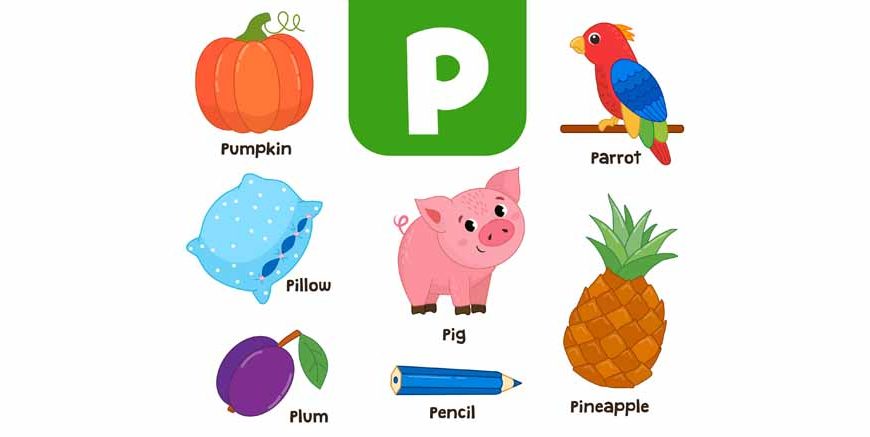
However, translating that fun “puh” sound into actually recognizing and reading words that start with p requires a bit of structure. Children learn best when new information is attached to things they can visualize and experience. If you are looking to expand your child’s vocabulary, you need a contextual, engaging p words list. We have categorized the best p english words to help you turn your next phonics session into a joyful, interactive game.
Mastering the “Puh” Sound
Before you start pointing at words on a page, you need to make sure your child is comfortable making the sound.
A Quick Phonics Trick: Have your child hold a tissue or a feather right in front of their mouth. Ask them to press their lips tightly together and then say a sharp “Puh!” If they do it correctly, the puff of air will make the tissue dance.
This visual feedback turns pronunciation into a game. Once they can make the feather dance consistently, they are ready to dive into the amazing p words for kids listed below.
Read More – Ways to Teach Your Child to Spell Words
The Ultimate Dictionary: P Letter Words for Kids
To make memorization natural, we have broken down these words that start with the letter p into relatable, child-friendly themes.
1. The Animal Kingdom
Children naturally gravitate toward animals. Teaching p words through their favourite creatures is a guaranteed way to capture their attention.
- Penguin
- Meaning: A black and white bird that lives in very cold places, cannot fly, but swims beautifully in the ocean.
- Example: The funny penguin waddled across the thick ice.
- Pig
- Meaning: A highly intelligent farm animal with a curly tail and a flat snout, known for making an “oink” sound.
- Example: The pink pig rolled happily in the wet mud.
- Parrot
- Meaning: A brightly coloured tropical bird that can often learn to copy human words.
- Example: The green parrot said “Hello!” to the visitors.
- Panda
- Meaning: A large, peaceful bear from China with black and white fur that loves to eat bamboo.
- Example: The sleepy panda chewed on a long green bamboo stick.
2. Everyday Objects (Things That Start With P)
Connecting phonics to tangible items around the house reinforces learning every single time your child sees that object. Here are common things that start with p.
- Plate
- Meaning: A flat, round dish that you put your food on to eat.
- Example: I ate all the healthy vegetables on my dinner plate.
- Pillow
- Meaning: A soft, fluffy cushion you rest your head on when you go to sleep in your bed.
- Example: She fluffed her white pillow before going to sleep.
- Pencil
- Meaning: A wooden tool with a dark centre used for writing or drawing on paper.
- Example: He used a sharp yellow pencil to draw a big house.
- Pan
- Meaning: A flat metal container with a long handle, used on the stove for cooking food.
- Example: My father cooked delicious eggs in the frying pan.
3. Building Length: Five Letter Words Starting With P
As your child progresses from simple three-letter CVC (consonant-vowel-consonant) words, you need to slightly increase the challenge. These five letter words starting with p are perfect for expanding their spelling skills.
- Plant
- Meaning: A living thing that grows in the earth and needs water and sunlight to survive.
- Example: We must water the green plant every morning.
- Paint
- Meaning: A colourful liquid used to make art or change the colour of a wall.
- Example: I used red paint to draw a giant fire engine.
- Paper
- Meaning: A thin, flat material made from wood that we use for writing, drawing, or folding.
- Example: Please give me a piece of white paper to draw on.
- Puppy
- Meaning: A very young, small, and playful baby dog.
- Example: The golden puppy chased a bouncy ball in the yard.
- Peach
- Meaning: A sweet, juicy fruit with fuzzy orange and pink skin and a large seed in the middle.
- Example: I ate a sweet, juicy peach for my afternoon snack.
4. Building Character: Positive Words That Start With P
Language shapes how children view the world and themselves. Introducing positive words that start with p helps them express good emotions and builds their self-esteem.
- Proud
- Meaning: Feeling very happy and satisfied because of something good you have done.
- Example: I felt very proud when I tied my own shoes.
- Peace
- Meaning: A feeling of calm and quiet, without any fighting or loud noise.
- Example: The quiet garden is full of peace and beautiful flowers.
- Play
- Meaning: To do things for fun and enjoyment, like running, building blocks, or pretending.
- Example: I love to play with my friends at the park.
- Polite
- Meaning: Having good manners, like saying “please” and “thank you” to others.
- Example: The polite little boy held the door open for his grandmother.
Read More – Words That Start With I for Kids
Interactive Games to Practice the P Alphabet
Do not just hand your child a list and expect them to memorize it. Children are wired to learn through physical play and discovery.
The Pizza Parlour Pretend Play:
Set up a pretend pizza shop. Ask your child to make a “Pizza” (a great P word!). Have them add toppings that start with the target letter: Pepperoni, Peppers, Pineapples, and Prawns. As they place each pretend item on the pizza, they must pronounce the word clearly.
Pop the P Balloon:
Blow up several balloons and write different alphabet letters on them. Tell your child that they have a special mission: they can only pop the balloons that have the letter P on them. When they find one, they must yell a word from your vocabulary list before they sit on the balloon to pop it!
P-Word Picasso:
Give your child some Paint and Paper. Ask them to draw as many things that start with p as they can think of on one page. A pig eating a peach? A penguin holding a pencil? The sillier the picture, the more deeply the vocabulary will stick in their memory.
Read More – Spelling Games and Fun Activities for Kids
The EuroKids Philosophy on Early Literacy
Teaching a child to read and speak confidently is a delicate, wonderful responsibility. At EuroKids, we completely understand the science of language acquisition. We know that forcing a child to sit at a desk and stare at black-and-white flashcards does not build a lifelong love of reading.
Our classrooms are built on active, joyful engagement. We utilize the HEUREKA Curriculum, which is deeply inspired by Harvard University’s Project Zero. Our educational framework focuses heavily on “Visible Thinking.” When we introduce new letters and vocabulary, we do not just ask children to repeat after us. We use sensory bins, interactive storytelling, and guided questioning. We make their thinking visible so that they understand the logic behind the sounds. They do not just memorize a letter; they understand how it constructs the world around them.
When you are ready to give your child an educational environment that values both academic excellence and joyful discovery, the EuroKids Preschool Admission process is your clear next step. We invite you to visit a centre, speak to our dedicated educators, and see our child-first philosophy in action.
In the meantime, we highly encourage you to explore the EuroKids Blog for more weekly vocabulary lists, expert parenting advice, and developmental guides to support your little learner at home.
Frequently Asked Questions (FAQs)
1. How do I help my child if they keep mixing up the ‘P’ and ‘B’ sounds?
This is very common because both sounds are made with the exact same lip position (bilabial plosives). The difference is that ‘B’ uses the vocal cords, and ‘P’ does not. Have your child put their hand on their throat. When they say “Buh,” they will feel a buzz. When they say “Puh,” they should feel no buzz at all.
2. How many new vocabulary words should I introduce at once?
For preschoolers, less is more. Introduce three to five new words a week. Focus heavily on depth rather than quantity. Act out the word, draw it, and use it repeatedly in your daily sentences.
3. Are there easy three-letter P words for a child just starting to read?
Yes! Start with easily decodable CVC words like Pig, Pan, Pot, Pen, and Pet. These follow strict phonetic rules and are very easy for a beginner to blend.
4. How can I correct my child if they use the wrong word without discouraging them?
Always use positive reinforcement. If they point to a dog and say “Puppy!”, but it is a fully grown dog, say, “That does look like a big puppy! A puppy is a baby dog, and that one is all grown up.” You validate their thought process while gently providing the correct nuance.
5. How does the EuroKids curriculum teach new letters?
We immerse children in a letter-rich environment. During a ‘P’ week, children might Paint pictures of Pigs, pretend to make Pizzas, and play with Puppets. Through the HEUREKA framework, learning happens organically across art, science, and physical play.