Building a strong vocabulary serves as a fundamental step in early childhood education. Parents frequently look for effective methods to teach their children new letters and sounds. The i alphabet presents a distinct phonetic challenge because it acts as a vowel with multiple sound profiles. Teaching words that start with i requires a clear, logical strategy rather than simple memorisation. When you understand how to break down these sounds, you can guide your child towards reading fluency with much greater ease. This guide provides a detailed approach to teaching i words for kids, ensuring they grasp both the spelling and the pronunciation perfectly.
The Importance of Vowel Recognition
Vowels act as the glue in the English language. Every single word requires at least one vowel to make a proper sound. Introducing i words to your child early on helps them understand how words link together. The letter ‘I’ is incredibly common, appearing in countless everyday objects and actions. By focusing heavily on i letter words, you give your child the tools to decode the books they read and the sentences they hear.
Children absorb information best through structured repetition. When you dedicate time to specific i sound words in English, you build their phonetic confidence. This confidence translates directly into their ability to speak clearly and express their thoughts accurately. You can start this learning process by pointing out simple objects around the house and emphasising the initial vowel sound.
Read More – Short and Long Vowel Pronunciations
Mastering the Crisp Short Sound
The most common pronunciation young learners encounter is the short sound. We classify short i sound words as those where the letter sounds like the beginning of the word ‘igloo’. To teach this, you should ask your child to relax their mouth slightly and make a quick, sharp sound from the back of their throat.
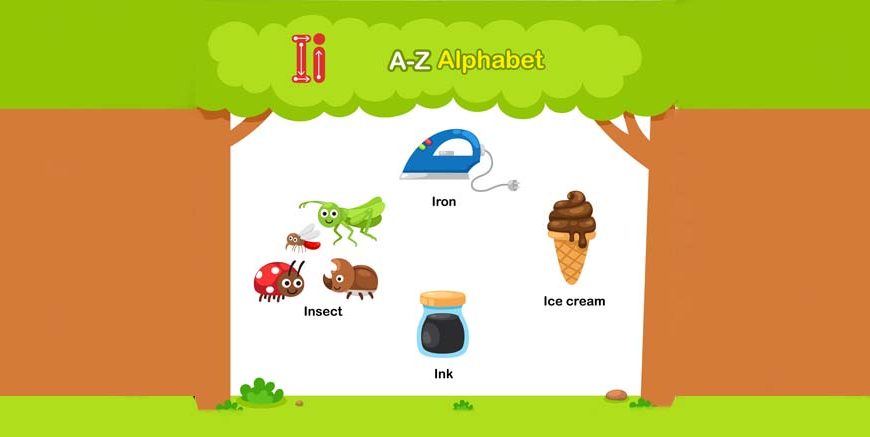
You will find this sound in many basic consonant-vowel-consonant combinations, though starting words with this letter provides the most direct example. Words like ‘ink’ and ‘insect’ serve as perfect teaching tools. You can make this learning highly interactive. Buy a non-toxic ink pad and let your child make fingerprints while saying the word aloud. Go to the garden and look for small insects, repeating the phonetic sound together. Connecting the verbal sound to a physical activity solidifies the lesson in their memory.
Exploring the Elongated Long Sound
Once your child feels comfortable with the short pronunciation, you can introduce the second variation. We define long i sound words as those where the letter simply says its own name. You pronounce it exactly as you would when reciting the alphabet.
Teaching this concept requires careful explanation. You can tell your child that sometimes letters like to shout their own names to be heard. Excellent examples include ‘ice’ and ‘island’. To practice, you might give your child an ice cube to hold and ask them to describe the temperature while emphasising the starting letter. You can look at maps together and point out islands, discussing how water completely surrounds the land. These visual and tactile experiences make learning i sound words much more engaging than simply reading from a textbook.
Read More – Ways to Teach Your Child to Spell Words
A Detailed Dictionary of Essential Words
To assist your teaching efforts, we have compiled a comprehensive list of words starting with this specific letter. You can use this dictionary to introduce new concepts daily. We have included clear meanings to help you explain them easily.
- Ice: Frozen water that becomes solid due to cold temperatures.
- Igloo: A dome shaped house built from blocks of solid snow.
- Iguana: A large lizard native to tropical areas of Central and South America.
- Idea: A thought or a plan formed in the mind to solve a problem.
- Iron: A strong, hard magnetic metal people use to build structures.
- Island: A piece of land surrounded entirely by water.
- Ink: A coloured fluid contained in pens used for writing and drawing.
- Infant: A very young child or a newly born baby.
- Insect: A small creature with six legs and a body divided into three sections.
- Inch: A standard unit of measurement for length.
- Illness: A specific disease or a period of sickness affecting the body.
- Inside: The inner part, space, or side of an object or building.
- Instrument: A tool or device people use to create music or perform delicate work.
- Igneous: A type of rock formed through the cooling and solidification of magma or lava.
- Image: A visual representation of something, like a photograph or a painting.
- Imagine: To form a mental picture or concept of something not present.
- Important: Having great significance, value, or consequence.
- Improve: To make something better than it was before.
- Invite: To politely ask someone to attend an event or go to a specific place.
- Item: An individual article or unit, especially one that is part of a list.
Turning Vocabulary into Daily Conversations
Knowing the words represents only the first step. You must help your child use these words in their daily conversations. If your child learns the word ‘important’, encourage them to tell you what toys or books feel important to them. If they learn the word ‘improve’, discuss small tasks they can improve upon, like making their bed or drawing a picture.
Active usage prevents children from forgetting their new vocabulary. You can create a dedicated ‘word of the day’ routine. Write one word from the list on a piece of paper and stick it to the refrigerator. Challenge everyone in the family to use that specific word during dinner. This turns language development into a collaborative family effort rather than an isolated homework task.
Read More – Comprehensive Vocabulary Building for Kids
Encouraging a Love for Reading
Books offer the best natural exposure to new vocabulary. Visit your local library and ask the librarian for books that heavily feature the target letter. As you read to your child, pause when you encounter these specific words. Ask your child to identify the starting letter and attempt to sound it out.
Always praise their efforts, even if they mispronounce the word initially. Positive reinforcement encourages children to keep trying. Over time, they will begin to spot these letters independently, pointing them out on street signs, cereal boxes, and television screens. This natural curiosity indicates that your phonetic lessons are working successfully.
Conclusion
Expanding your child’s vocabulary gives them a profound academic advantage. By systematically introducing both short and long vowel sounds, you provide a comprehensive understanding of the English language. Use the provided list, engage in tactile learning experiences, and maintain a positive, encouraging environment at home.
EuroKids follows the HEUREKA curriculum to encourage mindful and interactive learning in early childhood. If you want to support your child’s educational journey further, we invite you to explore the EuroKids Preschool Admission process for the next term. You will also discover a wealth of additional resources and parenting guides in the EuroKids Blog section. Take the next step in fostering your child’s love for learning today.
Frequently Asked Questions
Why does the letter I have two completely different sounds?
The English language borrowed words from many different languages over centuries. This blending of languages resulted in a complex phonetic system where vowels adapted multiple sounds depending on their origin and the surrounding consonants.
At what age should I start teaching specific vowel sounds to my child?
You can begin introducing basic sounds as early as two or three years old. Toddlers naturally mimic sounds, so starting early with simple words like ‘ice’ or ‘ink’ builds a great foundation for preschool.
How do I correct my child when they use the wrong vowel sound?
Always correct them gently. Instead of saying they are wrong, simply repeat the word back to them with the correct pronunciation. For example, if they mispronounce ‘island’, you can say, “Yes, that is a beautiful island!”
Are there any physical games to help teach these words?
You can play ‘I Spy’ using only objects that start with the target letter. You can also hide flashcards around the living room and ask your child to find specific words and read them aloud upon discovery.
What should I do if my child struggles to remember the meanings of the words?
Focus on quality over quantity. Instead of teaching ten words at once, focus on just two words for an entire week. Connect those two words to physical objects or fun activities to cement the meaning in their mind.