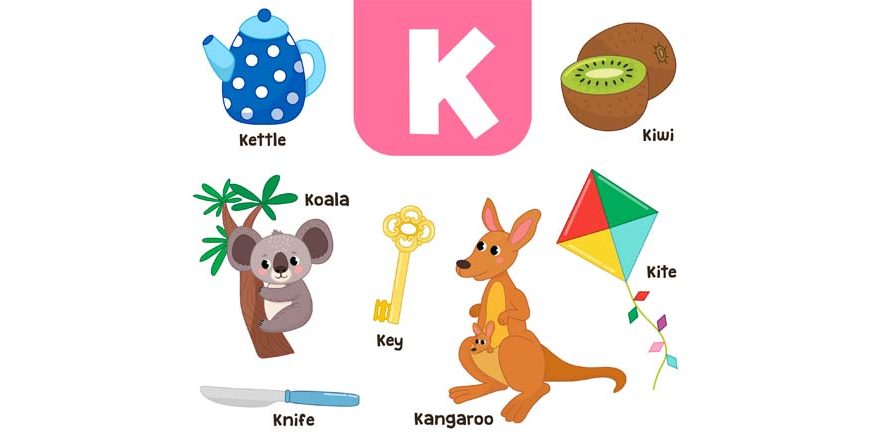
Watching a child discover the alphabet is like watching them unlock a secret code to the universe. Some letters glide softly off the tongue, while others demand a little more energy. The letter k is one of those energetic, sharp sounds that toddlers naturally love to make. It has a crisp “click” in the back of the throat that makes saying k words incredibly fun for early learners.
When you introduce the k alphabet words to a young child, you are not just teaching them a new symbol. You are handing them the keys to a whole new vocabulary. However, moving from recognizing the shape of the letter to actually reading and understanding words that start with k requires a strategic approach. Children do not learn through boring, abstract lists. They learn by connecting new sounds to things they can see, touch, and imagine.
Whether you are a parent trying to support your child’s phonics journey at home or an educator looking for fresh ideas, you need context. We have put together a comprehensive, kid-friendly dictionary of k letter words. By breaking these down into themes and adding simple meanings, we will help you turn a basic phonics lesson into a joyful daily conversation.
Mastering the “Kuh” Sound
Before we jump into the vocabulary, let us talk about the sound itself. The letter k makes an unvoiced velar plosive sound. In simple terms, this means the sound is made by stopping the airflow in the back of the mouth and then releasing it with a sharp puff of air, without using the vocal cords.
To help your toddler master k sound words, turn it into a physical game. Ask them to open their mouth slightly, pull the back of their tongue up to touch the roof of their mouth, and pretend they are a little coughing crocodile making a sharp “kuh, kuh, kuh” sound. Once they can isolate that crisp sound, they are completely ready to dive into the wonderful english words with k listed below.
Read More – Ways to Teach Your Child to Spell Words
The Ultimate List: K Words for Kids
To make learning highly engaging, we have categorized these words that start with k into themes that naturally capture a child’s imagination.
1. The Animal Kingdom
Children absolutely adore animals. When they ask what is k for, pointing to a fascinating creature is always the best starting point.
- Kangaroo
- Meaning: A large, furry animal from Australia that jumps on its strong back legs and carries its babies in a special pouch.
- Example: The mother kangaroo hopped quickly across the hot sand.
- Koala
- Meaning: A small, grey animal that looks like a teddy bear and spends its whole life eating leaves high up in eucalyptus trees.
- Example: The sleepy koala took a long nap on the tree branch.
- Kitten
- Meaning: A very young, small, and playful baby cat.
- Example: The tiny white kitten chased a ball of red yarn.
- Kingfisher
- Meaning: A beautiful, brightly coloured bird that dives into the water to catch small fish.
- Example: We saw a blue kingfisher sitting near the river.
2. Everyday Objects and Things
Connecting phonics to physical items around the house is a fantastic way to reinforce learning. These are common things that start with k that your child might see every day.
- Kite
- Meaning: a light frame covered with paper or cloth that you fly high up in the sky using a long string.
- Example: The yellow kite flew high above the green park.
- Key
- Meaning: A small, shaped piece of metal used to open a locked door or start a car.
- Example: My father used his silver key to unlock the front door.
- Kettle
- Meaning: A special metal or plastic pot with a lid and a spout, used for boiling water.
- Example: The hot water inside the kettle began to whistle loudly.
- Keyboard
- Meaning: A board with rows of buttons (keys) that you press to type letters into a computer or play musical notes.
- Example: She typed a story on the computer keyboard.
3. High-Energy Action Words (Verbs)
Toddlers learn best when their bodies are moving. Teaching them action words allows them to physically act out the phonics lesson.
- Kick
- Meaning: To hit something strongly with your foot.
- Example: The little boy loves to kick the round football.
- Keep
- Meaning: To hold onto something and not give it away or lose it.
- Example: I will keep my favourite toy safe in this box.
- Kiss
- Meaning: To touch someone gently with your lips to show them love and affection.
- Example: My mother gives me a goodnight kiss before bed.
- Knock
- (Note for parents: Explain that the ‘K’ is silent here, but it still belongs to the K family!)
- Meaning: To tap loudly on a door to let someone know you are there.
- Example: Please knock on the door before you come inside.
4. People and Titles
Sometimes a k word name or title helps children understand roles in stories and real life.
- King
- Meaning: A man who rules a country and usually wears a shiny gold crown.
- Example: The brave king lived in a giant stone castle.
- Kid
- Meaning: A friendly, informal word for a child.
- Example: The happy kid played on the swings all afternoon.
Read More – Silent Letters in English For Kids
Interactive Games to Practice the K Alphabet
Rote memorization is boring for a young mind. If you want these words to stick, you have to gamify the learning process.
The Key Sorting Game:
Gather a bunch of old, unused keys (make sure they are clean and safe) and put them in a sensory bin filled with dried beans or rice. Give your child a few small bowls. Every time they dig out a key, ask them to say another word from your k letter words list before they drop the key into the bowl.
Kite Flying Indoors:
You do not need wind to fly a kite. Have your child draw and cut out a simple paper kite. Attach a piece of string to it. Write a different k for word on each kite they make. Have them run down the hallway holding the string, shouting out the word written on their flying paper kite.
The King’s Command:
Play a variation of “Simon Says” called “The King Says.” Wear a paper crown. Give your child instructions using the target words. “The King says, kick the imaginary ball!” or “The King says, hop like a kangaroo!” This connects physical movement directly to the vocabulary.
Read More – Word Games for Kids
The EuroKids Philosophy on Early Literacy
Teaching early literacy is a delicate, wonderful responsibility. At EuroKids, we completely understand the science of reading. We know that forcing a child to sit at a desk and stare at flashcards does not build a lifelong love of learning. Active, joyful engagement is the secret to deep comprehension.
This is exactly why our classrooms utilize the HEUREKA Curriculum. Heavily inspired by Harvard University’s Project Zero, our educational framework focuses on “Visible Thinking.” When we introduce new letters and vocabulary, we use interactive storytelling, sensory play, and guided questions. We make the thinking process visible so that children understand the logic behind the sounds and words. They do not just memorize a letter; they understand how it works in the real world.
When you are ready to give your child an educational environment that values both academic excellence and joyful discovery, the EuroKids Preschool Admission process is your clear next step. We invite you to visit a centre, speak to our dedicated educators, and see our child-first philosophy in action. In the meantime, we highly encourage you to explore the EuroKids Blog for more weekly vocabulary lists, expert parenting advice, and developmental guides to support your little learner at home.
|
Word Category |
Key Examples |
Developmental Benefit |
|
Animals |
Kangaroo, Koala, Kitten |
Builds empathy and natural world connection. |
|
Everyday Objects |
Kite, Key, Kettle |
Connects abstract sounds to tangible household items. |
|
Action Words |
Kick, Keep, Kiss |
Links physical movement to phonics memory. |
|
People & Titles |
King, Kid |
Enhances imaginative storytelling and role-play. |
Frequently Asked Questions (FAQs)
Why does my child confuse the letter K with the letter C?
This is incredibly common because both letters often make the exact same “kuh” sound (like in cat and kite). When teaching early phonics, focus strictly on the sound first. Later, as they begin spelling, you can introduce the spelling rules that separate the two letters.
How many new words should I teach my toddler at once?
For preschoolers, introduce no more than three to five new words a week. Focus heavily on depth rather than quantity. Act out the word, draw it, and use it repeatedly in your daily sentences.
What should I do when a word starts with a silent K, like “Knight” or “Knee”?
For absolute beginners, stick to words where the K makes a hard phonetic sound. Once they are confident, you can introduce the “silent K rule” as a fun, secret trick that the English language likes to play. Tell them the K is hiding quietly!
How can I correct my child if they use the wrong word without discouraging them?
Always use positive reinforcement. If they point to a wallaby and say “Kangaroo!”, say, “That does look exactly like a kangaroo! They are cousins. That one is a smaller wallaby.” You validate their thought process while gently providing the correct vocabulary.
How does the EuroKids curriculum teach new letters?
We immerse children in a letter-rich environment. During a ‘K’ week, children might paint kites, pretend to be kangaroos, and try to open locks with keys. Through the HEUREKA framework, learning happens organically across art, science, and physical play.