Look around the room right now. What do you see? Perhaps there is a television screen on the wall, a round clock ticking on a shelf, or a rectangular window letting in the afternoon sunshine. Our entire world is built out of shapes. Long before children can write complex sentences, they learn to recognise these familiar outlines.
Understanding geometry begins with the absolute basics. Today, we are going to explore the wonderful world of flat figures. We will carefully define 2D shapes, look at brilliant real-world examples, and learn exactly how to tell them apart from their chunky 3D cousins.
What are 2D Shapes?
If you are wondering exactly what are 2D shapes, the answer is delightfully simple. The ‘2D’ stands for ‘two-dimensional’. This means the figure only has two measurements: length and width.
Because they only have these two dimensions, they are completely flat. If you draw a picture of a house on a piece of paper, you cannot reach down and physically pick up that house. It has no depth or thickness. When we look at 2D shapes in maths, we use cardinal numbers (counting numbers like one, two, three, and four) to carefully count their straight sides and their corners (vertices) to figure out exactly what they are.
Read More – Fun Ways to Teach Shapes
2D Shapes Names
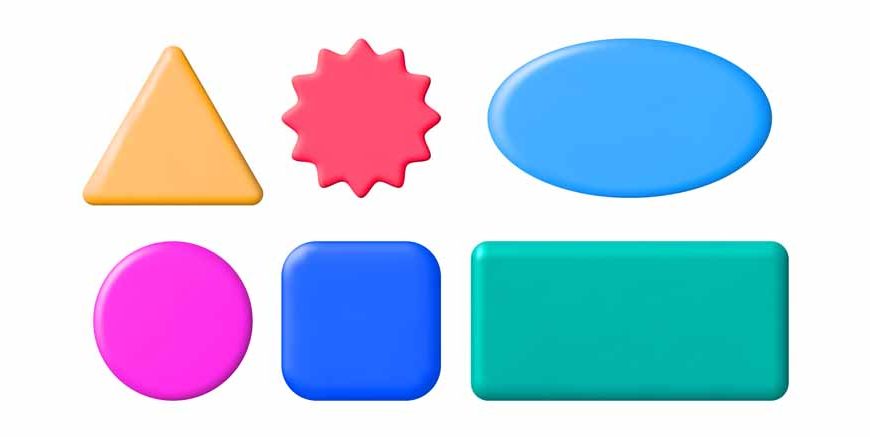
To help your child build a brilliant mathematical vocabulary, it is essential to learn the proper 2D shapes names. Here are the foundational 2D mathematical shapes every young learner should know, using our trusty cardinal numbers to count their features:
- Circle: This shape is perfectly round. It has exactly zero straight sides and zero corners. It is made of one continuous, curving line.
- Triangle: A classic shape that features exactly three straight sides and three corners.
- Square: A very neat shape with exactly four straight sides and four corners. The special rule for a square is that every single side must be the exact same length.
- Rectangle: Similar to a square, it also has four sides and four corners. However, two of its sides are long, and the other two are short.
- Pentagon: A slightly larger shape that features exactly five straight sides and five corners.
To help your child visualise these flat figures and see how counting their sides helps identify them, try experimenting with our interactive shape explorer below!
2D Shapes with Examples
Mathematics becomes much more exciting when we pull it off the chalkboard and into our daily lives. Here are some fantastic examples of 2D shapes that you can spot around your own home:
- Circles: A shiny coin in your pocket, a flying frisbee in the park, or the base of a teacup.
- Triangles: A tasty slice of pizza, a warning sign on the road, or a musical triangle instrument.
- Squares: A sticky note on the fridge, a slice of sandwich bread, or a single square on a chessboard.
- Rectangles: The front cover of your favourite storybook, your front door, or a crisp banknote.
By pointing out these 2D shapes with examples during your daily routine, you help your child realise that maths is absolutely everywhere.
Read More – Geometric Shapes Name for Kids
2D vs 3D Shapes
Once a child understands flat figures, they inevitably bump into the next big question: how are they different from 3D shapes?
As we learned, 2D objects are entirely flat (like a drawing of a ball). However, 3D stands for ‘three-dimensional’. These objects have length, width, and depth (or height). Because they have depth, they take up physical space. You can hold them in your hand.
If you draw a flat square on a piece of paper, it is 2D. But if you hold a wooden building block or a rolling dice, that is a 3D shape (called a cube). A flat circle is 2D, but a bouncy football is 3D (a sphere).
Summary
When we sit down with our children to count the sides of a triangle or point out the rectangular windows on a passing bus, we are doing far more than just teaching basic vocabulary. We are handing them the vital tools they need to categorise and make sense of their entire universe. Geometry is the fundamental language of the physical world.
By mastering these early, flat shapes, children build the sturdy cognitive foundations required for complex problem-solving, advanced mathematics, and even brilliant architectural design later in life. Every grand castle and soaring skyscraper started as a simple, flat 2D drawing on a piece of paper. Encourage your child to keep looking closely at the outlines of the world, because great things always begin with a simple shape.
To discover more educational activities and to spark a lifelong love for learning, step into the EuroKids Blog, and find everything you need to begin your child’s wonderful journey through EuroKids Preschool Admission.
FAQs
Can a shape have more than five sides?
Yes, absolutely! Shapes can have many sides. A hexagon has six sides, an octagon (like a stop sign) has eight sides, and a decagon has ten sides.
Is a star a 2D shape?
Yes, if it is drawn flat on a piece of paper, a star is a brilliant 2D shape! A standard drawing of a star is officially known as a decagram.
Why is it important to learn flat shapes before 3D ones?
Children must understand flat dimensions (length and width) before their brains can process the more complicated idea of depth. Flat shapes act as the simple building blocks for understanding chunky 3D objects.