Children possess a highly hilarious superpower: they can take the simplest string of words and turn them into an absolute, jumbled mess of giggles. If you have ever watched a four-year-old try to aggressively repeat a tricky phrase, you know exactly how entertaining it is to witness their little brain attempting to coordinate their lips, teeth, and tongue. Language development does not always have to be about serious spelling lists or boring flashcards.
Sometimes, it is entirely about making ridiculous sounds, twisting syllables, and laughing until your stomach physically hurts. Today, we are looking closely at a classic piece of childhood nostalgia that perfectly combines clever wordplay with a very silly mental image, helping young children master difficult speech sounds without even realizing they are actively learning.
The Brilliant Mechanics of a fuzzy wuzzy tongue twister
Before we dive into the actual story of the bear, we need to understand why this specific type of rhyme exists in the first place. A fuzzy wuzzy tongue twister is essentially a high-intensity gymnastics routine for a toddler’s mouth. When children are learning to speak clearly, they rely heavily on muscle memory. They have to figure out exactly where to place their tongue and how to shape their lips to push the air out correctly.
This specific rhyme is an absolute masterpiece of phonetic design. It forces a child to rapidly switch between the soft, blowing ‘f’ sound (where the top teeth rest gently on the bottom lip), the rounded ‘w’ sound, and the harsh, buzzing ‘z’ sound. Moving between these specific shapes at high speed trips up the brain, causing the words to crash into each other. When a child practises this repeatedly, they are actively strengthening the delicate muscles in their jaw and face, paving the way for incredibly clear, confident enunciation as they grow older.
Read More – Nursery Rhymes For Kids with Lyrics
Reading the Classic fuzzy wuzzy was a bear poem
The absolute best thing about this specific rhyme is its brilliant brevity. It does not drag on for ten long verses, making it incredibly easy for a young child to memorise entirely on their own after just a few quick repetitions.
Here are the traditional lyrics to the fuzzy wuzzy was a bear poem:
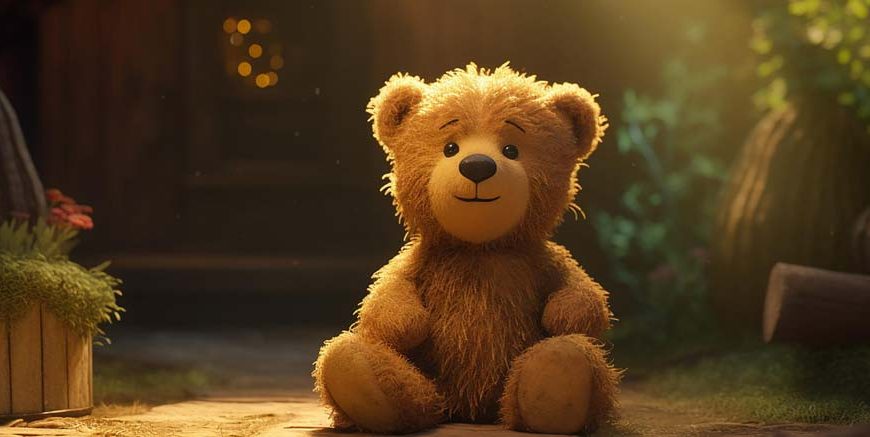
Fuzzy Wuzzy was a bear,
Fuzzy Wuzzy had no hair,
Fuzzy Wuzzy wasn’t very fuzzy, was he?
It is incredibly short, punchy, and demands to be spoken at a rapid pace. The rhythm bounces along naturally, mimicking the heavy, clumsy footsteps of a walking animal, right up until the final punchline completely flips the script.
The Charm of fuzzy wuzzy
Why do young kids absolutely obsess over this tiny, four-line verse? It all comes down to the brilliant use of irony. By the time a child reaches three or four years old, they generally understand the basic concept of wild animals. They know that a bear is a massive, heavy woodland creature completely covered in a thick, warm coat of brown fur.
So, when you introduce a character named fuzzy wuzzy, their brain instantly pictures the absolute fluffiest, softest creature imaginable. The poem then immediately snatches that expectation away by revealing the bear is completely, entirely bald. This sharp contradiction completely breaks the logical rules a child has just started to understand about the natural world. They find this concept absolutely hysterical. They are experiencing the fundamental mechanics of a joke, setting up a strong expectation and then aggressively breaking it, long before they actually know how to write a joke of their own.
Read More – Jack and Jill Nursery Rhyme for Kids
Fun Ways to Practise Speaking Skills at Home
You cannot just read this rhyme once in a flat, boring voice and expect a child to engage with it. You have to bring the chaotic energy of the words to life. Turning pronunciation practice into a loud, messy game removes all the heavy academic pressure.
Here is a highly practical list of ways to turn this classic verse into a brilliant afternoon activity:
- The slow-motion challenge: Start by saying the rhyme as slowly as humanly possible, drawing out every single buzzing ‘z’ sound. This helps the child feel exactly how their teeth and tongue vibrate.
- The mirror game: Stand side-by-side in front of the bathroom mirror. Challenge your child to watch their own mouth closely to see how their lips change shape when they switch from the ‘f’ to the ‘w’ sounds.
- The speed race: Once they have the words memorised, grab a kitchen timer. See who can say the entire poem three times in a row the absolute fastest without completely stumbling over the words.
- Draw the punchline: Hand them a piece of paper and some bright crayons. Ask them to draw exactly what a completely bald, embarrassed bear looks like standing in the middle of a cold forest.
Read More – One Two Three Four Five Nursery Rhyme For Kids
Conclusion
It is a deeply thought-provoking reality that the absolute most effective educational tools are often the ones completely disguised as pure, messy play. We often stress heavily over our children’s developmental milestones, desperately buying expensive phonics books and strict learning apps. Yet, simple, ancient word games passed down through generations remain unmatched in their ability to rapidly wire a growing brain for complex communication. A silly rhyme about a hairless animal teaches a child rhythm, breath control, facial muscle coordination, and the brilliant concept of irony, all within a matter of ten seconds.
Laughter truly is the ultimate, unstoppable vehicle for early learning. When a child is giggling uncontrollably at their own jumbled syllables, they are fearlessly engaging with language. To uncover more joyful strategies to nurture your child’s communication skills and explore our unique environment that heavily champions play-based learning, kindly browse the latest updates on the EuroKids Blog and secure their bright future today through EuroKids Preschool Admission.
FAQs
Why do tongue twisters cause us to completely mix up our words?
The human brain heavily relies on established patterns to speak quickly. When a sentence forces similar but slightly different sounds together incredibly fast, the brain’s processing centre gets confused, sending mixed signals to the mouth muscles and causing a hilarious verbal crash.
At what age can a child successfully learn to recite this specific rhyme?
Most children can easily start attempting the basic sounds and rhythm around three years old, though they will likely not master the rapid, clear pronunciation of the difficult ‘z’ and ‘w’ transitions until they are four or five.
Do these silly word games actually help kids learn how to read later on?
Yes, absolutely! Mastering these tricky rhymes builds massive phonological awareness, which is the crucial ability to hear, identify, and smoothly manipulate the individual sounds inside spoken words, a vital foundation for decoding written text in primary school.