Toddlers are natural, boundless explorers. From the moment they can crawl, they grab, squish, and inspect absolutely everything within their reach. Long before they can confidently count to ten or recite the alphabet, they are busy measuring the physical world with their tiny hands. When a child tries to bite into a massive, chunky sandwich and then nibbles on a delicate little wafer, they are already experiencing early mathematical concepts.
Giving these tangible, physical experiences a proper name is the next exciting step in their cognitive development. Helping them label what they see and feel empowers them to communicate better. Let us dive into how you can introduce these essential measurement concepts to your preschooler in a fun, completely natural way.
Thick and Thin Meaning
What do these measurement words actually mean to a curious three-year-old? The thick and thin meaning relates directly to the distance between opposite sides of an object. Unlike tall and short (which measure height), or heavy and light (which measure weight), these words specifically measure width or depth.
When you hand a child a thick item, it feels substantial, chunky, and wide in their small hands. It takes up a lot of physical space. On the flip side, a thin item feels slender, flat, and takes up very little space. Explaining this verbally can be a bit tricky for a toddler to grasp, which is exactly why physical touch is your absolute best teaching tool.
Read More – Commonly Confused Words in English for Kids
The Difference Between Thick and Thin
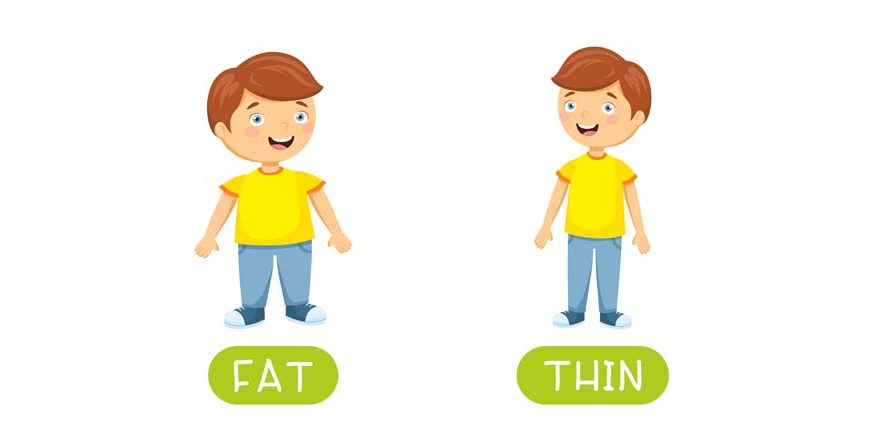
To truly understand the difference between thick and thin, young children require stark contrast. It is all about direct comparison. When looking at thick vs thin, the most effective strategy is to place two very similar items right next to each other.
For example, show them a heavy winter jumper sitting next to a light summer t-shirt. Let them scrunch the heavy, dense wool in their fists, and then have them touch the delicate, breezy cotton. Explain that the winter jumper is thick, while the summer t-shirt is much thinner. Another great visual is drawing. Draw a wide, dark line with a jumbo marker, and then draw a faint line with a sharp pencil. By letting them see and feel the contrast simultaneously, the vocabulary effortlessly locks into their growing brains.
Exploring Thick and Thin Objects at Home
You absolutely do not need to buy expensive educational flashcards to teach this lesson; your house is already overflowing with fantastic thick and thin objects. By turning the house into a tactile scavenger hunt, learning becomes a joyous, messy game rather than a boring classroom lesson.
Here are a few brilliant ways to practise at home:
- The Bookshelf Hunt: Pull out a massive, heavy dictionary and a flimsy, softcover comic book. Ask your child to carry both across the living room and tell you which one feels wider.
- Kitchen Sorting: Food is highly motivating for preschoolers! Cut a chunky, wide slice of bread and a very fine, delicate slice of cheese. Ask your little one to point to the thicker snack.
- The Garden Challenge: Step outside and look at the trees. Point out the massive, sturdy trunk of an old oak tree, and then gently touch the delicate, slender stem of a blooming flower.
Read More – Opposite Words In English For Kids
Through Thick and Thin Meaning
Language is wonderfully playful, and sometimes we use physical measuring words to talk about our deep feelings and relationships! As your child’s vocabulary blossoms, you might cuddle them at bedtime and say, “I will love you through thick and thin.”
But what is the through thick and thin meaning? You can gently explain to your child that ‘thick’ times are the difficult, messy, or hard days when things go wrong, while ‘thin’ times are the easy, breezy, and happy days. It is a beautiful, comforting promise that no matter what happens, good days or bad days, wide smiles or big tears you will always be right there by their side.
Summary
Teaching measurement words is not just about ticking off a preschool maths requirement; it is about giving a child the precise, colourful tools they need to accurately describe their reality. When a child can successfully articulate that their winter blanket is too thick or that a slice of apple is too thin, they are gaining a wonderful sense of independence and a much stronger voice.
Every single new word acts as a tiny, sturdy bridge connecting their inner thoughts to the vast, fascinating world around them. Foster that beautiful curiosity, celebrate those small realisations, and watch their confidence bloom.
To discover more joyful early learning strategies and to start an incredible educational adventure with your child, visit the EuroKids Blog and easily explore all the details you need for EuroKids Preschool Admission today.
FAQs
At what age can children understand these spatial concepts?
Most children begin to grasp basic spatial awareness and measurement comparisons around the age of three, especially if they are taught using hands-on, physical objects.
Why is teaching this specific concept so important?
It builds vital foundational pre-maths skills. Understanding width and depth helps young children learn how to categorise, sort, and compare the objects in their daily environment.
Should I teach ‘tall and short’ at the same time?
It is usually best to teach one measuring concept at a time to avoid confusion. Master width (thick/thin) first, and once they are confident, move on to height (tall/short).