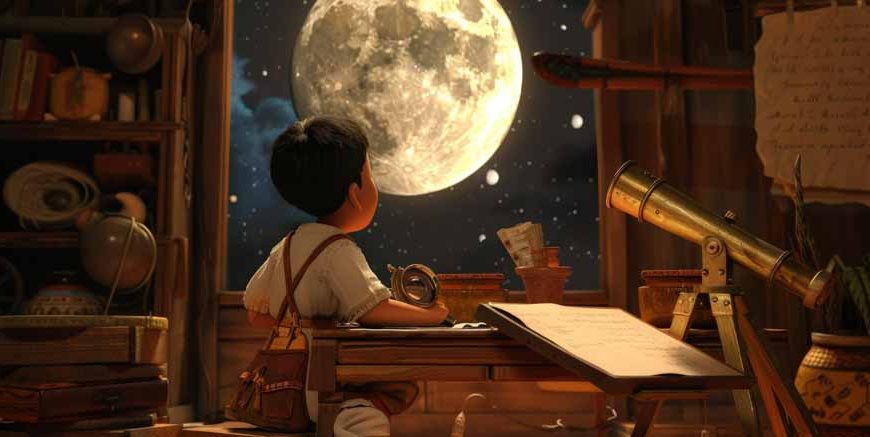
Looking up at the night sky reveals a glowing white circle that chases away the dark. Children love pointing at it before bedtime, tracing its shape through their bedroom windows. Teaching them to write about moon in English helps them understand our amazing solar system while actively practising their daily grammar. Let us look at how to put these brilliant nighttime observations onto paper for different primary classes.
Understanding the Basics: A Simple Moon Definition
Before a student can write an essay on moon, they need to understand exactly what they are looking at. A clear moon definition is that it is Earth’s only natural satellite. This means it is a giant, round rock that constantly travels in a circle around our planet.
The most surprising fact for young children is that it does not make its own light. Instead, it acts like a giant mirror in space, reflecting the bright light of the hidden sun down to our eyes.
Read More – Essay On Wonders of Science for Students
10 Lines on Moon (Perfect for Class 1)
When younger students need a moon sentence for class 1, keeping the facts short and numbered works best. Here are ten easy lines on moon that kids can quickly memorise. Reading these moon lines in english out loud builds their basic vocabulary effectively.
- The moon is a large natural satellite of the Earth.
- It appears high in the sky during the night.
- It looks exactly like a bright, glowing white ball.
- It does not have its own light to shine.
- It only shines because the sun reflects light onto it.
- It changes its shape in the sky every few nights.
- A fully round shape is called a full moon.
- There is absolutely no air or water on it.
- Brave astronauts have travelled there in a fast spaceship.
- I love looking at the bright stars and the night sky.
Short Paragraph on Moon (Perfect for Class 2)
For second graders, we can combine a few lines about moon into a flowing, continuous story. If a teacher asks for a paragraph on moon, here is a great example that uses descriptive words.
The night sky is home to the beautiful moon, which is our closest neighbour in space. It is a giant rock covered in grey dust and deep holes called craters. Because it is so close to Earth, it looks very large and bright to our eyes. Even though it looks peaceful and quiet from our gardens, there is no wind, no sound, and no weather up there at all. Watching it shine softly through the clouds is a wonderful way to end a busy day of school and play.
Long Essay on Moon (Perfect for Class 3)
Older students can write a much longer essay by adding specific scientific facts. A very common question children ask when writing is, what are the phases of the moon?
Our glowing night light does not actually change its physical shape. It is always a giant, solid round ball of rock. However, as it travels around the Earth, the sun lights up different parts of it. These changing lit areas are called phases.
When we cannot see it at all in the sky, it is called a New Moon. A few days later, a tiny sliver appears, which we call a Crescent. When we see exactly half of the glowing circle, it is a Half Moon. Finally, when the entire circle glows brightly in the dark sky, we celebrate the Full Moon. Learning these specific shapes turns a simple writing task into an exciting science lesson.
Besides giving us light at night, it also has a secret invisible power called gravity. This gravity pulls gently on the Earth’s oceans, creating the high and low tides we see at the beach. So, it is not just a pretty sight; it actually helps control our oceans!
Read More – Interesting Facts About the Moon for Preschoolers
Conclusion
To summarise, writing about our closest space neighbour helps children practise their spelling while learning amazing facts about the universe. From simple sentences to detailed paragraphs, the night sky offers endless inspiration for young writers.
Looking up at the sky leaves us with a truly wonderful thought. Even in the middle of complete darkness, there is always a source of light to guide the way. It changes its shape constantly but always returns to its full brightness, showing us that change is a natural and beautiful part of life.
To read more fun and educational articles, check out the EuroKids Blog, and visit our website for details on EuroKids Preschool Admission.
FAQs
Why do we see holes on the surface?
Those deep holes are called craters. They were made millions of years ago when fast flying space rocks crashed into the surface.
How long does the moon take to travel around the Earth?
A sidereal month takes 27.3 days and marks the Moon’s actual 360-degree orbit around Earth. Earth is always moving around the Sun, so the Moon has to travel a bit further to realign with it. This extra travel makes the synodic month, or the full cycle of lunar phases, take 29.5 days.
Can humans live there?
No, humans cannot live there right now because there is absolutely no oxygen to breathe and no liquid water to drink.
Who was the first person to walk on it?
An American astronaut named Neil Armstrong was the very first person to step safely onto the surface in the year 1969.