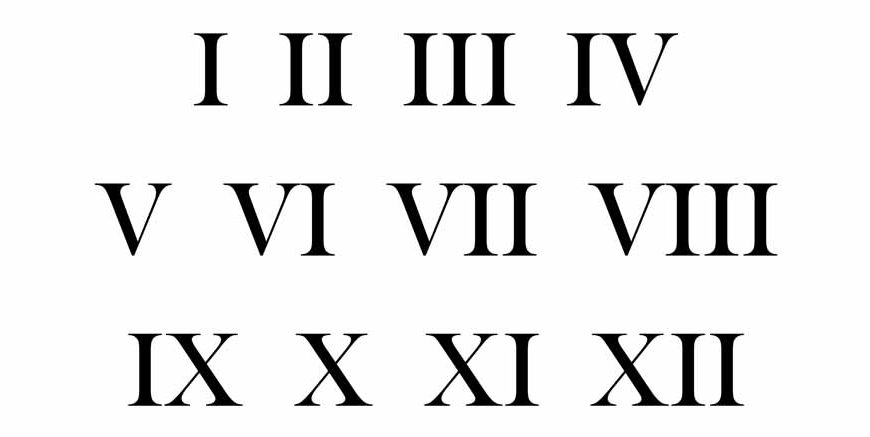
Imagine walking up to a massive, dusty stone wall in an ancient city. Or perhaps, you are just staring up at the giant grandfather clock standing quietly in your grandparents’ living room. You look closely at the dial. Instead of the familiar, loopy digits you practice in your school math workbook, you see strange, sharp letters. An X. A V. An I.
It feels like a secret code. And honestly? It kind of is.
Long before calculators and digital watches were invented, the ancient Romans needed a way to count their sheep, map out their grand buildings, and keep track of the passing days. They didn’t use the curved numbers we rely on today. Instead, they built an entire mathematical language using the straight lines of their alphabet. Today, we are going to crack open one specific piece of that ancient puzzle. Let’s decode the VI roman numeral, figure out exactly how to build it, and understand why these sharp letters still pop up everywhere in our modern world.
The Secret Code: What is the VI Meaning Number?
To a young learner, seeing letters shoved into the middle of a math problem is incredibly confusing. Letters belong in spelling class, right? Not in Rome.
To figure out the VI meaning number, we have to break the code into two distinct pieces. The Roman counting system is basically just a very simple puzzle made of building blocks.
- First, look at the letter V. In this ancient system, the V stands for the number 5.
- Next, look at the letter I. The I stands for the number 1.
But wait. Why a ‘V’? Historians actually believe this comes directly from human hands! If you hold up your hand and open your fingers wide, look at the shape between your thumb and your pointer finger. It makes a perfect ‘V’ shape. Your hand has five fingers. So, ‘V’ became the ultimate symbol for five. It is literally hand-math!
Read More – Teaching Kids About Roman Numerals
The Golden Rule of Addition
Now that we know our basic building blocks, how do we actually write a 6 in roman numerals?
The Romans had a very strict, but very clever, rule for gluing their symbols together. It is all about direction. If you put a smaller number on the right side of a bigger number, it means you have to add them together.
Think of it like walking forward.
You start with your big number: V (which is 5).
You take one step forward, placing a smaller number on the right: I (which is 1).
Now, you just do the basic math. 5 + 1 = 6.
Boom. You have successfully created the VI roman numeral.
This rule is super important because if you accidentally swap the letters and walk backward (putting the I on the left side to make IV), you are telling the reader to subtract. 5 minus 1 equals 4. Just by flipping the letters, you change the entire value. Direction is absolutely everything when it comes to reading ancient stone carvings!.
Spotting the Number 6 in the Wild
You might be thinking, “This is ancient history. Why do I need to know how to write a 6 in roman numerals today?”
Because the Romans left their secret code absolutely everywhere, and we still use it! Once you know what to look for, you will start spotting the number VI all over your neighbourhood.
- The Clock Tower: Look at fancy watches or the giant clocks in the middle of town squares. The number right at the bottom, pointing straight down to the ground, is always VI.
- Kings and Queens: When kings and queens share the same name, they use these symbols to tell them apart. King George VI (the sixth) was a very famous ruler of England.
- Books and Movies: Open a classic storybook. You won’t see “Chapter 6” at the top of the page. You will see “Chapter VI”. The same goes for huge movie franchises like Star Wars!
It makes things look highly official, grand, and important.
Read More – Roman Numerals 1 to 50
Practice Makes Perfect: Building Your Own
Want to get really good at this? Ditch the pencil and paper. Since this system was originally designed for the physical world, the best way to practice writing a VI roman number is to build it with your own hands.
Go outside and grab three straight twigs. Lay two twigs down so they connect at the bottom, creating your ‘V’. Then lay the third twig straight up and down on the right side to create your ‘I’. You just wrote the number six exactly the same way an ancient builder would have planned out a monument. You can do the exact same thing on your living room floor using raw spaghetti noodles, crayons, or building blocks. When you physically build the math, your brain remembers the rule forever.
Conclusion
Decoding ancient numbers is much more than just a tricky math lesson. It is a genuine form of time travel. When you learn to read and write the number VI, you are using the exact same symbols that mighty emperors, skilled stone carvers, and ancient soldiers used thousands of years ago.
It shows us that while human beings have completely changed the way we build houses, drive cars, and communicate, the fundamental logic of numbers never really changes. Math is a permanent, unbreakable bridge connecting our modern, fast-paced world straight back to the dusty, grand streets of the past. To read more fun and educational articles, check out the EuroKids Blog, and visit our website for details on EuroKids Preschool Admission.
FAQs
– What exactly does VI mean in numbers?
The symbol VI stands for the number 6. It combines the Roman symbol for five (V) and the symbol for one (I).
Why do we put the ‘I’ after the ‘V’?
In the Roman counting system, placing a smaller value (I) on the right side of a larger value (V) means you add them together. 5 + 1 = 6.
Is IV the same thing as VI?
No! Position changes everything. IV means 4 (because placing the smaller number on the left means subtraction: 5 – 1). VI means 6.
Where do we still use these ancient numbers today?
You will easily spot them on analog clock faces, the titles of monarchs and popes (like King Charles III or George VI), book chapters, and movie sequels.