Staring up at the giant clock face on a historical town hall building can leave a kid scratching their head. Instead of the familiar, round digits they see on a digital tablet or a television screen, there are strange, sharp letters carved deep into the stone. History is packed with these ancient codes, and teaching children to read them is essentially like handing them the keys to a time machine.
When it comes to understanding 14 in roman numerals, things get a little bit tricky for early learners. It is not just a simple case of counting fingers; it is about mastering a clever ancient system of adding and subtracting letters. Let us pull apart this old puzzle and see exactly what makes the 14 roman number tick without causing a headache.
The Basic Letters You Need to Know
You cannot decode a secret message without knowing the alphabet first. The ancient Romans did not use the standard numerical digits we write with today. Instead, they just borrowed letters directly from their own alphabet to count everything from soldiers in an army to loaves of bread at the local market.
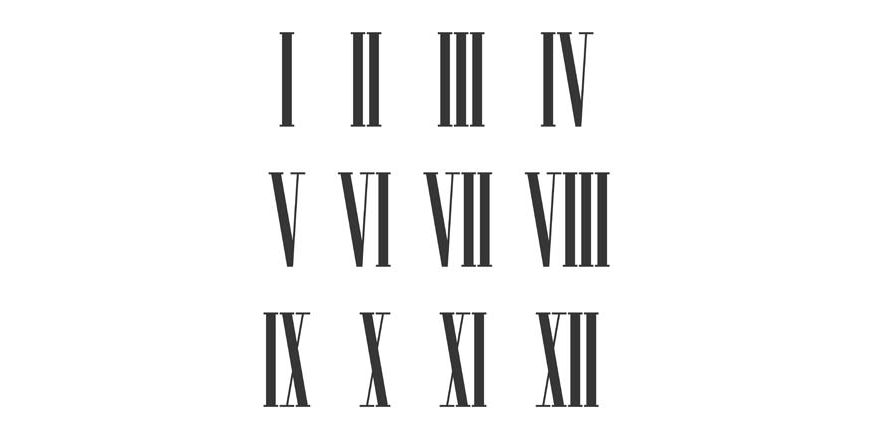
To figure out how to write 14 in roman numerals, your child only needs to get familiar with three specific letters: X, V, and I. Think of the letter ‘X’ as a strong, heavy block representing the number 10. The letter ‘V’ stands firmly for 5. Finally, the simple, straight line of an ‘I’ equals exactly 1. Once a child understands the mathematical weight of these three basic symbols, the rest of the code becomes incredibly easy to crack.
Read More – Roman Numerals 1 to 20 Chart for Kids
The Sneaky Subtraction Rule
Here is where the ancient Romans decided to throw a slight curveball into the mix. You might naturally assume that to make the number four, you would just line up four straight sticks on a page like this: IIII. While you might occasionally spot that specific layout on a very old grandfather clock, the official mathematical rule book handles things slightly differently to save space on those heavy stone carvings.
When a smaller letter is placed directly in front of a bigger letter, it means you have to subtract it. So, if you put an ‘I’ (which is 1) directly in front of a ‘V’ (which is 5), you are essentially telling the reader “one less than five.” This clever little trick gives us IV, which is their official way of writing the number four.
Putting the Pieces Together
Now that we understand the building blocks and that sneaky subtraction trick, assembling the final code is wonderfully straightforward. We do not have to guess; we just stack the pieces together logically.
We take our solid block of 10 (which is X) and attach our newly built number 4 (which is IV) right next to it. When you sit them side by side, you get XIV. That is the exact, foolproof formula for writing the number fourteen. Breaking the code down into tens and units makes it vastly easier for a primary school student to digest, rather than just expecting them to stare at a whiteboard and memorise a random string of letters.
The Code in the Real World
Kids usually wonder why they even need to learn this ancient math if we have perfectly good numbers to use today. You just have to show them where the Romans left their lasting mark on our modern world.
If they pick up a thick, fancy storybook, the chapters at the very front are often labelled with these exact symbols. Reaching Chapter XIV promises a massive reading adventure! You also see these letters attached to the names of famous kings and queens in history lessons, or even marking the grand release dates at the end of huge blockbuster films. Bringing dry classroom concepts into the physical world reflects the core approach of the Heureka curriculum, which turns rote memorisation into an active, daily discovery.
Read More – Teaching Kids About Roman Numerals
Conclusion
Decoding ancient numbering systems is about so much more than just ticking off a maths requirement before the school bell rings. It connects a child’s modern mind directly to the builders, thinkers, and vast empires of the ancient world. By breaking down the simple rules of addition and mastering that sneaky subtraction trick, a confusing cluster of letters suddenly turns into a totally readable, logical sequence.
It proves that with the right tools, no puzzle is too complicated for a young learner to crack open. Are we making sure our kids realise that history and maths are actually part of the exact same incredible story, or are we just teaching them to pass a test?
Encouraging them to question the world around them builds a fiercely independent mind. To discover more ways to turn everyday curiosity into a lifelong love of learning, read the latest articles on the EuroKids Blog and find out how to secure their educational foundation through EuroKids Preschool Admission.
FAQs
Why is it written as XIV and not XIIII?
The Romans used the subtraction method (IV) because it was much quicker to carve three letters into heavy stone than it was to carefully carve out five individual strokes.
Does the letter order actually matter?
Yes, it matters entirely! If you accidentally swap the order and write XVI, you are adding the one to the five, which completely changes the final amount to sixteen.
Can you write a zero using this ancient system?
No, the ancient Romans did not actually have a designated symbol or letter for the number zero in their standard numbering system.