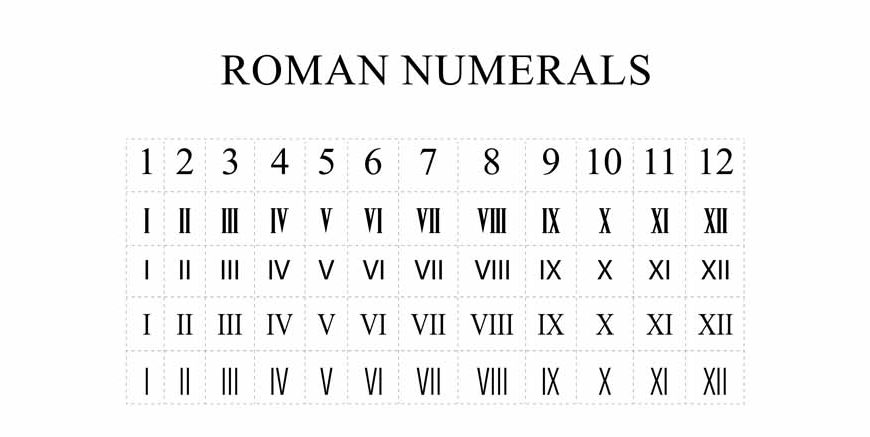
Numbers can be written in different ways. Today, we commonly use digits like 1, 2, 3, and 4, but long ago, people used a different system called Roman numerals. Roman numerals are still seen today on clocks, in book chapters, movie titles, and special events. Learning Roman numerals 1 to 20 is a great way for children to explore number history while strengthening their number recognition skills. In this guide, we will understand what Roman numerals are, how they work, the Roman numbers 1 to 20 chart, simple rules, examples, memory tricks, and fun practice ideas.
What Are Roman Numerals?
Roman numerals are a number system that started in ancient Rome. Instead of digits, this system uses letters from the Latin alphabet to represent numbers. The basic Roman numeral symbols are:
- I = 1
- V = 5
- X = 10
- L = 50
- C = 100
- D = 500
- M = 1000
For Roman numerals 1 to 20, we mainly use I, V, and X. Children enjoy Roman numerals because they look like codes made from letters.
Read More – Roman Numbers 1 to 100 for Kids
Why Should Kids Learn Roman Numerals?
Learning Roman numerals helps children:
- Understand number history
- Improve number recognition
- Develop pattern skills
- Read clock faces with Roman numbers
- Recognise chapter numbers in books
- Identify the event years written in Roman style
It also builds curiosity and makes math more interesting.
Basic Rules of Roman Numerals
Before learning the Roman numerals 1 to 20 chart, children should know a few simple rules.
1. Rule 1 — Addition Rule
When a smaller or equal numeral follows a larger one, you add them.
Example: VI = 5 + 1 = 6
2. Rule 2 — Repetition Rule
A numeral can be repeated up to three times.
Example: III = 3, XXX = 30
3. Rule 3 — Subtraction Rule
When a smaller numeral comes before a larger one, subtract it.
Example: IV = 5 − 1 = 4, IX = 10 − 1 = 9
These three rules help form all Roman numerals from 1 to 20.
Roman Numerals 1 to 20 Chart
1 — I
2 — II
3 — III
4 — IV
5 — V
6 — VI
7 — VII
8 — VIII
9 — IX
10 — X
11 — XI
12 — XII
13 — XIII
14 — XIV
15 — XV
16 — XVI
17 — XVII
18 — XVIII
19 — XIX
20 — XX
Read More – XXV in Roman Numerals
How Roman Numerals 1 to 20 Are Formed
Let’s understand how some key numbers are formed.
1. Numbers 1 to 3
Just repeat I:
I, II, III
2. Number 4
Use the subtraction rule:
IV = 5 − 1
3. Numbers 6 to 8
Add I after V:
VI = 6
VII = 7
VIII = 8
4. Number 9
IX = 10 − 1
5. Numbers 11 to 13
Add I after X:
XI, XII, XIII
6. Number 14
XIV = 10 + (5 − 1)
7. Number 19
XIX = 10 + (10 − 1)
Roman Numerals in Daily Life
Children often see Roman numerals in:
- Wall clocks
- Book chapters
- Movie sequels
- Sports events
- Building cornerstones
- Monarch names (like kings and queens)
Examples:
Clock shows: IV = 4
Chapter XII = Chapter 12
Event Year MMXX = 2020
Recognising Roman numbers helps children read these correctly.
Roman Numerals Practice Examples
Let’s convert some numbers.
1. Convert to Roman Numerals
7 = VII
12 = XII
15 = XV
18 = XVIII
20 = XX
2. Convert to Numbers
IX = 9
XIV = 14
XVI = 16
XIX = 19
Practice both directions for better learning.
Common Mistakes Children Make
Students often:
- Write IIII instead of IV
- Write VIV instead of IX
- Repeat symbols more than three times
- Forget the subtraction rule
Fun Activities to Learn Roman Numerals
Try these classroom or home activities:
- Roman numeral flashcards
- Roman clock reading
- Matching number games
- Chart coloring activity
- Roman numeral bingo
- Number conversion race
- Roman numeral puzzles
Learning through play improves memory.
Read More – Teaching Kids About Roman Numerals
How EuroKids Helps Children Learn Roman Numerals Clearly
Early number systems, like Roman numerals, are introduced through visual charts, matching games, and number storytelling activities. Children learn Roman numerals using clocks, flashcards, and pattern-building exercises so they understand how symbols form numbers. Teachers connect Roman numbers to everyday objects like clocks and book chapters, making the learning meaningful and memorable. Instead of memorising blindly, children explore number patterns and symbol rules through guided play and visual learning tools.
Conclusion
Roman numerals are an interesting and historical way to represent numbers using letters instead of digits. Learning Roman numerals 1 to 20 helps children recognise patterns, understand number systems, and connect math with history and daily life. With simple rules like addition and subtraction patterns, children can quickly learn to read and write Roman numbers. Using charts, memory tricks, games, and regular practice makes Roman numerals easy and enjoyable. When taught through interactive methods and discovery-based learning, children develop both understanding and curiosity.
To explore more learning ideas, simple explanations, and early childhood resources, parents can visit the EuroKids Blog. Those who wish to understand the preschool journey better or explore enrolment options can find complete information on the EuroKids Preschool Admission Page, where learning is designed to be joyful, engaging, and child-friendly.
FAQs:
1. What are Roman numerals?
Roman numerals are a number system that uses letters like I, V, and X to represent numbers.
2. What are the main symbols used in Roman numerals 1 to 20?
I, V, and X are mainly used.
3. How do you write 4 in Roman numerals?
4 is written as IV.
4. How do you write 9 in Roman numerals?
9 is written as IX.
5. What is the Roman numeral for 20?
20 is written as XX.
6. Why should kids learn Roman numerals?
They help children understand number history, patterns, and real-life number uses like clocks and book chapters.
You May Also Read:
- Roman Numerals Chart Rules Symbols
- What is Xvi in Roman Numerals
- 90 in Roman Numerals
- 250 in Roman Numerals
- Mmiv Roman Numerals
- Roman Numerals 1 to 200
- How to Write 99 in Roman Numerals