Look down at your own hands, touch your favorite wooden toy, or take a big gulp of cold water. Even though a hand, a wooden block, and a glass of water look and feel completely different, they all share one massive secret. They are all built from the exact same fundamental “stuff.” In the scientific world, we do not just call it stuff; we use a very specific vocabulary word to describe everything physically present in our universe. Let us dive into the fascinating microscopic world to explore the building blocks of reality.
Read More – Facts About Molecules
Understanding the Basics: What is Matter?
If a curious student asks you what is matter, how would you give them a clear answer? To truly understand what is the meaning of matter in science, you only need to remember two simple rules. It is absolutely anything that has weight (which scientists call mass) and takes up space (which scientists call volume).
So, what is matter in science really? It is the heavy textbook on your school desk, the invisible air inflating your birthday balloon, and even the hair on your head! When older students study the matter meaning in physics, they dive deeper to learn exactly what constitutes matter. They discover that every single object is made up of millions of tiny, invisible puzzle pieces called atoms and molecules. How these tiny particles pack together determines how an object looks and feels.
Exploring the World: What Are the Kinds of Matter?
Knowing the definition is great, but what are the kinds of matter we interact with every single day? Scientists group this universal “stuff” into different categories based on how those tiny microscopic particles behave and move around. Let us look closely at the main types of matter, which are frequently referred to as the different types of states of matter:
1. The Solid State
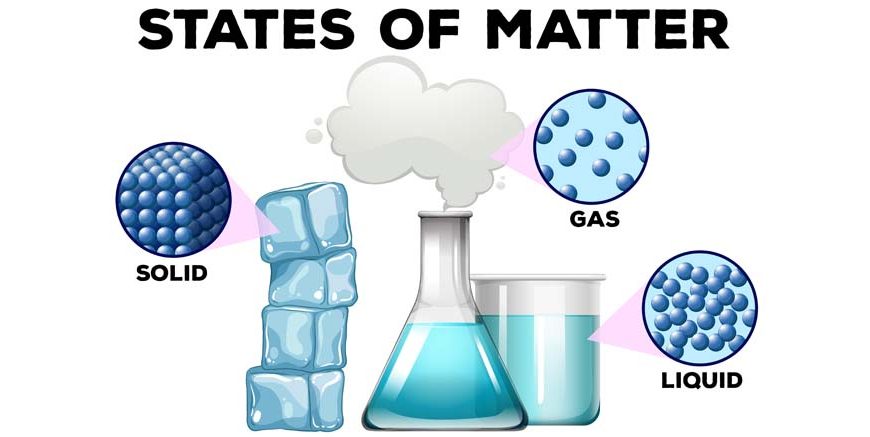
A solid state of matter definition is very straightforward: it has a fixed, permanent shape and a specific size that does not change on its own. The tiny particles inside are holding hands very tightly and do not move around freely. A perfect matter definition and example for this category is a frozen ice cube, a brick, or a wooden pencil. It will not change its rigid shape unless you apply force, like breaking it with a hammer or melting it with extreme heat.
2. The Liquid State
Liquids also take up a specific amount of space (volume), but they absolutely do not have a fixed shape. Instead, they flow, drip, and perfectly take the shape of whatever container you pour them into. Water, cold milk, and sticky honey are all common liquids. The tiny particles in a liquid are still close friends, but their grip is loose, allowing them to smoothly slide past one another.
3. The Gaseous State
Gases are the wild rebels of the science world. They do not have a fixed shape, and they do not have a fixed size. They naturally spread out completely to fill any container or room they are placed inside. The oxygen we breathe into our lungs is a gas. The particles in a gas have enormous amounts of energy, bouncing all over the place and staying far apart from each other!
Read More – How do you make science interesting for kids
Beyond the Basics: The Five Types of Matter
While we usually only talk about solids, liquids, and gases in primary school, the universe is vast and highly complex. Did you know there are actually five types of matter recognized by advanced physicists?
Beyond the familiar three, there is a fourth state called Plasma. Plasma is super-hot, highly energized gas found inside bright lightning bolts, glowing neon signs, and the fiery center of our Sun. Finally, there is a very bizarre fifth state known as a Bose-Einstein Condensate. This state does not exist naturally on Earth; it can only be created by scientists in special laboratories by freezing particles to the absolute coldest temperatures possible!
Conclusion
To sum up our scientific journey, the entire universe is essentially a giant, interactive puzzle built from different states of vibrating particles. Whether it is the hard solid ground we run on, the flowing liquid oceans we swim in, or the invisible gaseous air we breathe, absolutely everything is wonderfully connected by these fundamental physics rules.
Learning about this topic leaves us with a truly mind-blowing, thought-provoking realization. The exact same tiny, ancient atoms that make up the distant, glowing stars in the night sky are the very same types of atoms that make up your own beating heart. You are not just living in the universe; you are literally built from the exact same amazing star-stuff as the universe itself!
To read more fun and educational articles, check out the EuroKids Blog, and visit our website for details on EuroKids Admission.
FAQs
Can matter change from one type to another?
Yes, absolutely! By adding or removing heat, you can change states. For example, heating solid ice melts it into liquid water, and boiling that liquid turns it into an invisible gas called steam.
Is light considered a type of matter?
No, light is not considered matter. Light does not have any mass or weight, and it does not take up physical space. It is actually a form of pure energy!
Are abstract things like feelings made of matter?
Things like sadness, happiness, memories, and thoughts do not have mass or volume, so they are not physical matter, even though they happen inside our physical brains.
What is the most common state of matter in the entire universe?
While we see mostly solids and liquids on Earth, the most common state in the entire universe is actually plasma, because all the giant, burning stars are made entirely of it!