Smash a piece of everyday classroom chalk with a heavy hammer, and you are left with a pile of fine white dust. If you had microscopic tools and limitless patience to grind that dust down even further, past the point where a standard magnifying glass or a school microscope could even spot it, you would eventually hit a physical wall. You would reach the absolute tiniest, unbreakable piece of that chalk. This tiny, invisible speck is where we find our atom simple definition: it is the smallest possible, indestructible unit of ordinary matter that forms every single chemical element in the universe.
Every drop of rain splashing on a grey pavement, every blade of grass in the back garden, and the very air filling our lungs is built from these microscopic blocks. Giving growing kids a proper introduction of atomic structure is basically handing them the hidden instruction manual for the entire physical world. It completely demystifies how natural things are built, why hot fires burn, and why tough metals bend.
Thousands of years ago, ancient Greek thinkers suspected that if you cut something in half enough times, you would find an “uncuttable” piece, but they could not prove it. Today, we know for a fact that these busy little spheres are real. So, let us strip away the complicated university jargon and break down exactly what is going on inside these invisible, bustling little worlds.
The Heavy Core: Exploring the atom nucleus structure
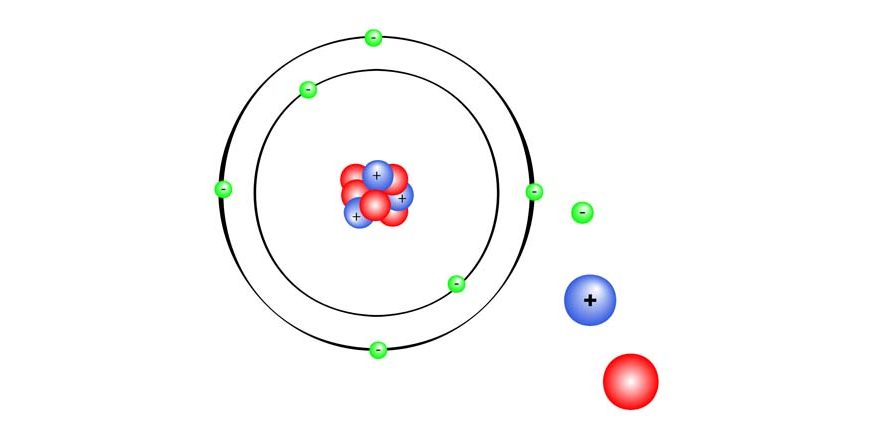
To successfully explain the structure of an atom to a curious young learner, the absolute best place to start is right dead in the middle. At the very centre of this tiny unit sits a remarkably heavy, dense core. We call this central hub the nucleus.
The atom nucleus structure is not just one solid, boring lump of matter. It is actually a tightly packed, vibrating cluster of even smaller particles, clinging together as if they have been glued by a phenomenally strong cosmic force. Inside this busy core, you will always find two very specific types of residents:
- Protons: These heavy particles carry a positive electrical charge. You can think of them as the loud, energetic pieces that actually decide what the element is going to be. They act as the ultimate identity card. If you manage to change the number of protons sitting in the middle, you completely change the material from one element into another.
- Neutrons: As their name cleverly suggests, these particles have absolutely no electrical charge at all. They are entirely neutral. They sit closely alongside the protons, acting a bit like a buffer or heavy packing material. Because positive protons naturally want to push away from each other, the quiet neutrons step in to stop the core from violently repelling itself and blowing completely apart.
Read More – Fascinating Science Facts for Kids
The Outer Limits: Electrons in Fast Motion
If you want to accurately describe the structure of an atom, you cannot just stop at the heavy, packed centre. You have to look at the chaotic, fast-moving traffic zooming around the outside edges.
Orbiting the heavy nucleus at completely dizzying speeds are incredibly tiny, lightweight particles called electrons. These carry a sharp, negative electrical charge. Because negative and positive charges naturally pull towards each other (just like the opposite ends of a strong fridge magnet snapping together), the negative electrons are constantly locked into a fast dance around the positive protons in the middle.
However, they do not just fly around randomly like angry wasps. They travel on strict, invisible racetracks known as electron shells. Modern science tells us these shells look less like flat rings and more like blurry, three-dimensional clouds where the electrons are most likely hiding. The basic structure of an atom relies entirely on this delicate, perfect balancing act between the heavy, pulling centre and the light, zooming outer rings keeping everything perfectly stable.
Real-World atom examples
It is much easier to picture this invisible science when we attach it to things we can actually touch, see, and breathe. Here are a few straightforward atom examples showing how adding just one or two extra particles creates a wildly different substance:
- Hydrogen: This is the absolute simplest, lightest element in existence. It has just one solitary proton in its centre and one lonely electron whizzing around the outside. It requires no neutrons at all. It is the highly flammable, primary gas that fuels the burning stars in the night sky.
- Carbon: Move slightly up the scale, and you find a core built with six protons and six neutrons, surrounded by six electrons. This specific arrangement is the fundamental, magical building block of all known life on Earth. It forms the dark graphite in your drawing pencils and the tough, sparkling diamonds in luxury jewellery rings.
- Oxygen: Add a couple more particles to get eight protons, eight neutrons, and eight electrons. Suddenly, you have the exact invisible gas that our human lungs desperately need to absorb to keep us alive every single second of the day.
- Gold: Jump much further down the periodic table to number 79, and you find a massive, crowded core containing 79 protons and 118 neutrons, with 79 electrons buzzing around it. This heavy, complicated traffic jam creates the shiny, valuable yellow metal humans have traded for centuries.
Read More – How do you make science interesting for kids?
Mind-Blowing atomic structure facts
The deeper you dive into this topic, the weirder the physics actually gets. Here is a quick list of atomic structure facts that completely flip our normal understanding of reality upside down:
- An illusion of solid ground: If you were to magically enlarge a single hydrogen atom so its central nucleus was the size of a standard football sitting on the centre spot of a massive football stadium, its electron would be a tiny fly buzzing all the way out by the highest back row of the spectator seats. Everything in between is just dead, empty space. This means that the solid wooden chair you are sitting on right now is almost entirely made of absolutely nothing!
- Ultimate speed demons: Those tiny negative electrons do not casually stroll around their tracks. They travel at roughly 2,200 kilometres per second. That is fast enough to travel completely around the Earth in just over 18 seconds.
- Ancient stardust: The specific pieces making up your physical body were not newly created when you were born. Many of them were forged under immense pressure inside the boiling cores of dying stars billions of years ago before scattering across the galaxy.
Read More – Facts About Molecules for Kids
Conclusion
Realising that the chaotic, bustling, seemingly solid world around us is constructed from completely invisible, mostly empty spheres of dancing energy changes the way we view absolutely everything. It is genuinely thought-provoking to look at a heavy brick wall or a soft cotton jumper and know that, deep down, they are both just different mathematical arrangements of protons, neutrons, and electrons.
The universe builds its infinite variety using just a handful of these microscopic LEGO bricks, snapping them together in different, clever patterns to create roaring oceans, green forests, and human beings. By pulling back the curtain on this microscopic world, we give children the ultimate key to understanding how our physical reality actually operates from the ground up. To discover more brilliant science guides and uncover fresh ideas to support your child’s daily learning journey, be sure to read the latest updates on the EuroKids Blog and secure their bright educational future today via EuroKids Preschool Admission.
FAQs
Can we see an atom with a normal school microscope?
No, they are far too incredibly tiny for standard glass light microscopes. Scientists have to use massive, highly specialised machines called scanning tunnelling electron microscopes just to see their faint, blurry, bumpy outlines.
Do electrons ever crash directly into the nucleus?
Despite being strongly pulled towards the positive centre by powerful magnetic forces, the sheer, incredible speed at which they travel keeps them locked safely in their designated outer orbits, entirely preventing any catastrophic crashes.
Are absolutely all elements made of the exact same three particles?
Yes! Whether it is a heavy block of shiny iron or a floating cloud of invisible helium gas, they are all built from the exact same protons, neutrons, and electrons. The only difference is the total number of pieces used in the specific recipe.