Look closely at a toddler playing on the living room rug. Long before they can read letters or write their own name, they are busy sorting wooden blocks, trying to force a square peg into a round hole. This natural, brilliant instinct to categorise the physical world is the very beginning of geometry.
Everything around us, from the wheels on a bus to the slices of toast on a breakfast plate, is built upon a foundation of lines and curves. Let us break down this geometric language and explore how to teach children to recognise the mathematical outlines hiding in their everyday environment.
Understanding the concepts of shapes
Grasping the concepts of shapes is about much more than just memorising a list of vocabulary words. It is about understanding the boundaries and the limits of an object. A shape is simply the external form, or the continuous outline, of something in our world.
When we teach a young child this concept, we are essentially giving them a pair of magical glasses that allows them to see the hidden, structural framework of their environment. They learn that a straight line feels entirely different from a swooping, curved one, and that sharp corners point in entirely different directions.
This foundational knowledge is absolutely crucial for later developmental skills, such as forming letters with a pencil and understanding more complex mathematics in the primary school classroom.
Read More – Fun Ways to Teach Shapes to Kids
The Foundation of basic shapes
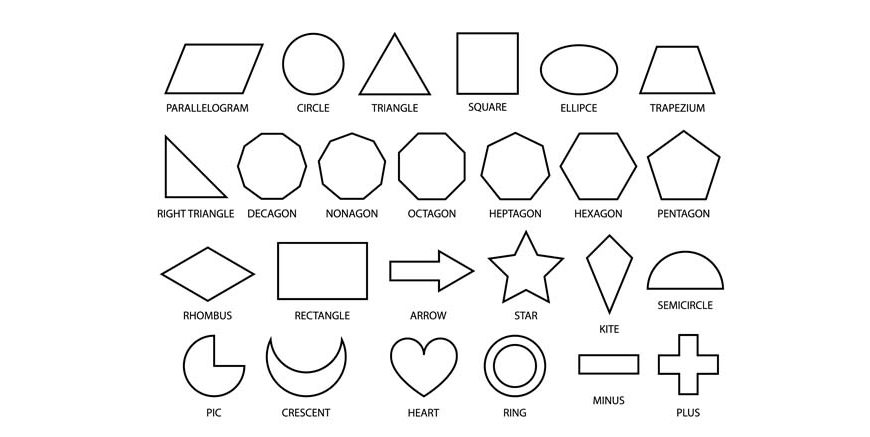
When we talk about basic shapes, we usually start with the simplest flat outlines, also known as two-dimensional (2D) figures. These are the outlines that can be easily drawn flat on a piece of paper. The most universally recognised is the circle. A circle is perfectly round, made of one continuous curved line with absolutely no sharp corners or straight edges. If you want to show a child a real-life example, simply point to the round face of a wall clock, a shiny silver coin in your purse, or a delicious pizza before it gets sliced into pieces.
Then we have the highly sturdy square. A square is very reliable, featuring four straight sides that are exactly the same length, and four sharp, equal corners. You can easily spot squares in the classic black and white chessboard, a standard slice of sandwich bread, or a colourful sticky note resting on an office desk.
Discovering triangle shaped objects names
A triangle is a fascinating figure for children because it feels a bit more dynamic and pointy than the others. It has exactly three straight sides and three corners. Because of its typically wide base and narrow top, it is structurally incredibly strong, which is why architects love using it to build tall bridges.
When teaching children about this three-sided wonder, providing a list of triangle shaped objects names makes the learning process highly interactive and fun. Ask them to look out for a cheesy slice of pizza, a colourful warning sign on the side of a busy road, the folded white sail of a small toy boat, or a crunchy nacho crisp waiting to be dipped in salsa. Even the plastic hanger inside their wardrobe forms a perfect, everyday triangle designed to hold their school uniform securely!
Read More – Best Shape Activities For Kids
Identifying rectangle shape items Around the House
The rectangle is closely related to the square, but it features a clever little twist. It also has four straight sides and four sharp corners, but only the opposite sides are the exact same length. It looks exactly like a square that has been stretched out on two ends.
Because of this stretched, highly practical design, the world is absolutely filled with rectangle shape items. Just look around your house right now. The wooden front door you walk through, the television screen you watch in the evening, the soft mattress you sleep on, and the very mobile phone you might be holding right now are all perfect rectangles. They are the ultimate, most efficient shape for building straight walls and packing things neatly into cardboard delivery boxes.
Gathering Essential shapes information
Equipping your child with this fundamental shapes information does wonders for their overall cognitive development. It drastically improves their daily observational skills. Instead of just seeing a ‘house’, they begin to see a large square with a triangular roof and smaller rectangular windows.
This vital ability to break down a large, complex picture into smaller, understandable pieces is the exact same mental skill required to solve difficult puzzles, read long words, and tackle tricky maths equations later in their academic journey. It teaches them to analyse the world rather than just looking at it.
Read More – The Importance of Math in Everyday Life
Summary
The physical world is essentially one giant, beautiful patchwork quilt of geometry. By teaching children how to identify the simple outlines of their favourite toys, snacks, and furniture, we are handing them the ultimate decoder ring for the environment around them. It transforms a boring, routine walk down the high street into an exciting, interactive treasure hunt.
It certainly makes you pause and reflect: if the entire universe is built upon such simple, elegant lines and curves, what other brilliant, fundamental patterns is your child ready to discover next? To uncover more engaging ways to support your child’s educational journey and nurture their bright future, take a moment to explore the EuroKids Blog and find out all the necessary details regarding EuroKids Preschool Admission today.
FAQs
How early can a child start learning to recognise these outlines?
Most toddlers can begin to distinguish between basic outlines like circles and squares around the age of two, especially if they regularly play with chunky wooden sorting toys.
Why is learning the names of these outlines so important?
It builds their descriptive vocabulary, allowing them to communicate clearly, and lays a vital cognitive foundation for early reading, writing, and mathematical logic.
What is the best way to teach these concepts at home?
Keep it highly interactive and physical. Ask your child to find three round objects in the kitchen, or challenge them to count how many rectangular doors are in your house.