Alphabet games are an absolute staple in early childhood learning. Families happily breeze through the beginning of the alphabet during long car journeys, A is for Alligator, B is for Bear, C is for Cat. The game moves quickly and confidently. But as the game progresses towards the very tail end of the alphabet, the choices suddenly become surprisingly narrow. When a child reaches the twenty-fifth letter, a long, confused pause usually follows.
It is a genuine head-scratcher for both parents and young students alike. Moving past the common zoo favourites requires us to look a little harder at the natural world. Today, we are exploring this tricky alphabetical corner to uncover some of the most unique, unusual, and brilliant wildlife on the planet, giving your children a secret advantage in their next vocabulary game.
The Challenge of Finding an animal with Y
Let us be entirely honest: the English language does not offer a massive, endless catalogue for this specific letter. If you ask a biologist to point out an animal with Y, they have to skip past the lions, tigers, and elephants to look at highly specific, often incredibly rare creatures.
The beauty of this challenge is that it introduces growing children to parts of the globe they might never have explored otherwise. Because these creatures are not the standard, everyday animals painted on nursery walls, learning about them feels like uncovering a hidden biological secret. It forces young learners to travel mentally from the freezing, snowy peaks of the Himalayas all the way down to the deep, dark ocean floor just to tick a letter off their alphabet list.
Read More – Domestic Animal Names in English for Kids
A Fascinating List of animals that start with Y
To make learning highly engaging and memorable, it helps to break down the options into a clear, descriptive list. When your child needs to quickly name animals that start with Y, here are the absolute best, most interesting creatures they can proudly share with their classmates:
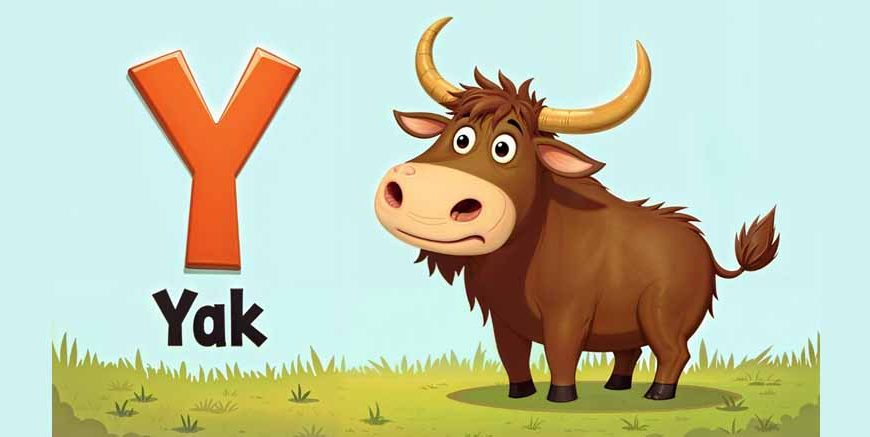
- Yak: A massive, heavily built wild ox covered in incredibly thick, shaggy hair, perfectly designed to survive the freezing winds of the high Asian mountains.
- Yorkshire Terrier: A tiny, highly energetic domestic dog breed famous for its long, silky coat and a massive, brave personality that completely ignores its small size.
- Yellow-Eyed Penguin: A remarkably rare, brightly coloured marine bird found waddling along the cold, rugged coastlines of New Zealand.
- Yeti Crab: A bizarre, fascinating deep-sea crustacean completely covered in thick, pale yellow bristles that make its claws look exactly like furry winter mittens.
- Yellowfin Tuna: A torpedo-shaped, incredibly fast-swimming ocean fish known for its bright yellow side fins and massive migratory journeys across the globe.
Deep Dive into an animal name starting with Y
If we had to pick one absolute superstar from that list to study in detail, the wild Yak easily takes the top prize. When teaching a child an animal name starting with Y, describing this giant mountain dweller is guaranteed to capture their imagination.
Think of a standard farm cow, but make it twice as tough and cover it in a heavy, sweeping winter blanket of dark hair that almost touches the ground. These incredible herbivores live high up in the mountains of Tibet, where the air is incredibly thin and the temperatures frequently drop well below freezing. To survive, their bodies are built like natural furnaces.
They have an extra-large heart and massive lungs to pull oxygen from the thin mountain air. Unlike normal cows that “moo” loudly across a field, these gentle giants actually communicate with each other using soft, rumbling grunts, which is why scientists occasionally refer to them as the “grunting ox”.
Read More – Animal Names Starting With H for Kids
Answering what animal starts with Y with Relatable Examples
While the wild mountain ox is fascinating, it is also highly beneficial to teach children about creatures that feel a bit closer to home. When a curious child asks what animal starts with Y, introducing them to the Yorkshire Terrier is a brilliant, relatable choice.
Most children have seen one of these tiny, feisty dogs trotting happily through a local park. Originally bred in the north of England to chase pesky mice out of noisy clothing mills, these little dogs are incredibly fast, fiercely loyal, and brilliant companions. It shows children that wildlife does not always have to live on a snowy mountain or in a deep jungle; sometimes, the correct alphabetical answer is sitting right on the living room sofa.
Another highly visual example is the Yellow-Eyed Penguin. Children absolutely adore penguins, but they usually only picture the standard black-and-white birds slipping on ice. This specific species is entirely unique because it features a striking, bright band of pale yellow feathers wrapping completely around its head and eyes. Teaching kids about this rare bird helps them understand that nature loves to break its own rules by adding unexpected splashes of bright colour to standard animal templates.
Using Y for animal name Activities
Memorising these unique creatures is a brilliant way to heavily boost a child’s working vocabulary. The next time the family plays a classic word game on a rainy Sunday afternoon, your child will no longer freeze when it is their turn. Using Y for animal name categories teaches them how to categorise data, remember complex biological facts, and proudly share highly unusual trivia with their peers. It builds massive academic confidence when a young student knows a brilliant, rare fact that even some adults might struggle to recall on the spot.
Read More – List of Animal Names That Start With
Conclusion
It is genuinely thought-provoking to realise that a simple alphabet game can act as a direct doorway to exploring the farthest, wildest corners of our planet. By looking past the obvious choices, we uncover hairy deep-sea crabs, grunting mountain oxen, and bright-eyed penguins. This proves that the natural world is infinitely diverse, constantly surprising, and brilliantly weird in the best possible way.
Encouraging children to seek out the unusual answers rather than settling for the obvious ones builds a highly resilient, inquisitive mindset that will serve them perfectly throughout their entire education. By nurturing this exact kind of deep, investigative curiosity through the brilliant Heureka Curriculum, we empower children to always look closer at the world around them. For more engaging learning ideas and vocabulary guides, read the latest articles on the EuroKids Blog and secure their vibrant academic adventure today through EuroKids Preschool Admission.
FAQs
Are there any insects that start with this letter?
Yes, the Yellowjacket is a very famous example. It is a type of predatory wasp known for its bright, warning stripes and its highly aggressive behaviour during the late summer months.
Is a Yak kept as a farm animal or is it totally wild?
It is actually both! While there are still rare, completely wild herds roaming the high mountains, local people have successfully domesticated them for hundreds of years to provide rich milk, heavy wool, and transport across the snow.
Why is the Yeti Crab so hairy?
Those strange, furry bristles on its claws are not actually for keeping warm. They act as a microscopic farm, growing special bacteria that the deep-sea crab actively eats to survive in the dark ocean.