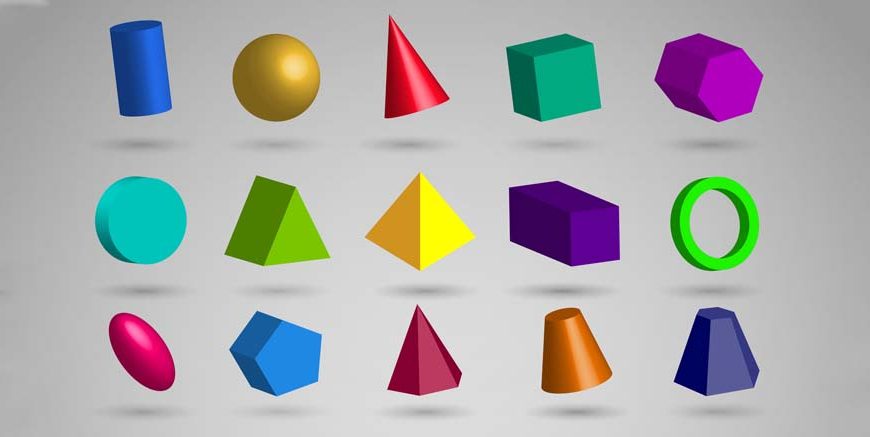
Have you ever picked up a bouncy football, held a cold tin of baked beans, or stacked wooden building blocks on the living room rug? Unlike drawings flat on a sheet of paper, these everyday objects take up actual, physical space. We can wrap our hands around them, roll them across the floor, and stack them to build magnificent towers.
The physical world around us is not flat. To make sense of everything we construct, hold, and use on a daily basis, we must deeply understand the basic geometry of solid objects. Teaching young learners about these concepts transforms a simple walk around the house into a brilliant, hands-on mathematical treasure hunt.
Understanding the Basics: Let Us define 3D shapes
When a young child draws a colourful square on a blank sheet of paper, that shape lies completely flat on the desk. It only possesses two simple measurements: length and width. However, if we want to accurately define 3D shapes, we must add a third, crucial measurement into the mix.
To fully understand what is 3D figure, you need to know that the ‘3D’ simply stands for three-dimensional. These robust, solid objects possess length, width, and depth (which is sometimes referred to as height). Because they proudly have this extra dimension, 3D dimensional shapes actually take up physical space in our universe. You can pick them up with your fingers, pour water inside them, or stack them carefully on top of one another. They are not just pictures; they are the fundamental building blocks of reality.
Read More – Geometric Shapes Name with Pictures for Kids
The Building Blocks: 3D shapes properties
Before we start looking at specific household objects, we need to learn the core vocabulary. The formal language of geometry gives children the exact words they need to describe what they are holding in their hands. When exploring different 3D shapes and their properties, we generally talk about three main, easily identifiable features.
- Faces: This is the flat or smoothly curved surface of the solid shape. If you look at a standard cardboard delivery box, every flat, brown side you can touch with your open palm is called a face.
- Edges: An edge is the straight line where two flat faces perfectly meet together. If you run your index finger along the sharp crease of that same cardboard box, you are actively touching an edge.
- Vertices: This is the proper mathematical word for corners. A vertex is the exact, pointy spot where several edges meet together.
Understanding these specific 3D shapes properties helps children easily compare and sort the different objects they find hiding in their toy box or kitchen cupboards. It allows them to confidently say why a ball is entirely different from a building block.
Everyday Geometry: 3D shapes in maths with examples
Let us dive directly into the wonderful world of solid geometry. Here are the most common 3D shapes in maths with examples that children happily interact with every single day:
The Sturdy Cube
A cube is a brilliant, perfectly balanced shape. It proudly features six identical square faces, twelve straight edges, and eight pointy vertices. A perfect real-life example is a numbered rolling dice from your favourite family board game, a colourful Rubik’s Cube, or a sugar cube waiting for a cup of tea.
The Versatile Cuboid
You can think of a cuboid as the cube’s longer, stretched-out cousin. It also features six faces, twelve edges, and eight vertices, but the faces are stretched rectangles instead of perfect squares. A classic paperback reading book, a thick red brick from a garden wall, or a large cereal box sitting on the breakfast table are all fantastic examples of a cuboid.
The Smooth Sphere
A sphere is perfectly round without a single sharp edge or pointy vertex to be found. It consists of one continuous, smooth curved face. A bouncy tennis ball, a sweet orange from the fruit bowl, or the beautiful, spinning planet Earth we live on are all massive spheres.
The Clever Cylinder
This highly useful shape features two flat circular faces (one sitting on the top and one resting on the bottom) and one smooth, curved face wrapped tightly around the middle. It has two curved edges but zero pointy vertices. A tin of tomato soup, a tall drinking glass full of water, or a fresh battery for a television remote are all everyday cylinders.
The Pointy Cone
A cone features a flat, circular face right at the base and a curved surface that wraps elegantly upwards into one single, sharp point at the very top. A crunchy, sweet wafer holding a massive scoop of strawberry ice cream, a bright orange traffic cone sitting on the pavement, or a paper party hat are brilliant real-life examples.
Read More – Best Shape Activities for Kids
Why Learning Solid Geometry Matters
Learning about these solid mathematical figures is not just an arbitrary exercise for the primary school classroom. When children deeply understand how shapes work together, they start viewing their daily environment completely differently. Architects carefully use sturdy cuboids to build towering, safe skyscrapers because they stack together brilliantly. Food manufacturers heavily rely on cylinders for fizzy drink cans because they are comfortable for a human hand to hold and very easy to pack into delivery lorries. By understanding these concepts, children learn to appreciate the incredibly careful, mathematical design of the human world.
Summary
To bring everything together, the physical universe is entirely constructed from the brilliant rules of solid geometry. From the perfectly round sphere of the bright moon floating in the night sky to the sturdy cuboid of the mattress you sleep on every night, every single object can be broken down into these fundamental, solid figures. Understanding exactly how many faces, edges, and corners make up an everyday object helps young learners appreciate the careful, clever design of their surroundings.
It actively teaches them to observe, physically measure, and boldly question the physical structures around them. It certainly leaves us with a highly inspiring thought: if you closely examine the intricate shapes scattered around your own living room right now, how many brilliant mathematical designs can you spot hiding in plain sight? To uncover more engaging ways to support your child’s brilliant learning journey, explore the EuroKids Blog and find out all the necessary details regarding EuroKids Preschool Admission today.
FAQs
What is the absolute easiest way to identify a 3D figure?
The simplest way is to ask if you can physically hold it. If an object is solid, takes up actual space in a room, and has physical depth along with length and width, it is three-dimensional.
Do all solid mathematical figures have sharp, pointy corners?
No, certainly not. Some solid objects, just like spheres and cylinders, feature completely smooth, curved surfaces without any sharp, pointy corners at all.
Why is a standard piece of drawing paper not considered 3D?
A standard piece of paper is considered a flat, 2D shape because it essentially only possesses length and width without any noticeable or measurable physical depth.