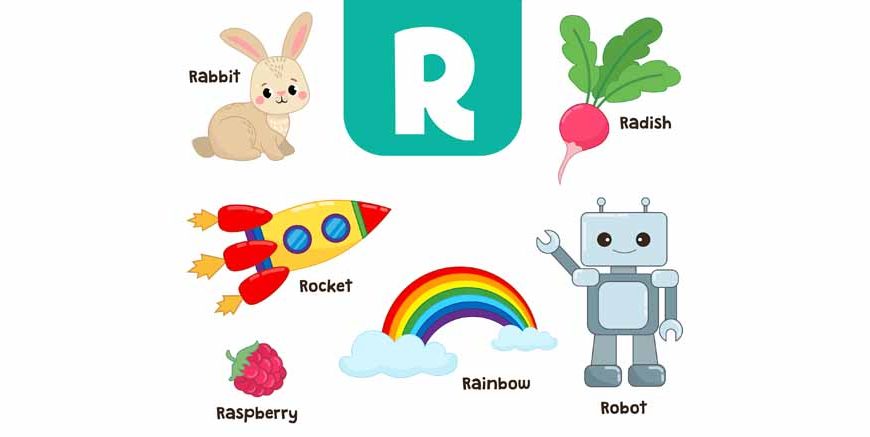
Teaching a child the alphabet is an incredible journey. You spend weeks singing the ABCs, pointing at letters on cereal boxes, and tracing shapes in the air. While some letters are easily grasped by toddlers, others require a little more theatrical flair. The letter r is one of those special characters. It does not just make a sound; it makes an attitude.
Think about how a child naturally plays. They love to roar like a lion or rev up a toy car engine. This natural, playful energy is the perfect gateway to teaching the r alphabet. However, moving from a playful “roar” to actually reading words that start with r requires structure. You are bridging the gap between sound and text.
If you are a parent or educator looking to build a robust vocabulary for your little one, you need more than just a random list. You need context. Children do not learn by memorising abstract lists; they learn by associating words with meanings, actions, and emotions. We have compiled a comprehensive, categorized r words list complete with kid-friendly definitions and examples, to help you turn phonics practice into a joyful daily habit.
Mastering the Sound of the Letter R
Before we dive into the vocabulary, we must talk about the sound. The ‘R’ sound (technically known as the alveolar approximant) can be tricky for early talkers. Many toddlers substitute it with a ‘W’ or an ‘L’ sound, saying “wabbit” instead of “rabbit.”
To help them, make it a physical game. Ask your child to open their mouth slightly and pull their tongue back so it floats in the middle of their mouth without touching the roof. Then, ask them to make the sound of a growling puppy: “Rrrrrr.” Once they can comfortably make that isolated sound, they are ready to attach it to the wonderful r words for kids listed below.
Read More – How Many Letters Are in The English Alphabet
The Ultimate R Words List: A Dictionary for Kids
To make learning manageable, we have categorized these r words in english into themes that young children naturally love.
1. The Animal Kingdom
Children are naturally drawn to animals. Connecting the target letter to a furry or feathered friend is one of the most effective memory aids.
- Rabbit
- Meaning: A small, soft animal with long ears, a fluffy tail, and strong back legs for hopping.
- Example: The white rabbit ate a crunchy carrot for lunch.
- Raccoon
- Meaning: A clever nocturnal animal with a bushy, striped tail and black fur around its eyes that looks like a mask.
- Example: The raccoon washed its paws in the small stream.
- Rhinoceros (Rhino)
- Meaning: A very large, heavy wild animal with thick grey skin and one or two large horns on its nose.
- Example: The giant rhino rested in the cool mud.
- Rooster
- Meaning: A male chicken that is famous for waking people up in the morning with a loud crow.
- Example: The rooster crowed loudly when the sun came up.
- Robin
- Meaning: A small, cheerful bird known for its bright red or orange chest.
- Example: A little robin built a nest in our oak tree.
2. Nature and the Great Outdoors
The natural world is full of fascinating r letter words. Use these words when you are taking a walk in the park or looking out the window on a cloudy day.
- Rain
- Meaning: Drops of fresh water that fall from the clouds in the sky.
- Example: We need an umbrella because the rain is falling fast.
- Rainbow
- Meaning: A beautiful arch of seven colours that appears in the sky when the sun shines through raindrops.
- Example: I saw a huge rainbow after the storm stopped.
- River
- Meaning: A large, natural stream of water that flows across the land and into the ocean.
- Example: The silver fish swam quickly down the river.
- Rock
- Meaning: A hard, solid piece of the earth’s surface.
- Example: My brother found a smooth, shiny rock on the beach.
- Rose
- Meaning: A beautiful, sweet-smelling flower that grows on a bush with thorny stems.
- Example: My mother planted a red rose in the garden.
3. High-Energy Action Words (Verbs)
Toddlers are constantly moving. Teaching them action words allows them to physically act out the vocabulary, cementing the phonics lesson into their muscle memory.
- Run
- Meaning: To move your legs very quickly, faster than walking.
- Example: The puppy likes to run across the green grass.
- Read
- Meaning: To look at words or symbols in a book and understand the story they tell.
- Example: I will read a bedtime story to my teddy bear.
- Ride
- Meaning: To sit on and control a bicycle, a horse, or a vehicle as it moves.
- Example: She learned how to ride her new blue bicycle.
- Roll
- Meaning: To turn over and over as you move across a surface.
- Example: We watched the round ball roll down the steep hill.
- Roar
- Meaning: To make a very loud, deep sound, exactly like a big lion.
- Example: The brave lion let out a loud roar in the jungle.
4. Everyday Objects and Things
These are the r words your child interacts with daily or sees in their favourite cartoons.
- Robot
- Meaning: A special machine that is built to follow instructions and do tasks, sometimes looking like a metal person.
- Example: The toy robot walked across the bedroom floor.
- Rocket
- Meaning: A tall, powerful vehicle shaped like a tube that travels up into outer space.
- Example: The astronauts flew a rocket to the moon.
- Ring
- Meaning: A small, circular piece of jewelry that you wear on your finger.
- Example: She wore a shiny gold ring on her hand.
- Rug
- Meaning: A thick, soft piece of material used to cover part of the floor.
- Example: The cat took a warm nap on the living room rug.
- Radio
- Meaning: A device that plays music, news, and stories through invisible waves in the air.
- Example: We listened to happy music on the kitchen radio.
Read More – A to Z Words List & Fun Learning Tips for Kids
Interactive Games to Practice the R Alphabet
You do not need flashcards to teach these words. Children learn best when their hands are busy and they are having fun.
The Rainbow Rice Bin:
Dye some dry rice with different food colours to make a sensory bin. Hide small plastic objects that start with the target letter inside the rice (e.g., a toy ring, a plastic rose, a miniature robot). Ask your child to dig through the “rainbow” rice and name the objects as they find them.
The Robot Freeze Dance:
Play some music and tell your child to “Run,” “Roll,” or “Roar” to the beat. When the music stops, they must freeze perfectly still, just like a metal “Robot.” This game practices four different action and object words while burning off excess energy.
Rocket Ship Countdown:
Use a cardboard box to build a pretend rocket. Have your child sit inside. Count backward from ten, and when you reach zero, shout, “Rocket!” and let them jump out. Ask them to name one new word from the list before they can climb back in for the next launch.
Read More – Word Games for Kids
The EuroKids Philosophy on Early Literacy
Teaching early literacy is a massive responsibility, and we know that parents are always looking for the best ways to support their child’s cognitive development. At EuroKids, we completely understand the science of reading. We do not force young children to sit in silence and copy letters endlessly. We know that active, joyful engagement is the key to deep learning.
This is exactly why our classrooms utilize the HEUREKA Curriculum. Heavily inspired by Harvard University’s Project Zero, our educational framework focuses on “Visible Thinking.” When we introduce phonics and vocabulary, we use interactive storytelling, sensory play, and guided questions. We make the thinking process visible so that children understand the logic behind the sounds and words. They do not just memorize; they comprehend and connect.
When you are ready to give your child an educational environment that values both academic excellence and deep, joyful discovery, the EuroKids Preschool Admission process is your clear next step. We invite you to visit a centre, speak to our dedicated educators, and see our child-first philosophy in action. In the meantime, we highly encourage you to explore the EuroKids Blog for more weekly vocabulary lists, parenting advice, and developmental guides to support your little learner at home.
The ‘R’ Vocabulary Overview
|
Word Category |
Key Examples |
Developmental Benefit |
|
Animals |
Rabbit, Rhino, Rooster |
Builds empathy and natural world connection. |
|
Action Words |
Run, Roll, Ride |
Links physical movement to phonics memory. |
|
Nature |
Rain, Rainbow, Rose |
Encourages outdoor observation skills. |
|
Objects |
Robot, Rocket, Ring |
Connects learning to imaginative play. |
Frequently Asked Questions (FAQs)
Why does my toddler struggle to pronounce the letter R correctly?
The ‘R’ sound is one of the last speech sounds to fully develop in children, often not mastered until age five or six. It requires complex tongue placement. Do not correct them harshly; simply model the correct pronunciation back to them naturally in conversation.
How many new words should I teach my child at once?
For preschoolers, introduce no more than three to five new words a week. Focus on depth rather than quantity. Act out the word, draw it, and use it repeatedly in daily sentences.
Are there any easy 3-letter R words for a child just starting to read?
Yes! Start with easily decodable CVC (consonant-vowel-consonant) words like Red, Rug, Rat, Run, and Rub. These are phonetic and very easy for a beginner to blend.
How can I correct my child if they use the wrong word without discouraging them?
Use positive reinforcement. If they point to a mouse and say “Rat!”, say, “That does look like a rat! Rats and mice are cousins. That one is a tiny mouse.” You validate their thought process while gently providing the correct vocabulary.
How does the EuroKids curriculum teach new letters?
We immerse children in a letter-rich environment. During an ‘R’ week, children might paint rainbows, act like robots, and read stories about rabbits. Through the HEUREKA framework, learning happens organically across art, science, and physical play.