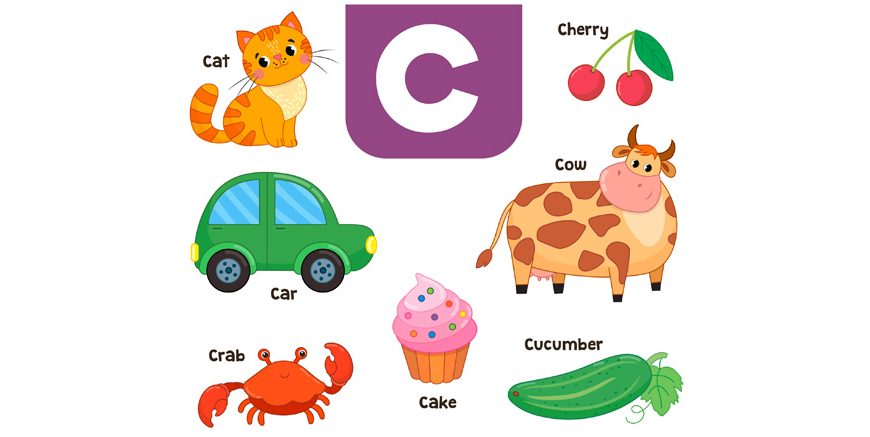
When a child first picks up a chunky crayon, one of the easiest shapes they learn to draw is a simple curve. It is essentially an unfinished circle. That simple, sweeping motion is the letter c. Because it is so physically easy to write, children naturally gravitate toward it. However, when we move from writing to reading c words, the English language introduces a fascinating new challenge. This specific letter has a superpower: it can make two completely different sounds.
It can make a “soft” sound, mimicking the letter S, like in the word city. Or, it can make a “hard” sound, mimicking the letter K, like in the word cat. When teaching young readers, you must always start with the hard c sound words. The crisp “kuh” sound is much easier for toddlers to isolate and pronounce.
If you are looking to expand your child’s vocabulary, you cannot just hand them a dictionary. You need a structured, engaging c words list that connects phonetic sounds to real-world objects they can see, taste, and touch. We have compiled the ultimate guide to words that start with c, complete with child-friendly meanings, examples, and interactive games to make learning absolutely joyful.
The Ultimate Dictionary: C Letter Words for Kids
To help your child naturally absorb these c words in english, we have broken them down into highly relatable themes.
1. The Animal Kingdom
Toddlers are fascinated by animals. When you introduce words beginning with c through the lens of nature, they pay immediate attention.
- Cat
- Meaning: A small, soft, furry pet with a long tail and sharp claws that loves to purr.
- Example: The sleepy cat curled up on the warm rug.
- Cow
- Meaning: A large farm animal that eats grass and gives us fresh milk.
- Example: The black and white cow stood peacefully in the green field.
- Camel
- Meaning: A tall animal with a long neck and one or two large humps on its back, living in the hot desert.
- Example: The camel walked slowly across the dry sand.
- Crab
- Meaning: A sea creature with a hard, flat shell and sharp claws that walks sideways on the beach.
- Example: A tiny red crab dug a hole near the ocean water.
2. Food and Yummy Treats
Children learn best when multiple senses are involved. Food-related c words for kids are incredibly effective because they can literally taste the vocabulary!
- Cake
- Meaning: A sweet, baked dessert usually covered in frosting and eaten at birthday parties.
- Example: My mother baked a chocolate cake for my birthday.
- Carrot
- Meaning: A long, crunchy, bright orange vegetable that grows in the ground.
- Example: The little rabbit nibbled on a fresh carrot.
- Candy
- Meaning: A sweet treat made mostly of sugar, coming in many different bright colours.
- Example: We bought some sticky pink candy at the funfair.
- Corn
- Meaning: A yellow vegetable that grows on tall green stalks and has many small, sweet kernels.
- Example: I love to eat hot, buttered corn in the summer.
3. Everyday Objects and Things
Connecting phonics to tangible items lying around your house reinforces the lesson every single time your child walks into a room.
- Car
- Meaning: A vehicle with four wheels and an engine that drives us on the road.
- Example: We drove the blue car to the supermarket.
- Cup
- Meaning: A small, round container with a handle, used for drinking water or milk.
- Example: I drank cold water from my favourite red cup.
- Coat
- Meaning: A thick, heavy piece of clothing you wear outside to keep your body warm in the winter.
- Example: Put on your heavy coat before you go out into the snow.
4. Building Length: 5 Letter Words Starting With C
As your child progresses past simple three-letter words (CVC words), they need a gentle challenge. These 5 letter words starting with c are perfect for stretching their blending and spelling skills.
- Cloud
- Meaning: A fluffy, white or grey mass of tiny water drops floating high up in the sky.
- Example: A big, dark cloud covered the bright sun.
- Clock
- Meaning: A machine with numbers and hands that hangs on the wall and tells us the time.
- Example: The big clock in the kitchen goes tick-tock.
- Crown
- Meaning: A beautiful, shiny gold circle covered in jewels, worn on the head of a king or queen.
- Example: The king wore a heavy gold crown on his head.
- Chair
- Meaning: A piece of furniture with four legs and a backrest, made for one person to sit on.
- Example: Please pull up a chair and sit at the dining table.
- Cabin
- Meaning: A small, simple house made of wood, usually found in a forest or near a lake.
- Example: We slept in a quiet wooden cabin during our holiday.
Read More – How Many Letters Are in the English Alphabet?
Interactive Games to Practice the C Alphabet
You cannot just hand a child a printed list and expect them to become a fluent reader. You must gamify the learning process. Here are three highly active games to play at home.
1. The Cloud Cotton Craft
Write several of your target words on a large piece of blue construction paper. Give your child a bowl of fluffy cotton balls and some glue. Tell them they are making a Cloud. Ask them to read a word out loud. If they read it correctly, they get to glue a cotton ball over the word. By the end of the game, they will have built a giant, fluffy 3D cloud.
2. The Car Race
Take some masking tape and make a “road” on your living room floor. Write different c letter words on small index cards and place them like speed bumps along the road. Hand your child a toy Car. They have to drive the car down the road, but they must stop and loudly read the word at every single speed bump before they can continue racing.
3. Cookie Cutter Phonics
If you are baking or playing with playdough, pull out your cookie cutters. Have your child flatten the dough. Ask them to cut out a shape, but before they press the cutter down, they must say a word that starts with the target letter. Tactile activities like pressing dough deeply embed the vocabulary into their physical memory.
Read More – Word Games for Kids
Concluding
When you are ready to give your child a foundation that values both academic excellence and joyful discovery, the EuroKids Preschool Admission process is your clear next step. We invite you to visit a centre, speak to our dedicated educators, and watch our child-first philosophy in action.
Furthermore, we highly encourage you to explore the EuroKids Blog for more weekly vocabulary lists, expert parenting strategies, and detailed developmental guides to support your little learner at home.
The ‘C’ Vocabulary Overview
|
Word Category |
Key Examples |
Developmental Benefit |
|
Animals |
Cat, Cow, Crab |
Builds empathy and connects phonics to nature. |
|
Food Items |
Cake, Carrot, Corn |
Associates reading with sensory, taste-based memory. |
|
Everyday Objects |
Car, Cup, Coat |
Reinforces learning through daily household observation. |
|
Five-Letter Words |
Cloud, Clock, Crown |
Challenges early spelling and sound blending skills. |
Frequently Asked Questions (FAQs)
How do I explain the difference between the hard C and the soft C to my child?
Keep it very simple. Tell them that this letter is a “copycat.” Sometimes it copies the strong ‘K’ sound (like in cat), and sometimes it copies the hissy ‘S’ sound (like in circle). For toddlers and early readers, focus 90% of your time on the hard ‘K’ sound first so they do not get confused.
How many new vocabulary words should I introduce per week?
For preschoolers, introduce no more than three to five new words a week. Focus on depth rather than quantity. Act out the word, draw it, and use it repeatedly in your daily conversations.
Are there easy three-letter words for a child just starting to read?
Yes! Start with easily decodable CVC (consonant-vowel-consonant) words like Cat, Cup, Cob, Cap, and Cot. These follow strict phonetic rules and are very easy for a beginner to sound out and blend.
How can I correct my child if they mispronounce the word without discouraging them?
Always use positive reinforcement. If they point to a cup and say “Tup”, smile and say, “Yes, that is your blue cup! C-c-cup.” You validate their attempt to communicate while gently providing the correct crisp pronunciation.
How does the EuroKids curriculum teach new letters?
We immerse children in a letter-rich environment. During our weekly themes, children might paint Clouds, pretend to drive Cars, and build Castles. Through the HEUREKA framework, phonetic learning happens organically across art, science, and gross motor play.