Close your eyes for just five seconds and listen carefully. What do you hear? You might notice the quiet hum of a ceiling fan, a dog barking across the street, or the chatter of people in the next room. We live in a world completely filled with an invisible symphony. We cannot hold it in our hands, and we cannot see it with our eyes, but it completely shapes how we experience the world.
If a curious child tugs at your shirt and asks, “what is sound?”, how do you explain something completely invisible? Today, we are going to break down the science of hearing. We will explore how it is made, how it travels through the air to reach our ears, and the different categories it falls into.
The Shaking Secret: Sound Definition
To give a simple and accurate sound definition, we have to talk about movement. Sound is a specific type of energy created by vibrations. When any object shakes or moves back and forth very quickly, it produces a vibration.
You can actually feel this happening right now! Place two fingers gently on the front of your throat and hum a happy tune. Do you feel that funny buzzing sensation under your fingers? That is your vocal cords vibrating. That buzzing energy captures the exact sound meaning: it is the physical energy of movement that our ears are able to detect and understand.
Read More – Educating Kids on Sound Production
The Domino Effect: Define Sound Wave
So, if a guitar string vibrates on a stage, how does that buzzing energy actually travel across a large room to reach your ears? To understand this journey, we have to define sound wave.
Think about lining up a hundred dominoes in a long row. If you push the very first domino, it falls and bumps into the second one, which bumps into the third. The dominoes themselves do not travel across the room, but the “falling energy” travels all the way to the end of the line.
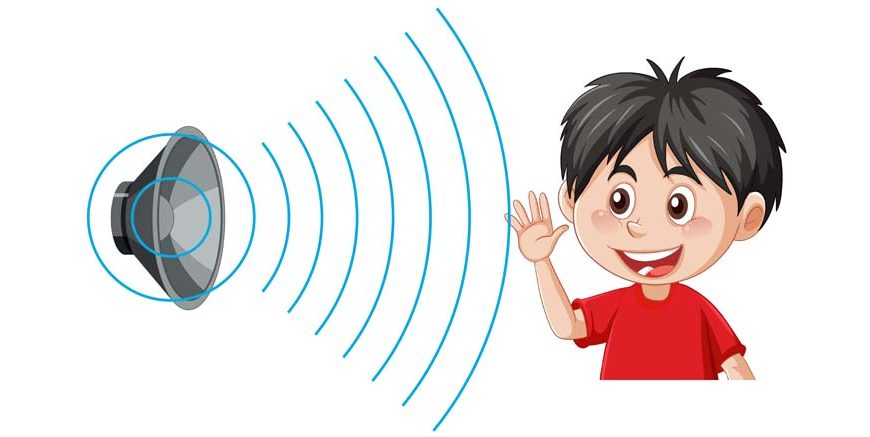
A sound wave works exactly like those falling dominoes. When an object vibrates, it quickly pushes against the invisible air particles floating right next to it. Those air particles bump into their neighbors, passing the energy forward. This invisible, traveling ripple of bumping air particles is called a sound wave. Once that ripple finally bumps into your eardrum, your brain recognizes it as a song, a voice, or a loud bang!
The Science of Hearing: Study of Sound
Because this invisible energy is so important for communication, music, and safety, scientists spend a lot of time researching it. The scientific study of sound is called acoustics.
People who work in acoustics do amazing things. They figure out how to build large movie theaters so the movie dialogues bounce perfectly off the walls without echoing. They study how whales and dolphins use underwater vibrations to talk to each other across entire oceans. They even design special earmuffs to protect factory workers from dangerous, loud machines.
Read More – Science of Sound Explained For Kids
Sorting the Symphony: How Many Types of Sound?
When learning about this topic, a very common question is: how many types of sound are there? We can sort them in two different ways.
First, let us look at how scientists sort them based on pitch (how high or low the vibration is). There are three main scientific types:
- Audible: This is the range that human ears can easily hear, like talking, music, and clapping.
- Infrasonic: These are vibrations that are way too low and deep for human ears to catch. However, massive animals like elephants and whales use these deep rumbles to talk to each other from miles away!
- Ultrasonic: These are vibrations that are way too high-pitched for humans. Dogs, bats, and dolphins can hear these super-high squeaks perfectly.
Second, we can sort them by how they actually feel to our ears in our everyday lives. Here is a simple table showing the difference between a pleasant tune and an annoying racket.
|
Feature |
Musical (Pleasant) |
Noise (Unpleasant) |
|
Vibration Pattern |
The air particles bump in a smooth, regular, and highly organized pattern. |
The air particles bump in a jagged, messy, and completely random pattern. |
|
How It Feels |
It feels soothing, happy, and makes you want to dance or relax. |
It feels annoying, tiring, and makes you want to cover your ears. |
|
Everyday Examples |
A piano playing, a bird singing, a mother humming a lullaby. |
A loud drill breaking the road, heavy traffic honking, a crashing plate. |
Read More – Science Quiz Questions for Kids with Answers
Learning Through the Senses
At EuroKids, we know that children learn the most when they actively use all their senses. We do not just ask children to read about vibrations in a silent room. We encourage them to hit a drum, shake a homemade rattle filled with dry beans, and listen to the crunch of dry autumn leaves under their shoes. By turning these abstract scientific concepts into loud, fun, and highly interactive physical play, young learners instantly grasp the magic of how the world works around them.
Conclusion
To summarize, sound is a wonderful, invisible form of energy caused by rapid vibrations. It travels through the air like a ripple of falling dominoes, finally bumping into our ears so we can experience the world. From the deep, hidden rumbles of giant elephants to the sweet, organized patterns of our favorite musical songs, it is the ultimate tool for communication.
As we finish reading this, it leaves us with a famous, thought-provoking riddle. If a massive tree falls in the middle of a deep forest, and there is absolutely nobody around to hear it, does it make a sound? Scientifically, the falling tree definitely creates vibrations and pushes the air particles. But without an ear to catch those ripples and a brain to translate them, it is just silent, moving air. It reminds us that communication is a beautiful two-way street; it always requires someone willing to speak, and someone willing to listen. To read more fun and educational articles, check out the EuroKids Blog, and visit our website for details on EuroKids Preschool Admission.
FAQs
Can sound travel through water?
Yes, it absolutely can! In fact, it travels much faster through water than it does through the air because water particles are packed closer together, making it easier for them to bump into each other.
Why is there no sound in outer space?
Outer space is a giant vacuum, which means there is no air. Without air particles to bump into each other and pass the vibrations along, sound waves simply cannot travel. Space is completely silent!
What makes a sound loud or quiet?
Loudness depends on how much energy the vibration has. If you hit a drum very hard, it creates a massive vibration with a lot of energy, making a loud boom. If you tap it gently, it makes a tiny vibration and a quiet tap.
How do bats use high-pitched squeaks to fly in the dark?
Bats use a trick called echolocation. They shout out an ultrasonic squeak, and when the invisible wave hits a yummy bug in the air, the wave bounces back to the bat’s ears, telling it exactly where the bug is hiding!