Take a deep breath. Fill your lungs with air, hold it for a brief second, and exhale. The invisible gas keeping you alive right now has been on a massive, continuous journey for millions of years. It travels through the crisp leaves of tall trees, across the surfaces of vast, turbulent oceans, into the bodies of running animals, and high up into the Earth’s protective atmosphere.
This grand, never-ending relay race of life is a fundamental mechanism of our planet. Let us break down exactly how this natural circulation works, where this vital gas originates, and why it is so crucial for the survival of every living creature.
What is Oxygen Cycle?
If a curious student points to the sky and asks, “what is oxygen cycle?”, the most direct answer is that it is nature’s ultimate recycling system. A formal oxygen cycle definition states that it is the continuous movement of oxygen through the Earth’s atmosphere (the air we breathe), the biosphere (all plants and animals), and the lithosphere (the Earth’s rocky crust).
Because this intricate process actively involves biological life, geological earth structures, and chemical reactions, scientists officially classify it as a biogeochemical cycle oxygen. This complex scientific term simply means that this life-sustaining element is never truly lost or destroyed; it merely changes forms and moves seamlessly from one location to another, ensuring the Earth never runs out of breathable air.
Read More – Ecosystem for Kids
A Clear Oxygen Cycle Explanation
To properly explain oxygen cycle mechanics, we must look at the continuous, invisible loop of giving and taking. When providing an oxygen cycle explanation for children, it heavily helps to view it as a bustling, global delivery service.
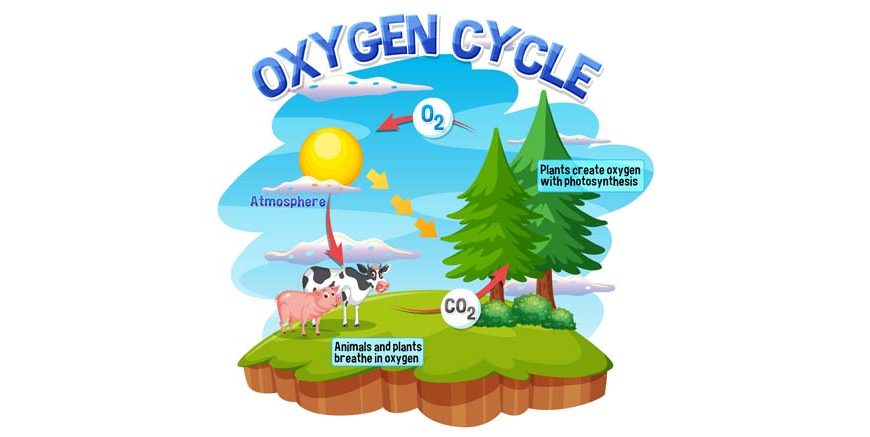
Green plants act as the grand, silent producers in this system. Through a brilliant natural process called photosynthesis, they soak up bright sunlight and water from the soil to manufacture their own food. As a helpful byproduct of making their food, they release fresh, breathable air out into the environment. Animals and humans act as the grateful consumers. We eagerly breathe in this fresh air to produce vital energy inside our bodies, a biological process officially known as cellular respiration. After we use the air for energy, we breathe out a completely different waste gas, which the plants happily collect to start the whole delivery process over again.
Oxygen and Carbon Dioxide Cycle
This brings us to the most magical, perfectly balanced partnership in nature: the oxygen and carbon dioxide cycle. These two elements are locked in a permanent, highly choreographed dance.
Plants desperately need carbon dioxide to survive and create their food, whilst humans and animals desperately need oxygen to keep their hearts beating. When we exhale, we release heavy carbon dioxide into the air, effectively feeding the surrounding trees. In return, the trees release the fresh air we need. This continuous oxygen carbon dioxide cycle is the exact reason why taking a long walk through a dense, green forest feels so incredibly refreshing and clean. It is a flawless, natural system where one creature’s bodily waste becomes another creature’s ultimate treasure.
Read More – How do you make science interesting for kids
Primary Sources of the Invisible Gas
Where does all this breathable air actually come from? While walking through a local neighbourhood park, you might naturally assume that the tall oak trees and green grass provide most of it. However, the absolute biggest source actually hides deep beneath the crashing waves.
Tiny, microscopic marine plants called phytoplankton live in the upper, sunlit layers of the Earth’s oceans. Even though you cannot see them without a powerful scientific microscope, these tiny ocean dwellers are directly responsible for producing more than half of the breathable air on our entire planet! The remaining amount comes from terrestrial green plants, vast tropical rainforests, and natural geological processes occurring deep within the Earth’s crust, where minerals trap and slowly release the gas over thousands of years.
Understanding the Importance of Oxygen Cycle
The importance of oxygen cycle goes far beyond simply filling our lungs. Without this continuous circulation, life as we know it would simply cease to exist, and our colourful planet would become a barren rock.
Firstly, it allows all living organisms, from the tiniest garden insect to the largest blue whale, to convert their daily food into usable, physical energy. Secondly, it is directly responsible for creating the protective ozone layer high up in the stratosphere. The ozone layer acts as a massive, invisible shield, firmly protecting the Earth’s surface from the sun’s harsh, dangerous ultraviolet radiation. Furthermore, it plays a massive role in the natural decomposition process, allowing fallen leaves and natural waste to effectively break down, decay, and enrich the soil so beautiful new plants can eventually grow.
Read More – Exploring the Living World
Conclusion
Every single breath we take intimately connects us to the vast, deep oceans, the dense, humid jungles, and the smallest green leaves growing quietly in our back gardens. The continuous movement of these invisible gases is a brilliant, silent reminder that absolutely every living thing on this planet is deeply and unavoidably interconnected. We are all active, daily participants in a delicate, global breathing exercise that has lasted for billions of years.
When we actively protect our green spaces and keep our oceans clean, we are not just saving the environment; we are fundamentally protecting our own ability to breathe. Nurture your child’s brilliant curiosity about the natural world and give them the most robust foundation for their future; read more insightful articles on the EuroKids Blog and secure their vibrant educational journey with EuroKids Preschool Admission today.
FAQs
What is the primary source of this gas on Earth?
Microscopic marine plants known as phytoplankton produce the vast majority of it in our oceans, working alongside terrestrial trees and green plants.
How does the oxygen and carbon dioxide cycle work?
Animals and humans breathe in fresh air and breathe out carbon dioxide, whilst plants actively absorb that carbon dioxide and release fresh air back into the atmosphere.
Why is this biogeochemical cycle so crucial?
It provides the essential element needed for humans and animals to create cellular energy, helps decompose natural waste, and forms the protective ozone layer around our planet.