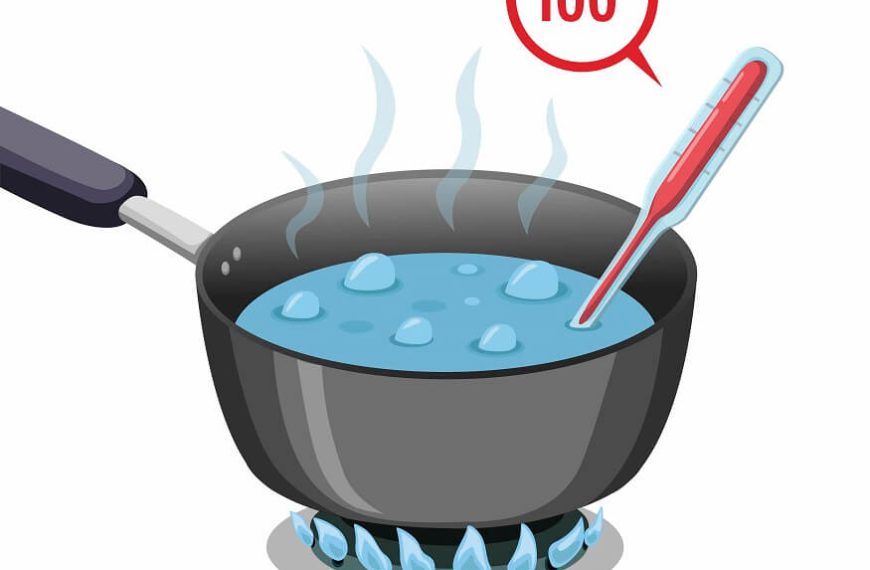
Picture a busy kitchen on a Sunday afternoon. A heavy steel pot sits on the cooker, filled with tap water bubbling furiously. Just as you prepare to drop in a handful of pasta, you grab a large pinch of salt and toss it into the pot. Instantly, the aggressive bubbling stops for a few moments. The water goes quiet, seemingly waiting for more heat from the flame before it can start boiling all over again.
This extremely common kitchen routine hides a brilliant piece of invisible science. Adding a simple, everyday solid into a liquid completely changes how that liquid behaves under heat. Today, we are going to unpack this mystery. We will break down the difficult vocabulary, look at how the math works, and discover how tiny, unseen particles possess the power to control the temperature of the world around them.
Read More – Heat Energy: Definition, Types, Sources & Examples for Kids
Define the Term Boiling Point
Before we can understand the clever salt trick, we must establish some basic ground rules. First, we need to define the term boiling point.
In the simplest terms possible, a liquid’s boiling point is the exact temperature at which it becomes so incredibly hot that it turns into a gas (which we call vapour) and escapes into the air around it. If you put a pot of pure, clean water on the stove, it will always reach its boiling point at exactly 100°C. At this precise temperature, the water molecules have gathered so much energy from the fire beneath them that they push past the heavy air pressure sitting on top of the pot and bubble away into the atmosphere.
The Big Shift: What is Elevation in Boiling Point?
So, what happens when that pot of water is no longer pure? What is elevation in boiling point?
If you take pure water and dissolve a solid substance inside it like salt, baking soda, or sugar the water suddenly requires a lot more heat to start bubbling. This upward shift in temperature is the core boiling point elevation definition.
If a science teacher ever asks you to define elevation of boiling point, you can confidently tell them that it is the direct increase in the boiling temperature of a liquid that happens when another substance is dissolved inside it. To answer the frequently asked question, “what do you mean by elevation of boiling point?”, simply look at the word ‘elevation’. When you step into a lift (an elevator), you go up. When you add salt to a pot of water, the required boiling temperature simply goes up!
But why does this happen? Think of the surface of the water like a busy set of exit doors at a cinema. When the water is completely pure, the water molecules can easily run straight out the doors and turn into floating vapour. However, when you add salt, the heavy salt particles crowd around those exit doors, physically blocking the way. Because the path is blocked, the water molecules need extra energy (extra heat) to push past the salt and successfully escape.
Read More – Properties of Water for Kids
Elevation in Boiling Point is a Colligative Property
Here is a fascinating secret about how this chemical process works. In the science world, elevation in boiling point is a colligative property.
That might sound like a terrifyingly complex phrase, but it is actually a very easy concept for young learners to grasp. Let us go back to our cinema analogy. Imagine a cinema manager who only cares about how many tickets are sold. He does not care if the tickets were bought by tall people, short people, children, or adults. He only cares about the total number on his spreadsheet.
A colligative property works in the exact same way. The hot water in your pot does not care what kind of solid you add. It does not care if you use table salt, baking soda, or sweet sugar. It only cares about the number of microscopic particles you throw into the pot. The more particles you add, the harder it is for the water to escape, and the higher the boiling temperature must climb.
Boiling Point Elevation Formula
Scientists do not just guess how hot the liquid will get; they use a specific piece of maths called the boiling point elevation formula.
The formula looks like this:
\Delta T_b = i \cdot K_b \cdot m
Let us break down this secret code:
- \Delta T_b: This represents the change in temperature. It tells us exactly how many degrees the boiling point went up.
- i (Van ‘t Hoff factor): This represents how many tiny pieces the solid breaks into when it hits the water.
- K_b: This is a special, unique constant number assigned to the specific liquid you are boiling.
- m (Molality): This is simply the amount of the solid ingredient you poured into the pot.
To help you visualise how changing the ingredients alters the temperature, try experimenting with our interactive calculator below!
Read More – Evaporation for Kids: Meaning, Process, Examples & Fun
The Ultimate Test: Which Solution Will Show Maximum Elevation in Boiling Point?
If you are taking a school chemistry test, you might stumble across a rather tricky question: which solution will show maximum elevation in boiling point?
Remember our colligative property rule? The water only cares about the number of pieces. Therefore, the solution that breaks apart into the most microscopic pieces always wins the prize!
Let us compare ordinary sugar and table salt. When you drop a grain of sugar into water, it dissolves, but it stays together as one single, connected piece (i = 1). However, when you drop table salt (NaCl) into water, it magically splits into two separate pieces: one piece of Sodium and one piece of Chloride (i = 2). Because salt gives you two blocking particles for the price of one, it will raise the boiling point much higher than the exact same amount of sugar! If you use a heavy-duty chemical like Calcium Chloride (CaCl_2), it splits into three pieces, raising the temperature even higher.
Exploring Different Liquids: All Solvent Boiling Point List
Up until now, we have only talked about water. But scientists boil lots of different liquids in their laboratories! The liquid that does the dissolving is called a solvent. To give you a broader picture of the chemical world, let us look at a quick all solvent boiling point list showing their pure, starting temperatures:
- Pure Water:0°C (Used mostly for cooking and making hot tea)
- Ethanol:4°C (A type of alcohol frequently used in perfumes)
- Benzene:1°C (A strong chemical used to manufacture plastics)
- Chloroform:2°C (A heavy, strong-smelling liquid used in laboratories)
If you take a spoonful of salt and dissolve it into any of the liquids on this list, their unique starting numbers will immediately rise.
Read More – Uses of Water for Kids: Key Facts & Activities Explained
Conclusion
When you strip away the complicated mathematical formulas and the long scientific words, the study of chemistry is really just the study of invisible relationships. It is absolutely mind-boggling to realise that the microscopic particles we cannot even see with our bare eyes are actively dictating how the visible world behaves.
The next time you are standing in the kitchen watching a pot of salted water bubble away on the cooker, you will know the wonderful truth. You are not just a hungry person waiting for your dinner; you are a scientist observing a colligative property in real-time. You understand that the salt is guarding the exit door, forcing the water to gather more heat and energy before it can escape into the air. Teaching children to see the extraordinary science hiding inside ordinary, everyday moments is one of the greatest gifts we can offer them.
To uncover brilliant learning strategies and spark your child’s boundless imagination, head over to the EuroKids Blog, and take the first step towards a bright educational future by exploring EuroKids Preschool Admission today.
FAQs
1. Does adding salt to water make pasta cook faster?
Yes, but only slightly! Because the salted water boils at a higher temperature than pure water, the water inside the pot is physically hotter. Hotter water transfers heat to the pasta faster, which speeds up the cooking time by a tiny fraction.
2. Why do councils put salt on icy roads in the winter?
This uses the exact same colligative property rule, but entirely in reverse! Just like salt makes the boiling point go up, it makes the freezing point go down. The salt stops the cold water molecules from locking together into solid ice, keeping the winter roads safe and wet instead of dangerously slippery.
3. Does it matter what kind of salt I use in the kitchen?
For changing the boiling point, no! Whether you use fancy pink Himalayan salt, flaky sea salt, or standard table salt, the hot water only cares about how many particles are dissolved, not how expensive the salt was.