Have you ever noticed how children suddenly stop and stare when a butterfly flies past or when they spot a line of ants carrying food? This curiosity about insects or other living or non-living beings is often the beginning of a child’s science journey.
It is also the perfect opportunity to introduce children to the fascinating world of insects. Learning about insects helps kids understand nature, develop observation skills, and build early scientific thinking. Instead of waiting for school lessons, parents can start teaching these concepts at home in a fun and simple way.
In this blog, we will explore insects, their body parts, where they live, and fun ways to teach your child about them. But first, let’s understand what an insect is.
What is an Insect?
An insect is a tiny animal that has:
- Six legs
- Three main body parts
- Two antennae
- A hard outer covering
- Often has wings
Insects belong to a group called invertebrates, which means they do not have a backbone like humans or dogs.
Read More – Rainy Season Insects
The Main Body Parts of an Insect
All insects have bodies divided into three main parts:
- Head
- Thorax
- Abdomen
Each part performs specific functions that help the insect survive, move, and grow. Let’s look at important parts of an insect.
- Head: The head is the front part of an insect’s body and acts as the centre for sensing and feeding. It contains the brain, eyes, antennae, and mouthparts.
- Antennae: Insects do not have noses or hands. Instead, they use antennae to sense their surroundings. Antennae help insects detect smells, feel objects, and sense movement or danger in their environment.
- Eyes: Most insects have compound eyes made up of many tiny lenses. These eyes help insects notice movement quickly and observe their surroundings from multiple directions.
- Mouthparts: Insects have different types of mouthparts depending on how they eat. Some insects chew food, some sip nectar, and others suck liquids. The mouthparts help insects gather and consume the food they need to survive.
- Thorax: The thorax is the middle part of an insect’s body and is responsible for movement. All insect legs and wings are attached to this section.
- Legs: Every insect has six legs attached to the thorax. These legs help insects walk, climb, jump, or hold onto surfaces.
- Wings: Many insects also have wings connected to the thorax. Wings allow insects to fly and move from one place to another. Some insects have two pairs of wings, while others may have one pair or no wings at all.
- Abdomen: The abdomen is the largest part of an insect’s body. It contains the systems that help the insect live and grow.
Read More – Butterfly Life Cycle
Why Should Kids Learn About Insects?
Kids interact with insects in some form or another every day. Therefore, teaching kids about different parts of the insects helps:
- Build curiosity about nature.
- Encourage scientific thinking early on.
- Develop respect for living and non-living beings.
- Improves kids’ concentration and observation skills. As soon as you tell kids about different parts of an insect, your curious little wonders would start noticing little details like wings, colours, and movements.
What are the Common Insects Kids See Every Day?
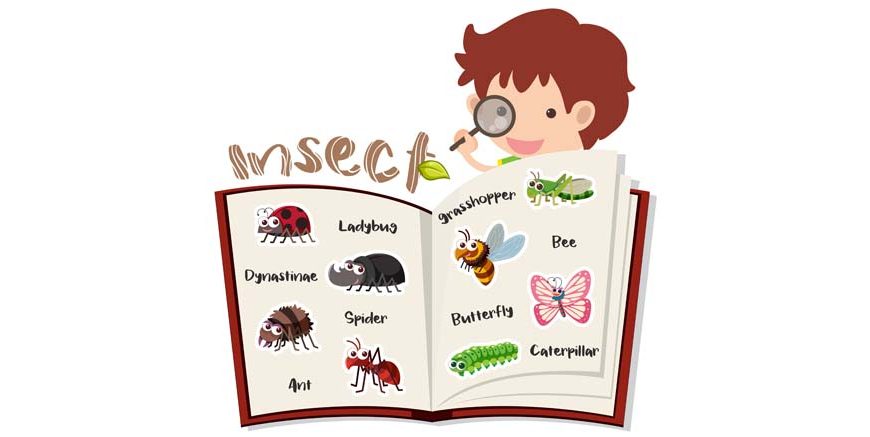
As mentioned before, kids may encounter insects in gardens, preschools or schools, or your building’s park. Here are some common insects kids may see every day:
- Ants: Live in colonies and work as a team.
- Bees: Pollinate flowers and produce honey.
- Butterflies: Known for colourful wings and flower pollination.
- Beetles: Help break down dead plants and keep nature clean.
- Flies: Help decompose and break down waste.
- Grasshoppers: Jump long distances using strong legs.
- Mosquitoes: Known for biting and spreading diseases.
Read More – Names Of Flying Animals For Kids
Do Insects Have Bones?
This question fascinates children. And the answer to it is very simple. Insects don’t have bones. Instead, they have a hard outer covering called an exoskeleton. This exoskeleton:
- Protects the body
- Supports movement
- Prevents water loss
Where Do Insects Live?
Insects can be found almost everywhere on Earth. They are generally found in:
- Underground
- On plants and trees
- Under rocks and logs
- In gardens and fields
- Near ponds and rivers
- Even in extremely cold places
What Do Insects Need to Survive?
Like humans, insects need:
- Food
- Water
- Shelter
- Warmth
Fun Insect Facts for Kids
Here are some fun facts about insects
- There are more than one million insect species.
- Some insects are smaller than 1 mm.
- Some stick insects grow up to 36 cm long.
- Butterflies taste with their feet.
- Ants can carry many times their weight.
Conclusion
Teaching children about insects is a great opportunity to nurture curiosity, observation, and respect for nature. When kids learn how insects live, move, and survive, they begin to understand the natural world around them in a deeper way.
Next time your child spots an ant or a butterfly, pause and explore together. That small moment could spark a lifelong love for science and discovery.
You can also check out EuroKids Blogs for more insightful and fun articles on your baby’s growth, health, and learning. Don’t forget to check out EuroKids Preschool Admission for the perfect foundation to kickstart your little one’s learning journey.