Have you noticed your little one’s eyes light up during science experiments on TV? Or their endless questions about how things work? This natural curiosity is the foundation of scientific thinking, and as parents, you can nurture it by introducing them to laboratory equipment from an early age.
While laboratory apparatus like beakers, test tubes, and microscopes aren’t part of the preschool curriculum, introducing your child to these tools early, even just by name and simple explanation, plants the seeds for future science learning. When your child eventually encounters these items in elementary or middle school, they will already have a foundation of familiarity.
In this article, we have shared all the essential laboratory apparatus and their uses, both for your knowledge and for sparking early scientific curiosity in your little one.
What is Laboratory Apparatus?
Laboratory apparatus refers to the tools and equipment used by scientists, students, and researchers to perform experiments safely and accurately. Every experiment involves observing, measuring, heating, mixing, or storing substances, and each task requires specific tools.
Understanding these tools, often referred to as laboratory equipment, is important because:
- It ensures experiments are safe
- It improves accuracy and reliability
- It helps children become familiar with scientific processes early
Read More – How do you make science interesting for kids
Let’s explore the most common laboratory equipment and their uses:
Observation Tools
These tools help scientists observe tiny objects and details that cannot be seen with the naked eye.
1.1. Microscope
A microscope is one of the most exciting tools in a laboratory. It allows us to see tiny things such as cells, bacteria, and small organisms. It uses light and special lenses to magnify objects many times.
1.2. Magnifying Glass
A magnifying glass enlarges small objects so we can see details clearly. A magnifying glass is generally used for:
- Observing insects, leaves, and small objects
- Reading tiny markings on equipment
Interestingly, this science lab equipment is usually the first lab tool children encounter because it is simple and safe.
Containers Used in Laboratories
Scientists need safe containers to mix, heat, and store substances. These are some of the most commonly used ones.
2.1. Test Tubes
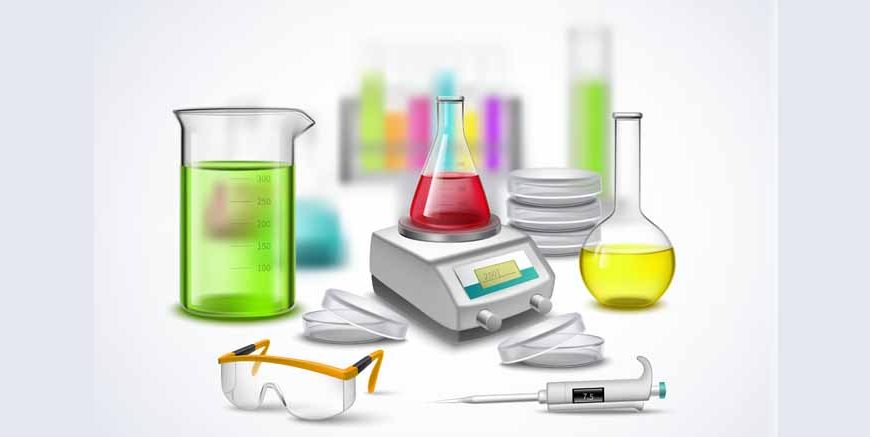
Test tubes are narrow glass tubes used to hold, mix, or heat small amounts of liquids. They are mostly used because they are perfect for small experiments and can handle heat well.
2.2. Beakers
Beakers are wide glass containers with flat bottoms and a pouring spout. They are often used for:
- Mixing chemicals
- Heating liquids
- Measuring rough quantities
They are very stable and easy to use, which makes them common in school laboratories.
2.3. Volumetric Flask
This special flask is used when scientists need very precise measurements of liquids. They are mostly used to prepare solutions and measure precise liquid volumes, among other things. That’s because the volumetric flask has a narrow neck and is designed for accuracy.
2.4. Watch Glass
A watch glass is a small curved glass dish. They are generally used for:
- Holding solids
- Evaporating liquids
- Heating small amounts of substances
2.5. Crucible
A crucible is a small container made of porcelain that can withstand very high temperatures. They are used for heating substances that are too hot for glass containers.
Measuring Tools in the Laboratory
Science experiments need accurate measurements. These tools help measure weight, temperature, and volume.
3.1. Measuring Cylinder
A measuring cylinder helps measure the volume of liquids accurately.
3.2. Thermometer
A laboratory thermometer measures the temperature of substances. It is used in experiments where:
- Heat affects chemical reactions
- Specific temperatures are required
3.3. Balance (Weighing Machine)
Balances measure the weight of substances. There are two common types of weighing machines:
- Precision balance
- Analytical balance (very sensitive)
3.4 Spring Balance
This tool measures weight using a spring and hook. In simple words, it works like a hanging scale!
Heating and Mixing Equipment
Many experiments involve heating and mixing substances. Here are some of the laboratory equipment used for heating and mixing:
4.1. Bunsen Burner
A Bunsen burner produces a flame used for heating and sterilising materials. Science labs use it to create a steady and safe flame.
4.2. Dropper (Pasteur Pipette)
A dropper transfers liquids one drop at a time. It is generally used when only a small amount of liquid is needed.
4.3. Spatula
A lab spatula is used to scoop and transfer solid chemicals. It’s like a mini spoon used in science experiments.
4.4. Burette
A burette releases liquids in very precise amounts. It is a common chemistry lab equipment used in titration experiments.
Safety and Handling Equipment
Safety is extremely important in laboratories. Here are some common safety and handling lab equipment:
5.1. Tongs
Tongs help hold hot or dangerous objects safely. In short, they protect your hands from heat and chemicals.
5.2. Funnels
A funnel helps pour liquids into narrow containers without spilling. There are different types of funnels, used for filtering and transferring liquids.
5.3. Wash Bottle
A wash bottle is a squeeze bottle used to clean laboratory glassware.
5.4. Brushes for Cleaning
Special brushes are used to clean test tubes and flasks.
Why Learning Lab Equipment Early Helps Children
Introducing children to lab tools early has many benefits:
- Children naturally ask questions about how things work. Knowing lab tools makes science feel familiar and exciting.
- When children already recognise equipment, science labs feel less intimidating in school.
- Lab tools encourage careful observation and attention to detail.
- Early exposure or knowledge of lab equipment often leads to interest in science, technology, engineering, and mathematics.
Read More – Friendly Science Experiments for Kids
Final Thoughts
Laboratory apparatus or lab equipment may look complex, but each tool has a simple purpose: helping us explore and understand the world through science. By introducing your child to these tools early, you nurture their curiosity, build familiarity, and prepare them for future science learning. The next time they see a microscope or a test tube, they won’t just see strange equipment; they will see exciting tools for discovery. And who knows? Today’s curiosity might grow into tomorrow’s scientist.
You can also check out EuroKids Blogs for more insightful and fun articles on your baby’s growth, health, and learning. Don’t forget to check out EuroKids Preschool Admission for the perfect foundation to kickstart your little one’s learning journey.