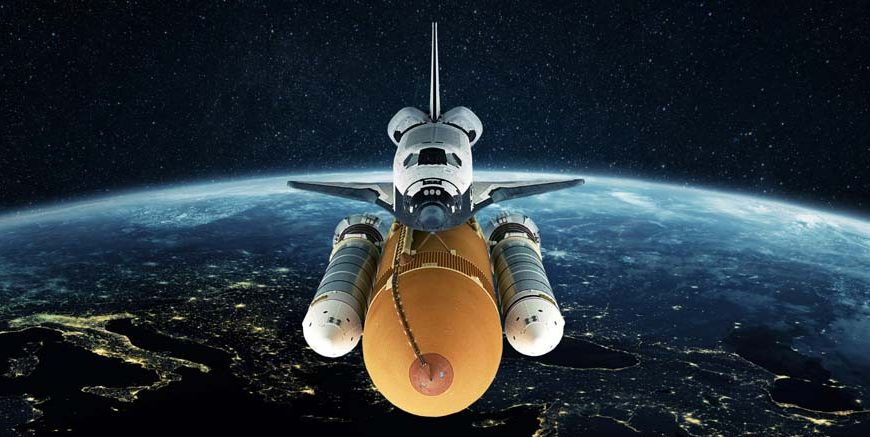
Imagine sitting on the living room floor, surrounded by hundreds of plastic building blocks, trying to construct the perfect spaceship. Most children will naturally build a tall, pointy cylinder that looks like a giant pencil. But for over thirty years, real-life astronauts flew to work in a machine that looked completely different from those simple toy models.
It resembled a chunky, delta-winged aeroplane strapped tightly to an enormous orange fuel tank. Let us explore the fascinating story of these incredible flying machines that completely transformed how humans travelled beyond our home planet.
Breaking Down the Definition
If a curious child taps you on the shoulder and asks, “what is a space shuttle?”, the simplest way to explain it is to imagine a clever mix between a heavy cargo lorry and a super-fast jet plane. The core meaning of space shuttle refers to a special, reusable spacecraft. It was built specifically to blast up into orbit, carry crews of astronauts alongside heavy scientific equipment, and then safely return home to Earth.
When we look closely at the space shuttle meaning in English, the word “shuttle” gives us a massive clue about how it worked. Just as a shuttle bus drives back and forth between a city centre hotel and an airport, this vehicle was designed to travel back and forth between Earth and space multiple times.
It was a true, hardworking commuter vehicle of the sky, rather than a one-time-use experiment. Understanding the space shuttle meaning helps children realise that space travel was treated very much like a regular, scheduled delivery service!
Read More – Interesting Space Rocket Facts for Kids
The Big Difference Between Space Shuttle and Rocket
This is a very common point of confusion for young space fans. The primary difference between space shuttle and rocket lies entirely in what happens after the launch is finished and the mission is over.
Think of a traditional rocket like a disposable plastic water bottle. Once it pushes a tiny capsule up into the stars, the heavy, empty rocket sections fall away, burn up in the high atmosphere, or drop heavily into the ocean. Historically, they were only used for one single, very expensive trip.
A space shuttle, on the other hand, is like your favourite sturdy metal water bottle. While it did use two massive, solid rocket boosters to help it get off the ground, the main aeroplane-like part (officially called the orbiter) was fully reusable. When it was time to come home, it did not splash down into the sea with giant parachutes. Instead, it glided smoothly through the air without any engine power and landed gracefully on a very long concrete runway, ready to be polished up and flown all over again.
Amazing Facts and Real-Life Examples
Let us look at some fun facts that will fascinate any young learner. Imagine having a car boot so huge that you could easily park a whole school bus inside it! That is exactly how big the cargo bay of this spacecraft was. Astronauts used this massive empty space to carry heavy satellites, and even the giant metal puzzle pieces needed to build the International Space Station up in orbit.
They even had a giant robotic arm that astronauts could control from inside the cockpit to grab and move floating objects in space. There were a few very famous examples of these crafts that you might have seen in old videos or museum photographs. Discovery, Endeavour, and Atlantis are some of the most well-known.
They acted as the ultimate moving vans of the galaxy. In fact, they were used to carry the famous Hubble Space Telescope into orbit, and astronauts even used the spacecraft as a base to fix the telescope when it broke! To survive the fiery, burning trip back to Earth, the bottom of the craft was covered in thousands of special black tiles that absorbed the heat and stopped the metal frame from melting.
Read More – Science Quiz Questions and Answers for Kids
Summary
Looking back at the brilliant history of space travel, these magnificent gliding ships showed us that going into orbit did not always mean throwing away the vehicle after just one trip. They taught humanity how to live, build, and work in space for longer periods, turning science fiction into an everyday reality. Understanding how these complex machines operated helps young minds realise that great engineering is simply a mixture of wild imagination and very clever problem-solving. Who knows? Perhaps the next generation of reusable spacecraft will be designed by a curious child currently sitting in a local classroom. To discover more helpful articles on nurturing young minds, read the EuroKids Blog and secure their bright future through EuroKids Preschool Admission today.
FAQs
What was the main job of this spacecraft?
It was primarily used to transport astronauts and heavy cargo, like satellites and space station parts, back and forth between Earth and orbit.
Do they still fly today?
No, the original programme officially ended in 2011, but the technology paved the way for the modern reusable space vehicles we see today.
How did it land?
Unlike older space capsules that dropped into the ocean with parachutes, it re-entered the atmosphere and glided down to land on a runway, much like a commercial aeroplane.