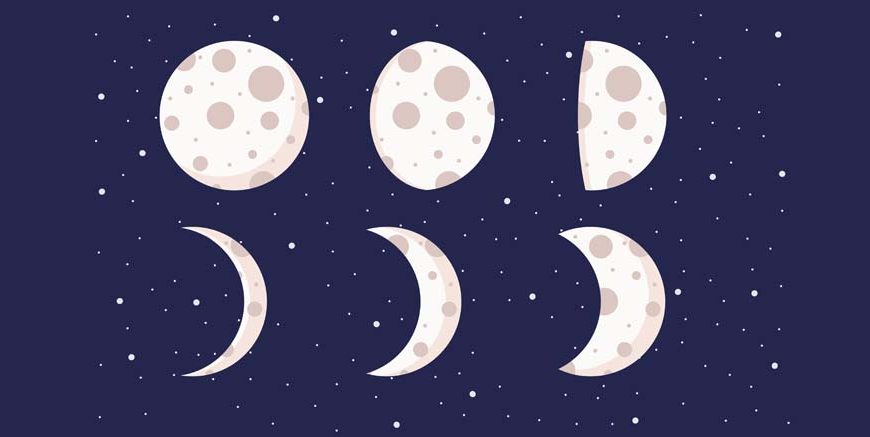
Step outside into your back garden on a clear, crisp night and simply look up. You will almost always spot our glowing, silent neighbour floating high above the trees. But have you ever stopped to notice that it rarely looks exactly the same two nights in a row? Sometimes it appears as a massive, bright, glowing circle, and other times it looks like a tiny, sharp sliver of a silver fingernail hanging in the dark.
It is incredibly easy for young children to think the rock is actually shrinking and growing right before their eyes. However, that is just a fantastic cosmic illusion. The massive ball of space rock never actually changes its physical shape. Today, we are going to dive straight into the night sky to understand exactly how this space magic works and explore the phases of the moon for kids.
Why Do We See the Changing Shapes of the Moon?
Before we start naming the different stages, we have to understand exactly why they happen in the first place. The most important thing to remember is that the moon does not actually make its own light. It acts exactly like a giant, dusty mirror floating in deep space, reflecting the incredibly bright light of our sun.
As this rocky sphere travels on its long journey (known as an orbit) around the Earth, the sun lights up entirely different parts of it. From where we are standing firmly on the ground, we can only ever see the specific parts that are actively lit up by the sun’s rays. As the rock moves, the shadows shift. This continuous, slow movement creates the brilliant changing shapes of the moon that we see out of our bedroom windows. It takes roughly 29.5 days for it to complete one full, giant circle around our planet.
Read More – Interesting Facts About the Moon for Preschoolers
The Different Shapes of Moon with Names
The month-long journey is split into highly specific stages that astronomers track carefully. Here is a clear, easy-to-read list covering the different shapes of moon with names so you can easily identify them with your children the next time you go stargazing:
- New Moon: This is the absolute beginning of the monthly cycle. Right now, the moon is sitting perfectly between the Earth and the Sun. The side facing us gets no sunlight at all, meaning the rock blends completely into the pitch-black night sky. You cannot see it even if you try.
- Waxing Crescent: The word ‘waxing’ simply means growing. A few days after the New Moon, a tiny sliver of bright light appears on the right edge. It looks just like a glowing, silver banana.
- First Quarter: About a week into the long cycle, exactly half of the face is lit up on the right side. Even though it looks exactly like a half-moon, space scientists call it a quarter because it is exactly one-quarter of the way through its orbit.
- Waxing Gibbous: The lit area keeps stretching further across the surface. The word ‘gibbous’ means bulging. Now, it is almost a full circle, but a small slice on the far left side is still hiding in the dark shadow.
- Full Moon: This is the main event of the night sky. The Earth now sits between the moon and the sun, allowing the sun to perfectly light up the entire face. It looks like a brilliant, glowing white dinner plate.
- Waning Gibbous: The word ‘waning’ means shrinking. After the full circle peaks, the light begins to slide away. The right edge starts to go dark, leaving a large bulging shape of light exclusively on the left side.
- Third Quarter: Exactly half the face is lit up again, but this time, it is the left side shining brightly while the right side sleeps completely in the dark.
- Waning Crescent: This is the very last stage before the cycle entirely restarts. Only a tiny fingernail of light is left on the far left side.
Read More – GK Quiz On Planets And Their Moons
Learning the Phases of Moon for Class 3
If you are trying to teach younger children the basics of astronomy, reading a heavy textbook can get a bit boring. The absolute best way to explain the phases of the moon for class 3 is to compare the whole process to a cosmic game of hide and seek.
You can easily recreate this at home. Grab a bright torch (which acts as the sun) and a standard tennis ball (the moon) in a completely dark room. Ask your child to stand in the middle while you shine the torch on the ball and slowly walk around them. They will instantly see how the dark shadows move across the fuzzy yellow ball, creating the exact same different shapes of moon they see in the actual sky. It keeps the science highly physical, incredibly fun, and very easy to grasp without getting bogged down in difficult maths.
Understanding the Phases of Moon Class 5
For older students looking at the phases of the moon class 5 science syllabus, it is time to look at the strict calendar and understand the wider impact on our planet. Older children need to understand that this celestial dance is incredibly reliable and completely predictable.
Human beings have used this exact 29.5-day cycle to track time, build early historical calendars, and carefully plan farming harvests for thousands of years.
They will also learn about gravity. The sheer weight of the moon physically pulls on our massive oceans as it travels around the earth, which creates the high and low tides on our local beaches. It is a fantastic, grounded lesson in how massive objects floating in deep space directly control our daily lives down here on Earth.
Read More – Surprising Facts About Space For Your Little Astronaut
Conclusion
Looking up at a starry night sky completely changes when you finally understand the quiet, constant clockwork of our solar system. The glowing slivers and bright circles we see are not just random accidents of nature; they are the result of a beautiful, endless dance between the Sun, the Earth, and our closest rocky neighbour.
Every single month, it puts on a spectacular light show, completely free of charge. The next time you are outside in the evening, look up and try to figure out exactly where it is on its month-long journey. To discover more fascinating scientific concepts and encourage your child’s brilliant early learning adventure, explore the EuroKids Blog and secure their vibrant educational future today via EuroKids Preschool Admission.
FAQs
Does the moon have a dark side?
Yes, because it spins on its own axis at the exact same speed that it circles the Earth, the exact same rocky side always faces us. This means the far side is permanently hidden from our view.
Why can we sometimes see it during the day?
It is always floating in the sky, and because the surface is so incredibly reflective and bright, it can easily compete with the blue daylight during certain parts of its cycle, especially around the quarter stages.
Is a half moon the exact same thing as a quarter moon?
Visually, they look identical to our eyes. We call it a ‘quarter’ moon purely because of its timed position in the month-long orbit cycle, even though the shape we actually see in the sky is a perfect half-circle.