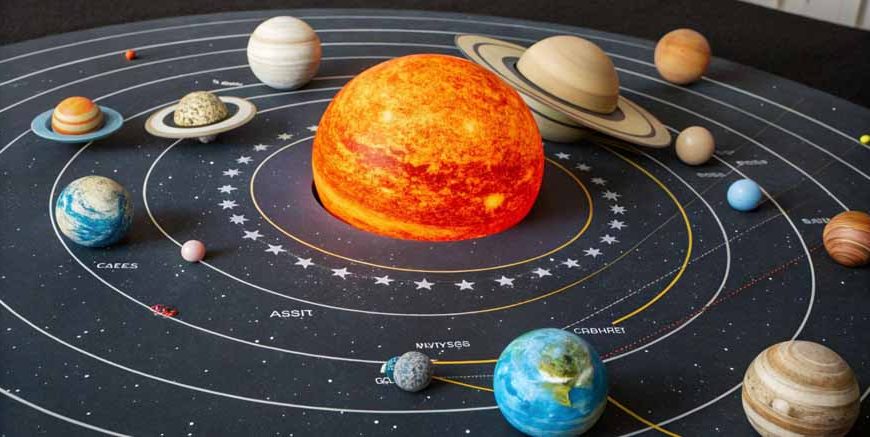
Look up at the night sky on a clear, dark evening. Those tiny, twinkling dots hanging above us are not just pretty, glowing lights; they are massive, swirling worlds of gas, freezing ice, and red-hot rocks. Millions of miles away from our own cosy Earth, an entire cosmic dance is taking place in the freezing vacuum of space. To truly appreciate this incredible universe, it helps to put on our imaginary astronaut helmets and dive headfirst into some brilliant cosmic trivia!
Learning about our celestial neighbourhood is a thrilling adventure for young minds. Instead of simply reading heavy, dusty textbooks, testing ourselves with a fun, interactive challenge is the perfect way to make science stick. Let us embark on an interstellar journey together and see just how much you know about the galaxy we call home.
Exploring the Universe Through Space GK Questions
When children point at the stars and ask how far away they are, they are showing a natural, beautiful curiosity about their place in the universe. Introducing space GK questions (General Knowledge) is a fantastic way to satisfy that boundless curiosity. These bite-sized facts help them understand mind-boggling concepts, like how a single day on Venus is actually longer than an entire year on Earth!
By regularly practising general knowledge questions about space, young learners begin to grasp the sheer, unbelievable scale of the galaxy. It sparks their imagination, encouraging them to think far beyond our blue skies and wonder about speeding rockets, robotic rovers, and distant, icy moons. It transforms abstract science into an exciting mystery waiting to be solved.
Read More – Science Quiz Questions and Answers for Kids
Preparing for the Quiz on Solar System with Answers
Gather your family around the living room table, grab some snacks, and get your imaginary buzzers ready! Hosting a quiz on solar system with answers is an excellent bonding activity for a quiet Sunday afternoon. We have compiled a special mix of fun and slightly tricky solar system questions and answers designed specifically to test your child’s astronomical knowledge.
Remember, the goal of this game is not just about getting the right answer instantly; it is about discussing the fascinating, bizarre science behind why that answer is correct. Let the countdown begin!
The Top 10 Questions About Solar System With Answers
Let us blast off straight into our cosmic test. Here are our top 10 questions about solar system with answers, packed with descriptive questions about planets and their trusty lunar companions!
1. Which planet is famously known as the Red Planet?
Answer: Mars. Mars gets its distinctive, rusty red colour from iron oxide covering its dusty surface. It is the exact same chemical reaction that makes an old bicycle rust if you leave it out in the rain!
2. What is the largest planet in our entire solar system?
Answer: Jupiter. Jupiter is an absolute giant. It is so incredibly massive that you could fit over 1,300 Earths inside it like jellybeans in a jar! It is famously known for its Great Red Spot, which is actually a giant, swirling storm that has been raging for hundreds of years.
3. Which planet wears the most spectacular set of rings?
Answer: Saturn. While a few other planets have very faint rings, Saturn undoubtedly wears the crown. Its beautiful, bright, glowing rings are not solid; they are made entirely of billions of pieces of floating ice, dust, and rock zooming around the planet.
4. What is the name of Earth’s one and only natural satellite?
Answer: The Moon. It is the brightest, largest object in our night sky and holds a very special record: it is the only place beyond Earth where human beings have ever actually walked!
5. Which planet is the closest neighbour to the Sun?
Answer: Mercury. Because it sits right next to the blazing Sun, you might think it is the hottest planet. However, it actually has freezing cold nights because it has no blanket of air (an atmosphere) to trap the daytime heat.
6. Which planet spins on its side like a rolling barrel?
Answer: Uranus. Unlike Earth, which spins upright like a toy top, Uranus is tilted completely sideways. This makes it look like a pale blue, icy ball rolling lazily around the Sun.
7. What is the hottest planet in our solar system?
Answer: Venus. Even though Mercury is physically closer to the Sun, Venus holds the heat record. It has a thick, toxic atmosphere that traps heat perfectly like a giant glass greenhouse, making the surface hot enough to melt solid metal!
8. Which planet has a famous, fascinating moon called Titan?
Answer: Saturn. Titan is Saturn’s largest moon and is incredibly special to scientists. It has thick orange clouds and deep lakes, but instead of water, the lakes are filled with freezing liquid methane.
9. What do we call the giant ring of space rocks that orbits the sun between Mars and Jupiter?
Answer: The Asteroid Belt. This is a massive, dusty highway made up of millions of jagged rocks and dwarf planets that never quite managed to pull together to form a full-sized planet of their own.
10. Which is the coldest, windiest planet in our solar system?
Answer: Neptune. Sitting at the very dark, freezing edge of our planetary neighbourhood, Neptune is an icy, blue world where the sun looks like just another tiny star, and winds blow faster than a fighter jet.
Read More – GK Questions For Class 3 Kids With Answers
Conclusion
Looking up at the night sky changes from a simple, passing glance into a profound experience once you know the secrets hiding in the dark. Testing our knowledge with a cosmic quiz does so much more than just fill our brains with fun trivia; it reminds us of how incredibly vast, mysterious, and beautiful our universe truly is.
When children learn that they are living on a small, spinning blue marble floating safely in an infinite ocean of stars, it sparks a lifelong sense of wonder and deep humility. It encourages them to ask big questions, dream of exploring the unknown, and realise that there are always new mysteries waiting to be solved just beyond the clouds. Keep looking up, keep asking questions, and never lose that brilliant sense of cosmic curiosity.
To uncover more fascinating educational adventures and to support your child’s brilliant learning journey, step into the EuroKids Blog, and discover everything you need to know about joining our vibrant community through EuroKids Preschool Admission.
FAQs
How many moons does Jupiter have?
Jupiter has a massive family of moons! Astronomers have currently confirmed over 90 moons orbiting this giant gas planet, with the largest four being called the Galilean moons.
Can humans ever live on another planet?
Scientists and engineers are currently studying Mars as a potential future home. They are actively sending robotic rovers to the surface to see if we could eventually build safe, warm habitats there!
Is the Sun considered a planet?
No, the Sun is actually a star! It is a gigantic, super-heated ball of burning, glowing gases sitting right at the centre of our system, holding all the planets firmly in their paths with its massive gravity.