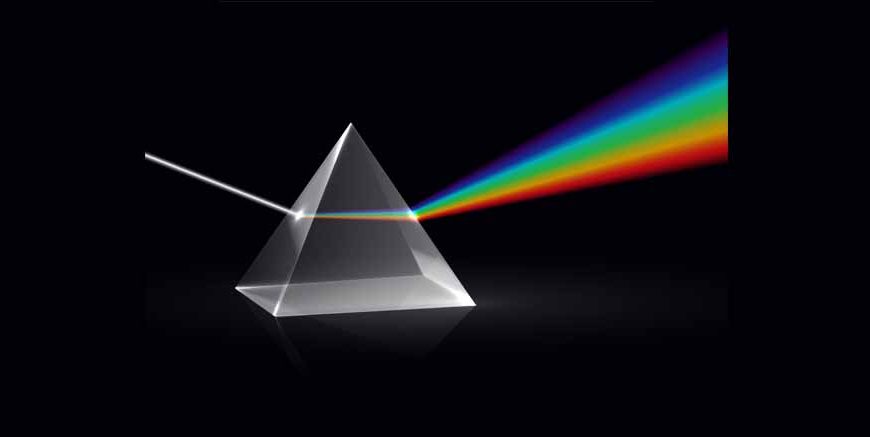
Sunlight tumbling through a classroom windowpane looks completely plain. It illuminates the wooden desks, warms the floorboards, and allows us to read our books. However, that seemingly ordinary beam of bright white light is actually carrying a massive, highly colourful secret. Centuries ago, curious scientists discovered that white light is not just one blank shade. It is a tightly packed, invisible bundle containing every single colour of the rainbow.
We only get to witness these hidden shades when the light hits a special object, like a glass prism or a falling raindrop, causing the beam to suddenly bend and shatter into brilliant, separate stripes. Breaking this complex physics concept down into practical, hands-on activities transforms a standard science lesson into pure magic for young, eager minds.
A Simple light spectrum definition
Before diving into messy, hands-on classroom experiments, we need to quickly anchor the lesson with a highly practical light spectrum definition. In the simplest possible terms, it is the complete, orderly range of colours that physically appear when white light is forced to split apart.
If a student raises their hand and asks exactly what is spectrum of light, you can enthusiastically tell them it is essentially nature’s hidden paintbox.
It is the exact scientific reason why a brilliant, glowing rainbow magically appears across the sky right after a heavy summer rainstorm. The millions of tiny, suspended raindrops act exactly like floating glass mirrors, grabbing the plain sunlight and bending it sharply until all the hidden colours burst outward for us to see.
Read More – Mirror Reflections for Kids
Exploring the Visible light spectrum
When the plain white light is successfully broken apart, it always reveals the exact same colours in the exact same reliable order. Here is a clear list of the colours that make up the visible light spectrum, moving from the longest waves down to the shortest:
- Red: This sits at the very top of the rainbow. It is the warmest, most visible shade and has the longest stretching wave.
- Orange: Sitting right below red, this vibrant shade is a brilliant mixture of warm light.
- Yellow: The bright, sunny centre of the warm colours.
- Green: The very middle of the rainbow, representing the cool, calming shade of the natural world.
- Blue: A deep, rich colour that scatters easily in the atmosphere, which is exactly why our sky looks blue during the day.
- Indigo: A very dark, midnight blue that sits quietly before the final shade.
- Violet: Sitting at the absolute bottom of the rainbow, this colour carries the highest energy and the tightest waves.
Understanding light spectrum wavelengths
How can one beam of light possibly contain so many different colours? The answer lies entirely in how light physically travels. Light does not shoot in a straight, rigid line like a solid arrow; it actually travels in bumpy, rolling waves, exactly like the ripples you see rolling across the ocean.
Each distinct colour depends entirely on its specific light spectrum wavelengths. This means that every single colour travels at a slightly different speed and rhythm. Red light travels in very long, lazy, stretched-out waves. Because it stretches so far, it easily pushes through thick clouds and dust. On the completely opposite end of the scale, violet light travels in very short, frantic, tightly packed waves. When white light hits a glass prism, these different waves get confused and bend at different speeds, forcing the colours to separate and form a rainbow.
Read More – Fascinating Science Facts for Kids
A Quick light wavelength table
To help older children logically understand the specific maths behind the colours, scientists measure these tiny waves using a unit called a nanometre. A nanometre is unimaginably small, far thinner than a single strand of human hair! Here is a helpful light wavelength table showing the distinct differences between the shades:
|
Colour Band |
Wavelength Range (Nanometres) |
Energy Level |
|
Red |
620 – 750 |
Lowest Energy |
|
Orange |
590 – 620 |
Low Energy |
|
Yellow |
570 – 590 |
Medium-Low Energy |
|
Green |
495 – 570 |
Medium Energy |
|
Blue |
450 – 495 |
Medium-High Energy |
|
Indigo / Violet |
380 – 450 |
Highest Energy |
This table clearly proves that what our human eyes perceive as a simple ‘colour’ is actually a highly specific, measurable physical wave of energy.
Exciting Classroom Experiments
You do not need to buy incredibly expensive laboratory equipment to prove these scientific facts to a group of children. The absolute best way to teach this concept is through active, tactile discovery.
One fantastic classroom experiment simply requires a shallow bowl of water, a small pocket mirror, and a bright torch. Place the mirror halfway into the water, resting it at a slight angle against the side of the bowl. Turn all the classroom lights off so the room is completely dark. Then, shine the white torch light directly into the water, aiming perfectly at the submerged mirror. The water acts as a natural prism, bending the torch beam and reflecting a beautiful, clear rainbow right onto the classroom ceiling!
Another brilliant, quick activity involves old, discarded CD-ROMs. Give each child a shiny disc and let them tilt it under the classroom lights. The tiny, microscopic grooves cut into the plastic surface instantly split the white light, causing shifting, vibrant rainbows to physically dance across their hands.
Read More – Simple Experiments for Junior Scientists
Conclusion
Stripping away the heavy, complicated physics and allowing children to actively play with bending light completely changes how they view their physical environment. They suddenly realise that the world is not just painted with static colours; it is actively illuminated by bouncing, shifting waves of invisible energy. It is genuinely thought-provoking to realise that every time a child looks up at a colourful summer rainbow, they are actually witnessing a massive, highly complex physics equation solving itself perfectly in the sky.
By bringing these vibrant experiments into the classroom, we actively encourage young minds to question the ordinary things they see every single day, building a lifelong foundation of sharp scientific curiosity. To uncover more fascinating learning activities and support your child’s brilliant academic growth, explore the rich resources on the EuroKids Blog and secure their next great educational adventure through EuroKids Preschool Admission today.
FAQs
Why does the order of the colours in a rainbow never change?
The order remains completely permanent because it is based strictly on physics. The longer red waves always bend the least, while the short violet waves always bend the most, forcing them into the exact same sequence every single time.
Can humans see every type of light wave?
No, our human eyes are highly limited. We can only see the visible spectrum. We cannot see ultraviolet waves (which cause sunburns) or infrared waves (which carry heat), even though they exist all around us.
Why does a red apple look red?
When white sunlight hits the apple, the skin of the fruit completely absorbs the yellow, green, blue, and violet waves. It only reflects the red waves back into our eyes, making the apple appear red.