Nursery rhymes are not just simple songs. They are powerful developmental tools that bridge the gap between play and learning. Among the most famous is the classic humpty dumpty rhymes collection. These verses do more than entertain. They teach cause and effect, history and rhythm in a way that your child’s developing brain can easily digest.
When you introduce humpty dumpty nursery rhymes to your child, you are doing more than singing a catchy tune. You are building the foundation for literacy and cognitive resilience. This blog will guide you through the lyrics, the fascinating history behind the egg and the crucial developmental benefits it offers. You will also discover how to turn this nursery rhyme into an interactive learning session that bonds you and your child.
The Classic Lyrics You Know and Love
The beauty of humpty dumpty English rhymes lies in their simplicity. The rhythm is repetitive and bouncing, which captures a toddler’s attention immediately. You probably remember the words from your own childhood, but reciting them with your child now creates a shared experience that is comforting and educational.
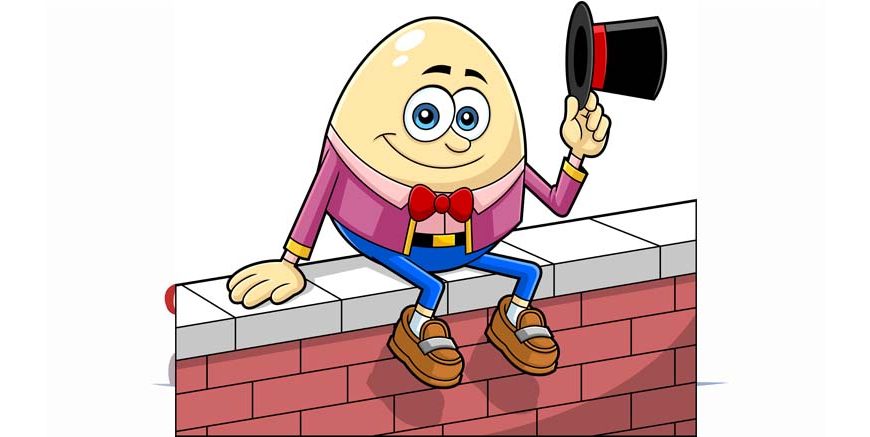
Humpty Dumpty sat on a wall,
Humpty Dumpty had a great fall.
All the King’s horses and all the King’s men
Couldn’t put Humpty together again.
When you recite this, you are teaching your child about narrative structure. There is a clear beginning where the character is safe, a middle where a crisis occurs and an end where the consequences are permanent. This simple AABB rhyme scheme helps children predict the sound at the end of the line. This prediction is a critical early literacy skill known as phonological awareness. You are training their ears to hear the similarities between ‘wall’ and ‘fall’ or ‘men’ and ‘again’. This auditory training is the first step towards reading readiness.
Read More – Classic Nursery Rhymes for Preschool Kids
Unlocking The History: Was Humpty Really an Egg?
You might be surprised to learn that the original humpty dumpty rhymes likely had nothing to do with an egg. The illustrations of an egg-shaped man came much later, largely popularised by Lewis Carroll in Alice Through the Looking Glass. Before that, the term “Humpty Dumpty” was 17th-century slang for a short and clumsy person or a drink made of brandy and ale.
Historians and subject experts often debate the true origin, and this is where the story gets fascinating for you as a parent. One dominant theory suggests that Humpty Dumpty was actually a massive cannon used during the English Civil War. It was mounted on the walls of St Mary’s at the Wall church in Colchester. During the siege of 1648, the Parliamentarians shot the wall beneath the cannon, causing Humpty Dumpty to have a “great fall”. Naturally, “all the King’s horses and all the King’s men” (the Royalists) could not hoist the heavy cannon back onto the ruined wall.
Another theory links the rhyme to King Richard III of England, who was hunchbacked and defeated at the Battle of Bosworth Field. His “fall” from power was absolute, and no amount of support could restore his reign. Sharing these stories (in a simplified way) adds a layer of depth to the rhyme. It transforms a simple song into a piece of living history. You are not just teaching a rhyme. You are passing down a fragment of cultural heritage that has survived for hundreds of years.
The Lesson Inside The Fall
Beyond the history, humpty dumpty sat on a wall rhymes carry a significant moral lesson about risk and consequence. Children are naturally curious and often unaware of physical dangers. This rhyme provides a safe space to discuss what happens when we take risks that we are not prepared for. Humpty sat on a wall, which is a precarious place to be. The result was a fall that could not be fixed.
You can use this narrative to teach your child about physical safety without instilling fear. It introduces the concept of irreversibility in a gentle manner. Some things, once broken, cannot be fixed. This is a vital cognitive leap for a toddler who is used to magic fixes or cartoons where characters always bounce back. It grounds them in reality while still being playful.
The involvement of “all the King’s horses and all the King’s men” also teaches a lesson about limitations. Even the most powerful figures in the land could not solve the problem. It shows that resources and power do not always guarantee a solution. This encourages children to think about prevention rather than just relying on a cure. You can ask your child questions like “Why do you think he sat so high?” or “What could he have done differently?”. These questions spark critical thinking skills that are essential for their growing minds.
Read More – Best Nursery Rhymes List for Kids
Developmental Benefits of Reciting Nursery Rhymes
Reciting humpty dumpty nursery rhymes supports holistic development in ways that formal teaching cannot. The repetition reinforces memory pathways in the brain. Every time you sing the rhyme, your child’s brain fires neurons that strengthen their ability to recall information. This is why adults can still remember rhymes they learned decades ago.
Language development is another massive benefit. The rhyme introduces new vocabulary and sentence structures that are slightly more complex than daily speech. Words like “together” or “couldn’t” challenge their articulation. As they try to mimic your mouth movements, they exercise the muscles in their face and tongue, which improves clarity of speech.
Social and emotional development also plays a huge role here. When you sit with your child and sing, you are engaging in a shared activity that builds trust and security. This emotional safety is the bedrock of all future learning. A child who feels secure is more likely to explore and take intellectual risks. The rhythm of the rhyme also has a calming effect. It can be used to soothe a child during a tantrum or help them wind down before a nap. The predictable structure provides a sense of order in a world that often feels chaotic to a small child.
Engaging Activities to Bring the Rhyme to Life
You do not have to limit the experience to just singing. You can turn humpty dumpty English rhymes into a full sensory activity. Gross motor skills can be developed by acting out the rhyme. You can encourage your child to “sit on a wall” (a low sofa or cushion) and then safely “fall” onto a soft rug. This physical enactment helps them understand the meaning of the words through movement.
Fine motor skills can be practised by creating a craft. You can boil an egg (to avoid the mess) and let your child paint a face on it. Then, you can use toy blocks to build a wall. This combines art, engineering and storytelling. If the egg falls and cracks, it reinforces the lesson of the rhyme in a tangible way.
You can also use this rhyme to teach sequencing. Ask your child what happened first, next and last. Being able to sequence events is a precursor to understanding complex stories and even mathematical logic later in school. You are essentially teaching them how to organise their thoughts.
Conclusion
Nursery rhymes are a timeless gift you give to your child. They are tools for connection, education and historical appreciation. By exploring humpty dumpty rhymes with your little one, you are enhancing their vocabulary, memory and understanding of the world. You are teaching them that actions have consequences and that history is full of fascinating stories.
As you navigate the journey of parenting, remember that you do not have to do it alone. Resources are available to help you guide your child’s growth. If you are looking for a partner in your child’s education, consider EuroKids. Our expert educators are trained to nurture your child’s potential. You can visit our website to learn more about EuroKids Admission and find a centre near you. For more insights on parenting and child development, explore the EuroKids Blog section where we share valuable tips and expert advice regularly.
Frequently Asked Questions (FAQs)
1. What is the moral lesson of the Humpty Dumpty rhyme?
The primary lesson is about cause and effect and the consequences of risky behaviour. It teaches children that some actions lead to results that cannot be undone, even with a lot of help. It introduces the concept of safety and fragility in a gentle, understandable way.
2. Is Humpty Dumpty actually an egg?
The lyrics never actually describe Humpty Dumpty as an egg. The egg imagery became popular in the late 19th century. Historical theories suggest Humpty Dumpty might have been a cannon used in the English Civil War or a reference to a historical figure like King Richard III.
3. Why are nursery rhymes important for toddlers?
Nursery rhymes are crucial for phonological awareness, which is the ability to hear sounds within words. This is the first step toward reading. They also boost memory, vocabulary and social skills when sung with a parent or caregiver.
4. How can I teach my child humpty dumpty english rhymes effectively?
Start by singing the rhyme slowly so your child can hear the distinct sounds. Use hand gestures to represent the wall, the fall and the horses. Repetition is key, so sing it often during play or bath time. Eventually, pause and let your child fill in the rhyming words.
5. At what age should children start learning nursery rhymes?
You can start singing nursery rhymes to your child from birth. Even infants benefit from the rhythm and the sound of your voice. Toddlers will start to mimic the sounds and gestures around age one or two, and by age three, they can often recite simple rhymes on their own.