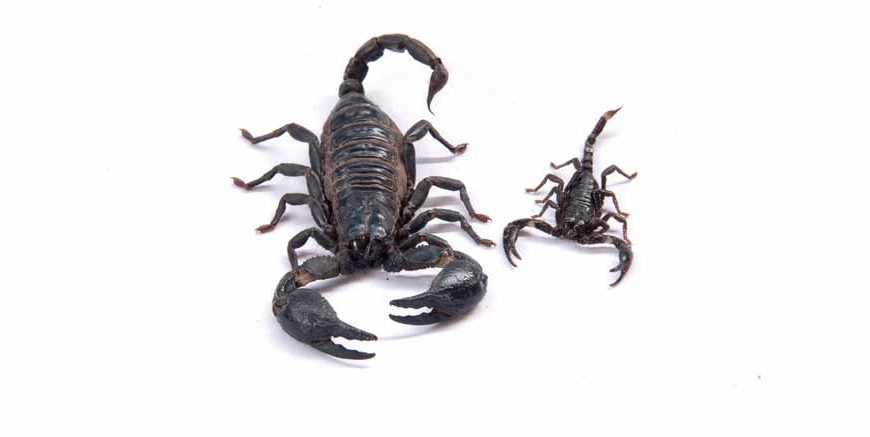
Let us take a quiet walk into the dense, damp forests of the Western Ghats just as the sun starts to set. The forest floor is covered in a thick blanket of crunchy dry leaves, fallen branches, and rich, dark soil. If you were to carefully peek under a heavy, rotting log, you might come face-to-face with a creature that looks completely alien.
It resembles a tiny, heavy-duty tank, dressed in glossy black armour, waving two giant pincers in the air. This magnificent, misunderstood creature is a favourite topic in environmental science classes. Children are naturally curious about things that look a little bit scary. So, let us turn that fear into pure fascination as we uncover some brilliant facts about these amazing night-time wanderers.
The Big Mistake: Are They Really Insects?
When kids first start learning about creepy-crawlies, they tend to group everything small and tickly into one single basket. It is very common for a student to point at a picture and call it a scorpion insect without thinking twice. However, this is a massive scientific mix-up!
To figure out why, all we have to do is count their legs. Insects, like ants, butterflies, and beetles, always have six legs and usually have a body divided into three distinct parts. If you look closely at our armoured friend, you will notice it has eight legs, just like a spider or a tick. They belong to a special family called arachnids. They also have two main body parts rather than three. So, the next time someone calls them an insect in your EVS class, you can gently correct them and share this brilliant piece of trivia.
Read More – Arachnids for Kids
Decoding the Name
In the scientific world, every single plant and animal gets a special tag, usually entirely in Latin. This helps researchers all over the globe know exactly which animal they are talking about, even if they speak different languages. The scorpion scientific name for the large, dark species we often see in Asian forests is Heterometrus.
It sounds a bit like a complicated magic spell from a wizarding book! This specific group is known as giant forest scorpions. Giving animals these complex names is a way for scientists to organise the natural world, much like a librarian organises books on a shelf by their genre and author.
Meet the Heavyweight Champion
Now, let us talk about the star of the show: the Indian black scorpion. Also known by its scientific tag Heterometrus swammerdami, this creature holds the impressive title of being one of the largest species in the entire world. Some of them can grow as long as a typical school ruler!
Because they are so big and black, they look completely terrifying. But nature has a very funny rule when it comes to these creatures. Usually, the bigger and thicker the pincers, the less dangerous their venom is. This big fellow has massive, muscular claws that look like they belong to a crab. It relies heavily on these strong claws to catch its dinner, mostly earthworms, crickets, and other small bugs, rather than using the stinger on its tail. Its sting is actually quite mild, feeling more like a nasty bee sting than something deeply dangerous to humans. They are shy, gentle giants who would much rather hide under a rock than pick a fight with a human.
Read More – GK Questions On Animals
A Brilliant World of Variety
If we zoom out from our own forests, we will see that the world is crawling with an amazing variety of arachnids. There are thousands of different types of scorpions living on almost every single continent except Antarctica. They are incredibly adaptable survivors.
Some live in the scorching, sandy deserts of Africa, while others hide in the freezing, snowy mountains of Europe. One of the most fascinating facts about almost all of them is that they glow in the dark! If you shine a special ultraviolet (UV) light on them at night, their outer shells light up in a bright, neon blue-green colour. Scientists are still trying to figure out exactly why they do this, but it makes finding them in the dark incredibly exciting for researchers.
Neighbours in Our Backyard
We do not have to travel the world to find variety. When we look at the types of scorpions in India, the differences between species are genuinely astonishing. Here is a quick list of some of the diverse species found across the country:
- The Giant Forest Scorpion: As we discussed, these are the large, dark, heavy-clawed creatures found in damp forests, relying on their grip rather than their venom.
- The Indian Red Scorpion: This one is a stark contrast. It is quite small, has very thin pincers, and is a dusty orange-red colour. Because its claws are weak, it relies entirely on its highly toxic venom for defence. It is actually considered one of the most dangerous species on the planet.
- The Bombay Scorpion: Mostly found hiding in rocky, dry terrains and inside the crevices of old stone walls.
- The Yellow Desert Scorpion: A master of camouflage, blending perfectly into the dry, sandy soils of arid regions like Rajasthan.
Comparing the big, harmless black giant to the tiny, dangerous red one is a perfect lesson for kids: in nature, looks can be incredibly deceiving. You can never judge a book by its cover, and you can certainly never judge an arachnid by its size!
Read More – List of Animals That Live On Land And Water
Conclusion
Studying these fascinating creatures in EVS class teaches us a profound lesson about the natural world. Instead of blindly fearing the things that crawl in the dark, we should take the time to understand their purpose. These eight-legged survivors control pest populations, keep our soils healthy, and show incredible adaptability. It leaves us with a thought-provoking question: how many other “scary” animals are actually just misunderstood helpers trying to go about their daily lives? Teaching children to respect wildlife from a distance, rather than fearing it, is the greatest environmental lesson of all. For more wonderful environmental science resources and parenting tips, read the EuroKids Blog, and discover a world of interactive learning through EuroKids Preschool Admission.
FAQs
Is a scorpion classified as an insect?
No, they are arachnids. Unlike insects which have six legs and three body segments, they possess eight legs and two main body segments, making them close cousins to spiders.
Why do some of these creatures glow in the dark?
Their outer skeleton contains special chemicals that absorb ultraviolet light and reflect it back as a bright blue-green glow, though scientists are still debating the exact evolutionary reason for this.
Is the large black scorpion dangerous to humans?
While it looks very intimidating due to its huge size, its venom is actually quite mild. It relies mostly on its strong pincers to catch food and will only sting humans if accidentally stepped on or provoked.
Where do they usually live during the day?
They are nocturnal creatures, meaning they sleep during the day. You will usually find them resting in cool, dark places like under rotting logs, heavy rocks, or deep inside burrows to escape the sun.