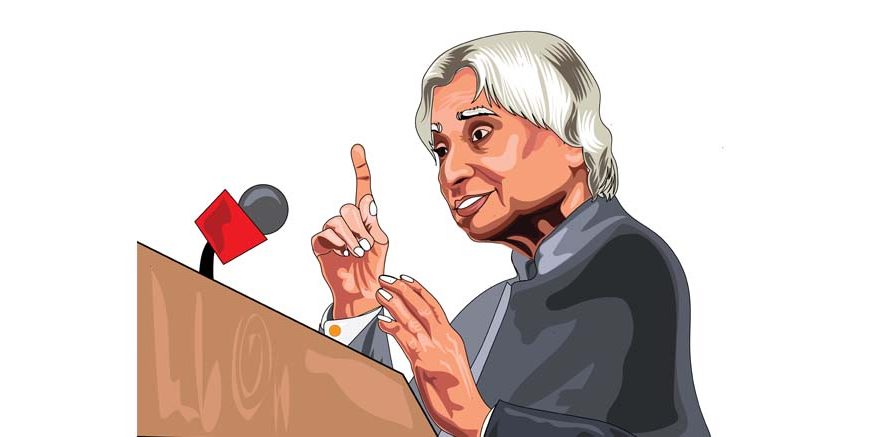
Long before he was known as the brilliant mind behind India’s space missions or the beloved President of the nation, he was just a hardworking student with a deep fascination for the world around him. Picture a young boy growing up in the quiet coastal town of Rameswaram in the 1930s, waking up long before the sun even began to rise over the ocean.
He did not have a life of luxury; instead, he spent his early mornings collecting heavy bundles of newspapers from the local railway station and running across town to distribute them. He did this to support his family’s small income, rushing to his classroom right after his route so he would not miss a single moment of his education.
This incredibly grounded, realistic beginning is exactly what makes the story of India’s ‘Missile Man’ so powerful for children to hear today. He did not inherit greatness or wealth; he built his legacy from scratch through sheer determination, an endless curiosity for physics, and a deep, enduring love for learning.
Today, we are going to explore the magnificent life of this inspiring leader. We will decode his long, historical name, look closely at his incredible scientific work, and discover how a boy who once sold newspapers became a global icon of hard work and humility.
What Does APJ Stand For?
When we read about great historical figures in our school textbooks, we often see their names shortened to initials. It makes them easy to remember, but it also hides a lot of beautiful family history. If a curious child looks at a photograph of the former president and asks you, what is the full name of APJ Abdul Kalam, the answer reveals a deep respect for his ancestors.
The Abdul Kalam full name is Avul Pakir Jainulabdeen Abdul Kalam.
Let us break down the APJ Abdul Kalam full form so that young learners can understand it better. In many traditional South Indian families, a person’s name proudly carries the legacy of the generations that came before them.
- ‘A’ stands for Avul, which was the given name of his great-grandfather.
- ‘P’ stands for Pakir, the name of his grandfather.
- ‘J’ stands for Jainulabdeen, which was his hardworking father’s name.
Every single time he signed an important scientific document or a presidential decree, he was carrying the memory, the struggles, and the blessings of three generations of his family along with him!
Read More – Top Freedom Fighters of India
Early Life: A Foundation of Hard Work and Science
Dr Kalam’s childhood was filled with real, everyday struggles. His father owned a simple wooden boat, ferrying Hindu pilgrims back and forth across the water to support the household. Despite their lack of money, his parents instilled a strong sense of discipline and honesty in him from a very young age.
When he grew older and wanted to study aerospace engineering at the prestigious Madras Institute of Technology, his family simply did not have the money to pay the expensive college fees. In a deeply touching display of family love, his fiercely supportive sister, Zohra, actually mortgaged her gold bangles to fund his education.
He was so deeply moved by her sacrifice that he vowed to work as hard as humanly possible to earn a scholarship and buy her bangles back. This story teaches children an invaluable lesson: behind every great person is a family that believed in them, and success is often driven by a desire to make our loved ones proud.
The Missile Man of India: His Great Achievements
After finishing his engineering studies, his absolute fascination with the science of flight led him to a brilliant career. He desperately wanted to understand the complicated mechanics behind aeroplanes, rockets, and satellites. His sharp, innovative mind soon caught the attention of India’s top scientific organisations, including the Defence Research and Development Organisation (DRDO) and the Indian Space Research Organisation (ISRO).
During his time at ISRO, he was chosen as the project director for India’s very first Satellite Launch Vehicle (SLV-III). To explain this massive achievement to a child, imagine a satellite as a giant, floating computer in space that helps us use our mobile phones, watch television programmes, and predict heavy rainstorms. Dr Kalam successfully led the team that built the enormous rocket needed to carry that computer safely up into the stars!
Later in his career, he played a massive role in developing India’s indigenous defence systems, including the famous Agni and Prithvi missiles. Because of his tireless contributions to the country’s space and defence programmes, the proud citizens of India gave him a wonderful nickname: ‘The Missile Man of India’.
Read More – Famous World Leaders for Students
The People’s President and the Ultimate Teacher
In the year 2002, Dr Kalam achieved something truly extraordinary when he became the 11th President of India. However, he was definitely not a traditional politician wrapped up in strict rules and fancy protocols. He remained a scientist, a poet, and a teacher at heart.
During his time in the highest office of the land, he famously opened the heavy doors of the presidential palace to the general public. He spent a massive portion of his time travelling the length and breadth of the country just to meet school students.
He firmly believed that the future of any country lies safely within the bright minds of its youth. He loved answering their curious questions, listening to their bold ideas, and actively encouraging them to study science and technology. Because he was so fiercely loved and respected by ordinary citizens, he became fondly known everywhere as the ‘People’s President’.
Inspiring Quotes to Live By
Dr Kalam was a man of beautiful, highly motivating words. He left behind a treasure trove of quotes that can inspire any young student to push through their daily challenges. One of his most famous sayings is:
“Dream, dream, dream. Dreams transform into thoughts and thoughts result in action.”
If you want to explain this lovely quote to a child, tell them that everything great in the world starts inside the imagination. Whether they want to become a brave firefighter, a brilliant doctor, or a famous artist, they first have to dream about it. That dream will make them think about how to achieve it, and those thoughts will make them pick up their books, study hard, and take real action.
He also famously said, “If you want to shine like a sun, first burn like a sun.” This simply and powerfully means that to achieve brilliant, glowing success, you must be willing to put in the hard, exhausting effort first.
Read More – Interesting GK Questions for Kids
Conclusion
The journey of Avul Pakir Jainulabdeen Abdul Kalam is undeniably one of the most remarkable stories of the modern era. It is the raw, authentic story of a humble newspaper boy who used the power of education, sheer determination, and an unbreakable spirit to touch the stars and eventually lead a nation. His life proves to us that it absolutely does not matter where you come from, how much money your family has, or how difficult your daily circumstances might be.
If you have a curious mind, a good heart, and a willingness to work incredibly hard, there is no limit to what you can achieve. He taught us all to look up at the sky, not just to admire the birds, but to confidently imagine ourselves flying right alongside them. To explore more inspiring stories and to give your child the perfect launchpad for their own big dreams, take a moment to visit the EuroKids Blog and find out all the necessary details regarding EuroKids Preschool Admission today.
FAQs
What do the initials APJ stand for?
The initials stand for Avul Pakir Jainulabdeen, which respectfully represent the traditional given names of his great-grandfather, his grandfather, and his father.
Why is Dr Kalam known as the Missile Man of India?
He earned this fantastic nickname because of his crucial, groundbreaking work in developing the technology for India’s ballistic missiles and space launch vehicles.
Did Dr Kalam only work as a scientist during his life?
No, while he spent the majority of his life as a dedicated aerospace scientist, he also proudly served as the 11th President of India and spent his later years as a passionate teacher and visiting professor.