Imagine a world where your favourite remote-control car is permanently plugged into the living room wall with a short, thick wire. You would not be able to race it down the hallway, take it into the garden, or bring it to the local park. The wonderful freedom to move our gadgets around relies entirely on a brilliant little invention that quietly stores immense power in a tiny, portable package. Instead of relying on long cables, we carry our electricity with us. Let us delve into the fascinating science behind these everyday powerhouses and learn how they bring our favourite toys to life.
What is the meaning of battery?
When curious children ask what is the meaning of battery, it is best to describe it as a portable, tightly packed lunchbox of energy. Just as a large water tank stores rainwater until you are ready to turn on the garden tap, this clever device safely stores chemical energy. It sits perfectly quiet and still until it is needed. When you slot it into a toy robot and flick the power switch, it instantly transforms that stored chemistry into flowing electricity, bringing the plastic toy to life with flashing lights and loud sounds. It is the ultimate travel-sized power station.
Read More – What is Mechanical Energy?
The Scientific battery definition
To truly understand what is battery definition, we need to take an imaginary peek inside the metal casing. A proper scientific battery definition states that it is an electronic component containing one or more electrochemical cells. That might sound like complicated science jargon, but it is actually quite simple!
Inside the metal shell, there are special chemicals waiting patiently. There are two different ends, usually marked with a plus sign (positive) and a minus sign (negative). When you connect these two ends using a metal wire inside a gadget, a chemical reaction suddenly happens inside the casing. This reaction pushes tiny, invisible particles called electrons out of the negative end, through the wire, and back into the positive end. This rapid flow of invisible particles is what we call electricity. It is exactly like a team of tiny workers rushing out to do an important job, whether that is lighting up a dark room with a torch or spinning the wheels on a toy train.
An example of battery in Our Daily Lives
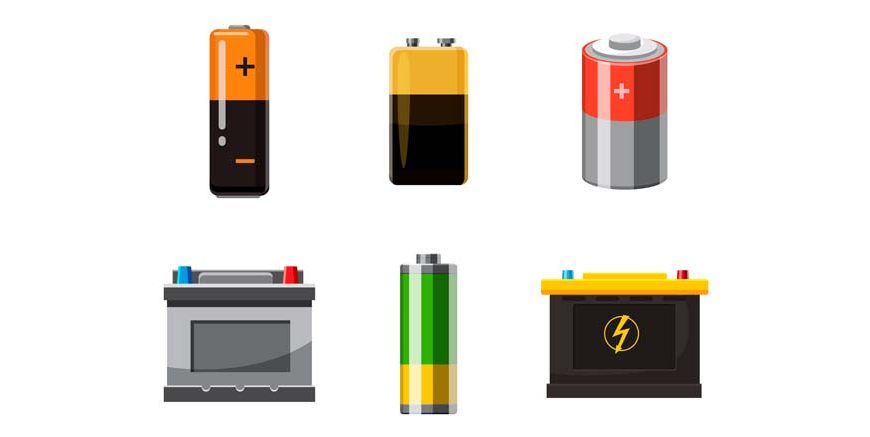
You do not have to look very far to find an example of battery hiding in your house. They come in an incredible variety of shapes and sizes, perfectly designed for the specific jobs they need to do.
Think about the tiny, shiny, silver buttons that keep your grandad’s wristwatch ticking accurately all year round. Then, look at the thick, chunky cylinders that power the television remote control. In the modern age, we also have highly advanced, flat rechargeable versions tucked safely inside the family tablet and mobile phones.
These are incredibly special because, unlike the older versions, they can be filled up with fresh energy again and again from the mains supply. Even the heavy family car sitting on the driveway relies on a giant, heavy version to start its rumbling engine every single morning!
Read More – GK Questions On Famous Inventions
Brilliant Power Facts for Kids
Science is full of wonderful surprises, and portable power is no exception. Did you know that the very first true version of this device was invented over two hundred years ago? A clever Italian scientist named Alessandro Volta built it by stacking alternating discs of copper and zinc together, separated by cloth soaked in salty water. Because of his brilliant invention, we still measure electrical force in ‘volts’ today!
Another highly amusing fact for young scientists is that you can actually create a very weak electrical current using food from your kitchen. Common items like potatoes and lemons contain natural, acidic juices. If you push specific metal nails into a juicy lemon, the acid acts just like the chemicals inside a real power cell, generating enough energy to light up a tiny LED bulb!
Summary
We live in a truly wonderful era where we can carry the power of lightning right in our trouser pockets. From allowing us to read a book under the bedcovers with a torch, to letting us speak to a friend on the other side of the country while walking through a forest, these compact energy boxes have completely revolutionised human history. They have made the entire world mobile. It makes you pause and wonder: as technology gets even smaller and much smarter, what kind of incredible, tiny power sources will the next generation invent to fuel our future? To discover more engaging scientific concepts and find the absolute best environment to nurture your child’s brilliant imagination, explore the EuroKids Blog and secure their educational journey through EuroKids Preschool Admission today.
FAQs
Who invented the very first portable power cell?
The Italian scientist Alessandro Volta invented the first continuous power source in the year 1800, which is why we measure electrical force in ‘volts’.
Why do some of them eventually stop working?
The chemicals inside slowly get used up. Once the chemical reaction finishes, the invisible electrons stop flowing, meaning the cell is flat and needs to be recycled safely.
Is it safe for a child to open one up?
Absolutely not. They contain strong, harmful chemicals and acids that can badly burn the skin and damage the eyes, so the metal casing must always stay sealed shut.