Early math learning begins with helping children notice patterns, group objects, and understand how counting works in everyday life. As they explore these basics, they come across different types of numbers, one of the most important being odd numbers. Learning about odd numbers helps children see how numbers behave and how they form pairs.
Understanding this concept strengthens counting skills, builds logical thinking, and prepares children for operations like addition, subtraction, multiplication, and division. When taught through patterns, activities, and real-life examples, odd numbers become easy and enjoyable for young learners to grasp.
In this guide, we will explain what odd numbers are, how to recognise them quickly, their patterns and properties, and simple activities that make learning interactive and meaningful for children.
What Are Odd Numbers?
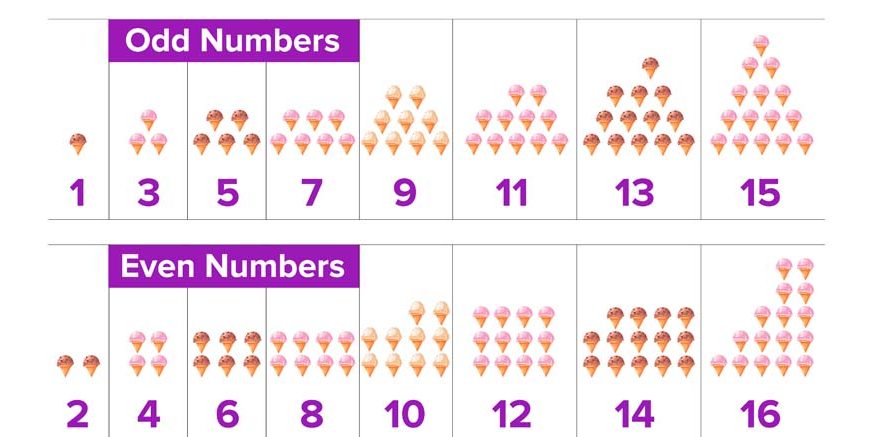
Odd numbers are numbers that cannot be divided evenly by 2. When an odd number is divided by 2, there is always one left over. An odd number is a number that leaves 1 extra when you try to make pairs. Examples: 1, 3, 5, 7, 9, 11, and 13. These are all odd numbers because they cannot be split into two equal groups without a leftover.
Read More – What are Odd Numbers?
Easy Way To Recognise Odd Numbers
If a number ends with: 1, 3, 5, 7, or 9, then it is an odd number Examples: 21, 35, 47, 89, and 103. This quick rule helps children identify odd numbers instantly without dividing.
Odd Numbers Pattern
Odd numbers follow a simple pattern:
Start at 1 and keep adding 2.
1 + 2 = 3
3 + 2 = 5
5 + 2 = 7
7 + 2 = 9
This skip-counting pattern helps children learn faster and improves mental math skills. Teachers often use skip counting to help children recognise number sequences easily.
Odd vs Even Numbers
|
Even numbers |
Odd numbers |
|
Divisible by 2 |
Not divisible by 2 |
|
No leftover |
One leftover |
|
End in 0,2,4,6,8 |
End in 1,3,5,7,9 |
Examples:
Even is 2, 4, 6, 8, 10
Odd is 1, 3, 5, 7, 9
Understanding this difference strengthens number classification skills.
Read More – What are Even Numbers?
Properties of Odd Numbers
Odd numbers follow interesting rules that help children build logical thinking.
1. Odd + Odd = Even
3 + 5 = 8
7 + 9 = 16
2. Odd + Even = Odd
3 + 4 = 7
9 + 2 = 11
3. Odd × Odd = Odd
3 × 5 = 15
4. Odd × Even = Even
3 × 4 = 12
Why Children Must Learn Odd Numbers
- Recognise number patterns
- Improve counting skills
- Build arithmetic foundations
- Understand division basics
- Strengthen logical thinking
- Learn number grouping
Real-Life Examples of Odd Numbers
Connecting math to real life improves understanding.
Examples:
- 5 fingers on one hand
- 7 days in a week
- 9 players in a baseball team
- 3 wheels in a tricycle
- 1 sun in the sky
Read More – Properties of Prime Number
Fun Activities To Teach Odd Numbers
1. Pairing Game
Give children objects like beads or blocks. Ask them to make pairs. If one is left, it’s an odd number.
2. Jump Counting
Ask children to jump forward by 2 each time while saying numbers aloud.
3. Odd Number Hunt
Ask children to find odd numbers around them, house numbers, clocks, books, etc.
4. Color Coding
Color all odd numbers red and even numbers blue on a worksheet.
Common Mistakes Children Make
- Thinking all small numbers are odd
- Forgetting the last-digit rule
- Mixing up even and odd patterns
- Not checking the leftover while pairing
- Guessing without verifying
How Quality Early Learning in EuroKids Builds Strong Number Foundations
Strong math understanding begins with concrete experiences. Early number concepts like odd and even are taught using objects, pairing activities, counting games, and visual tools. Children learn by grouping, sorting, and exploring numbers through play. Teachers use interactive exercises, story-based math learning, and hands-on number games so children understand patterns instead of memorizing rules. This approach builds confidence and long-term number sense.
How the HEUREKA Curriculum Supports Concept Discovery
The HEUREKA Curriculum approach focuses on discovery-based and experiential learning. Instead of rote memorization, children explore number ideas through:
- Object pairing activities
- Pattern recognition games
- Skip-counting exercises
- Collaborative math play
- Visual number tools
- Inquiry-based learning tasks
This method helps children understand why odd numbers behave differently, making math meaningful and enjoyable.
Conclusion
Odd numbers are a simple yet powerful concept in early math learning. They help children recognise number patterns, understand grouping, and improve logical thinking. An odd number cannot be divided into equal pairs and always leaves one extra. Children can quickly identify odd numbers by checking the last digit or using pairing methods.
With activities, games, and visual learning, children can master odd numbers easily. A strong understanding of number types lays the groundwork for future math success. When learning is playful and interactive, children develop both clarity and confidence.
To explore more learning ideas, simple explanations, and early childhood resources, parents can visit the EuroKids Blog. Those who wish to understand the preschool journey better or explore enrolment options can find complete information on the EuroKids Preschool Admission Page, where learning is designed to be joyful, engaging, and child-friendly.
FAQs:
1. What are odd numbers?
Odd numbers are numbers that cannot be divided evenly by 2 and leave one leftover.
2. How can kids recognise odd numbers quickly?
If a number ends in 1, 3, 5, 7, or 9, it is odd.
3. What is the smallest odd number?
The smallest odd number is 1.
4. Is zero an odd number?
No, zero is an even number.
5. Are all prime numbers odd?
Most prime numbers are odd, except 2, which is even.