Nature often holds a mirror up to our own social behaviours, quietly teaching us lessons we struggle to learn on our own. When we wander through a thick, green woodland, our eyes naturally drift towards the tallest, straightest timber. We admire the flawless bark, the perfect symmetry of the leaves, and the branches reaching triumphantly into the sky. Society often teaches us, from a very young age, to value this specific type of conventional perfection. However, the natural world is far wiser than we give it credit for. Sometimes, the most valuable insights are hidden inside the shapes and forms we hastily label as imperfect.
Today, we are going to explore a classic narrative that has been told for generations around campfires and in classrooms. It is a tale about finding worth in unexpected places and learning to love the quirks that make us utterly unique. Let us step into the heart of the forest and uncover the deep wisdom rooted inside a very special fable.
A Classic Tree Story in English
Every great fable requires a vivid setting. This particular tree story in English takes place in a sprawling, ancient forest. The woods were densely packed with magnificent timber. There were towering pines, sturdy oaks, and elegant silver birches. These trees stood incredibly straight, pushing their chests out with pride. They boasted bright green leaves and perfectly smooth, straight trunks that looked like they had been carved by a master craftsman.
However, right in the middle of this grand display of botanical perfection, stood one singular oddity. It was a completely crooked tree. Its trunk was bent at an awkward angle, twisting sharply to the left before jagging back to the right. Its branches were knotty, uneven, and curled in strange directions, making it look like a tangled ball of rough brown yarn.
Because it looked so vastly different, the straight, tall trees were incredibly cruel. They would rustle their leaves and laugh, whispering mean comments down at their crooked neighbour.
“Look at how strange you are,” a tall pine would sneer. “You are completely useless. You cannot even stand up straight to touch the sunlight.”
The crooked tree felt a deep, overwhelming sadness. It believed the cruel words of its neighbours. It wished with all its heart that it could magically straighten its trunk and become a ‘normal’ piece of the forest. It spent its days weeping sap, feeling deeply ashamed of its twisted, uneven appearance.
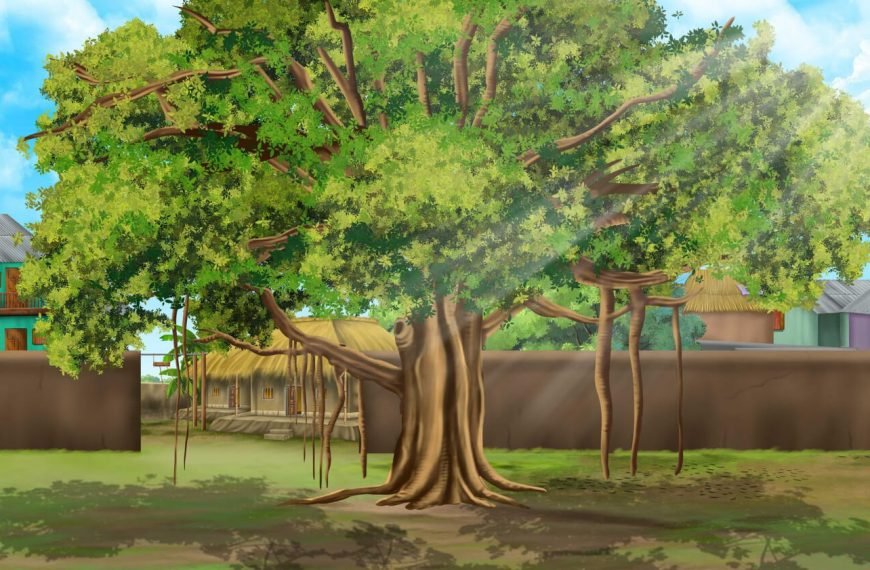
Read More – Banyan Tree for Kids
The Turning Point: The Heart of The Ugly Tree Story
The true turning point in the ugly tree story occurs on a crisp, chilly autumn morning. The peaceful silence of the forest was suddenly shattered by the heavy, thudding sound of boots and the sharp metallic clinking of steel. A group of burly woodcutters had entered the woods. They were searching for the finest timber to build a grand new palace for the local king.
The woodcutters walked proudly through the brush, inspecting the trunks. “Ah, look at these magnificent pines!” the head woodcutter shouted. “They are perfectly straight and tall. They will make the most beautiful, strong pillars for the king’s grand dining hall.”
Without hesitation, the men raised their heavy axes. One by one, the proud, boastful, beautiful trees were chopped down. They crashed heavily onto the forest floor, their perfect branches snapping in the dirt.
Soon, the head woodcutter approached the centre of the woods. He stopped right in front of the bent, twisted trunk. He ran his rough hand over the knotty bark and sighed. “This one is completely useless to us,” he told his men. “The trunk is far too crooked to be made into a straight pillar, and the branches are too twisted to cut into flat floorboards. Leave it be. It is not worth our time.”
The men packed up their tools, dragging the fallen straight trees out of the woods, leaving the bent tree standing entirely alone in the clearing.
Why Every Tree Story Matters for Kids
As the dust settled in the quiet forest, a profound realisation washed over the crooked tree. For its entire life, it had cried over its bent trunk and knotted branches. It had believed the cruel taunts of the others, convinced that its unusual appearance was a terrible curse.
Yet, it was that exact “ugliness” that had saved its life. The very traits it hated most about itself were the exact reasons it was still standing firmly rooted in the soil, able to feel the warm sunshine and watch the birds fly overhead. Its physical imperfections were not a curse at all; they were an invisible shield.
When we share a tree story like this with young children, we are doing much more than just entertaining them with talking plants. We are directly addressing the silent insecurities that almost every child harbours. In a world that constantly compares children to one another—who runs the fastest, who draws the neatest, who has the most fashionable shoes—kids quickly learn to feel ashamed of the things that make them different. This narrative serves as a gentle, powerful course correction.
Read More – Short Moral Stories For KidsValuable Lessons from the Crooked Branches
To help children fully grasp the depth of this ancient fable, it is incredibly helpful to break down the specific morals into relatable, everyday concepts.
1. Your Differences Are Your Strengths
Children often feel self-conscious about things they cannot control. A child might wear thick glasses, have a stutter, or be significantly taller or shorter than their peers. This fable teaches them that what society hastily labels as a “flaw” can actually be a tremendous advantage. Those thick glasses help them read brilliant books; that unusual height might make them a fantastic basketball player later in life. Our differences are the very things that protect us and make us beautifully unique.
2. The Danger of Vanity and Arrogance
The tall, straight timber in the forest were overly proud of their perfect appearance. They spent their days mocking someone who looked different, but in the end, their conventional beauty is exactly what led to their downfall. This is a brilliant way to teach children about humility. It shows them that being unkind or boastful about your own talents or appearance is foolish, as true worth is never determined merely by how something looks on the outside.
3. Everyone Has a Unique Purpose
Just because the crooked branches could not be used to build a royal palace does not mean they had no purpose. With the tall canopy gone, the twisted branches could now provide a massive, shady canopy for the forest animals. Birds could build sturdy nests in its tangled knots. It teaches kids that just because you do not fit into one specific, traditional box does not mean you do not have a wonderful, important role to play in the world.
Conclusion
When we strip away the bark and the leaves, this narrative is not truly about forestry or woodcutters. It is a profound reflection on self-acceptance. We spend so much of our lives trying to force ourselves into perfectly straight, conventional moulds, desperately hoping we will be chosen and validated by the people around us.
However, true peace is found the moment we stop apologising for our crooked branches. Every twist in our path, every unusual quirk in our personality, and every perceived imperfection is what makes our personal story worth telling. Have a think about this today: instead of looking in the mirror and wishing you were as ‘straight’ and ‘perfect’ as everyone else, what if you chose to celebrate the unique bends that make you incredibly resilient? Embracing your true self is the greatest adventure you will ever undertake.
To discover more enriching stories, parenting resources, and supportive early education insights, explore the EuroKids Blog, and find out everything you need to know about joining our family through EuroKids Preschool Admission.
FAQs
1. What is the core moral of this ancient fable?
The primary moral is that our flaws and imperfections can often be our greatest strengths. It teaches us to practice self-acceptance and to never judge or mock others based purely on their physical appearance.
2. How can I explain the concept of ‘vanity’ to a young child?
You can explain vanity by comparing it to a shiny, red apple that is completely rotten on the inside. Tell them that vanity means caring only about looking perfectly shiny on the outside, whilst forgetting to be kind and good on the inside.
3. Is this story appropriate for preschool-aged children?
Absolutely. The narrative is simple, the characters are easy to understand, and the ending is positive and uplifting. It is an excellent, gentle tool for introducing the concepts of bullying and self-love to very young listeners.