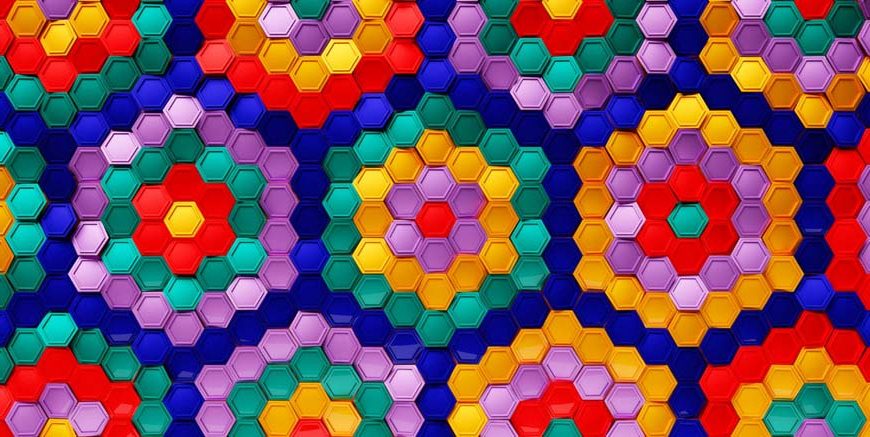
Are you trying to find a way to make maths actually exciting for your child? We all know that staring at numbers on a blank page can lose a toddler’s attention in seconds. But what if you could show them that maths is hiding all around them? What if maths looked like a giant, beautiful jigsaw puzzle?
If your child has ever stopped to stare at a honeycomb, a tiled bathroom floor, or the geometric patches on a football, they have already experienced one of the most fascinating concepts in geometry. They just did not have the vocabulary for it yet. Today, we are going to fix that. We are going to explore a topic that perfectly blends strict mathematical rules with wild artistic creativity. We are going to teach your child how to see the world through the lens of geometry.
The Magic Puzzle: What is Tessellation?
When a young child asks you what is tessellation, you do not need to pull out a heavy geometry textbook. You just need to explain the rules of the puzzle.
In the absolute simplest terms, a tessellation is a pattern made of shapes that fit perfectly together. There are two very strict rules for this game. First, there can be absolutely no gaps between the shapes. Second, the shapes can never overlap each other. They must lock together edge to edge, just like a jigsaw puzzle that could technically go on forever in every single direction.
When you introduce this concept to your kids, you are doing something wonderful for their brain. You are teaching them spatial awareness. You are showing them how individual parts connect to form a larger whole.
Read More – Geometric Shapes Name with Pictures for Kids
Exploring Different Tessellation Patterns
Once your child understands the basic rule of “no gaps and no overlaps”, you can start showing them the different categories. You can find these tessellation patterns everywhere once you train your eyes to look for them.
The Regular Pattern Family
This is the easiest type to spot. A regular pattern uses only one type of regular polygon to cover a surface. A regular polygon is simply a shape where all the sides are exactly the same length and all the angles are identical. You can only create this specific type of pattern using three shapes: equilateral triangles, squares, or regular hexagons. Think of a standard chessboard. It is a perfect, never ending grid of identical squares.
The Semi-Regular Pattern Family
This is where things get slightly more complex and visually interesting. A semi-regular pattern uses two or more different types of regular polygons. However, there is a catch. The arrangement of shapes around every single corner (or vertex) must be exactly the same. For example, you might see a pattern made of repeating octagons and squares. This teaches children how different geometric figures can interact and support each other perfectly.
The Mind-Bending World of Tessellation Art
Maths is not just about measuring things. It is about creating things. When geometry meets a vivid imagination, you get tessellation art.
If you want to blow your child’s mind, show them the work of the famous Dutch artist M.C. Escher. He took the strict mathematical rules of these patterns and completely turned them on their head. Instead of using boring squares or triangles, he manipulated the edges to create interlocking pictures. He drew birds that were perfectly locked into fish. He drew galloping horses that fit into each other without a single gap on the page.
Showing this specific type of art to a young mind changes their entire perspective on education. They stop seeing maths as a rigid set of rules that their teacher forces them to memorise. They start seeing it as a tool for extreme creativity. It proves that logic and art are actually best friends.
Read More – Fun Ways to Teach Shapes to 2-4 Years Old Toddlers
Easy Tessellation Activities to Try at Home
You do not need expensive kits or difficult software to try this. You can create an easy tessellation right at your kitchen table using basic household supplies.
The Sticky Note Custom Stencil
This activity is pure magic for a primary school student. Take a square sticky note or a small piece of thick cardboard. Have your child draw a simple, squiggly line from the top left corner down to the bottom left corner. Cut along that line. Now, take that cut out piece and tape it straight onto the right flat edge of the square.
Next, draw a line along the bottom edge, cut it out, and tape it to the top edge. You have just created a custom, interlocking stencil! Have your child place this stencil on a large piece of white paper and trace it. Because of how you moved the pieces, the stencil will interlock with its own outline perfectly as you slide it across the page. Once the page is full of traced lines, they can colour each shape differently to reveal their masterpiece.
The Neighbourhood Pattern Hunt
Get your kids away from their screens and take a walk outside. Give them a notebook and a pencil. Their mission is to find five different geometric patterns in the real world. They will start noticing the brickwork on houses, the paving stones on the footpath, and the wire mesh on fences. Ask them to draw what they see and identify if the pattern has any gaps.
Kitchen Floor Tape Geometry
If you have a tiled floor, you already have a grid. Buy a roll of colourful, easily removable painter’s tape. Let your child use the tape to block out larger shapes over the existing tile lines. They can create massive triangles or giant repeating squares directly on the floor. It involves large motor movements and helps them physically map out mathematical concepts in real space.
The Hidden Benefits of Geometric Play
Why should parents spend time cutting out paper shapes and hunting for bricks? Because manipulating physical patterns is a core building block for future problem solving. When children engage with these activities, they are developing critical thinking skills. They learn how to predict visual outcomes. They understand symmetry on a tactile level. This early spatial training translates directly into better performance in advanced maths, science, and even reading comprehension later in life.
Read More – Creative Shape Crafts for Preschool Children
The EuroKids Approach to Visual Learning
At EuroKids, we take these foundational concepts incredibly seriously. We do not just hand a child a worksheet full of shapes and ask them to colour inside the lines. We want them to understand the logic behind the shapes.
We proudly utilise the HEUREKA curriculum in our classrooms. This specialised framework is deeply inspired by Harvard University’s Project Zero. It focuses heavily on the concept of “Visible Thinking”. When a child creates a pattern block design in our centre, our educators actively ask them to explain their thought process. We ask them why they chose a specific block or how they know the pieces will fit together. This turns a simple art project into a profound cognitive exercise, building superior thinkers who are confident in their reasoning.
Take the Next Step in Your Child’s Journey
Providing your child with an environment that values deep comprehension and joyful discovery is the most important decision you can make. If you are looking for a preschool that blends art, logic, and active play, the EuroKids Admission process is your clear next step. We invite you to visit a centre near you to see our brilliant educators in action.
For more engaging activities, expert parenting advice, and deep dives into early childhood milestones, please continue to explore the EuroKids Blog. We are here to partner with you in raising highly inquisitive, capable, and creative children.
The Rules of the Pattern
|
Concept |
The Rule |
Real World Example |
|
The Core Definition |
Shapes fitting together with zero gaps and zero overlaps. |
A brick wall or a tiled floor. |
|
Regular Tessellation |
Made of only one type of regular polygon. |
A chessboard (squares) or honeycomb (hexagons). |
|
Semi-Regular |
Made of two or more regular polygons. |
Octagon and square floor tiles. |
|
Vertex Rule |
The point where shapes meet must look identical everywhere. |
The corners of a bathroom tile grid. |
|
Escher Style Art |
Using complex, non geometric figures that interlock. |
Drawings of interlocking birds or fish. |
Frequently Asked Questions (FAQs)
1. How do I easily explain what is tessellation to a four year old?
Do not use complicated words. Hand them some square building blocks. Tell them to push the blocks together so the table underneath is completely hidden. Tell them that when shapes hug each other tightly without any spaces in between, they have made a tessellation.
2. Can you make a regular pattern with circles?
No, you cannot. This is a great experiment to do with your kids. Cut out several paper circles and ask them to put them together. They will immediately see the gaps between the curves. This proves that circles do not tessellate on their own.
3. What are the best shapes to use for an easy tessellation craft?
Squares, rectangles, and equilateral triangles are the easiest starting points. They have straight, predictable edges that lock together perfectly without confusing a young child.
4. Why is tessellation art good for brain development?
It forces the brain to shift perspectives. The child has to focus on the positive space (the actual shape) and the negative space (the outline it leaves behind) simultaneously. This greatly improves spatial reasoning and visual processing.
5. How does the EuroKids HEUREKA curriculum teach geometry?
We teach geometry through tactile exploration and questioning. Instead of just showing a picture of a hexagon, we give children wooden pattern blocks. We ask them to build a larger shape using smaller pieces, making their thought process visible and ensuring they truly understand how angles and edges interact.