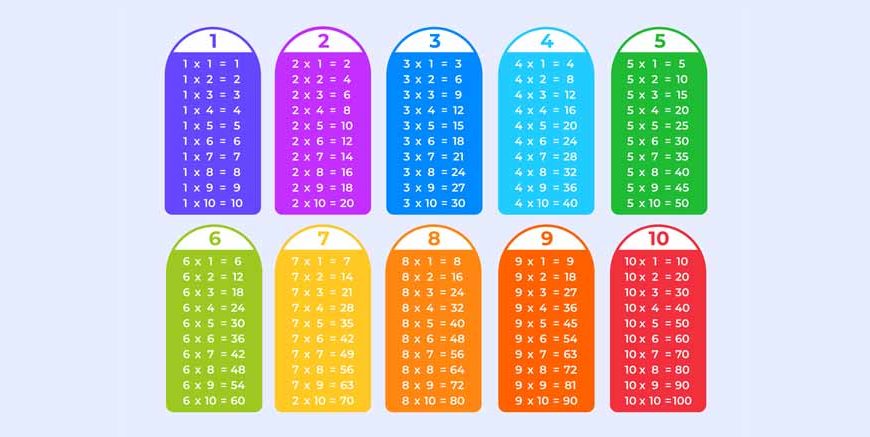
Look at your own hand. You have exactly five fingers. Now imagine giving a cheerful high-five to all your friends in the playground. If you give one high-five, you count five fingers. If you give two high-fives, you count ten fingers. This simple act of counting hands is exactly how we start to explore numbers in a fast and fun way. Instead of counting absolutely everything one by one, we can skip ahead using a special mathematical tool that saves us lots of time. Let us look at how jumping in groups can make learning maths a wonderful adventure.
What is the Table of 5?
The table of 5 is basically a clever shortcut for adding the number five over and over again. Imagine you have three small boxes and each box holds exactly five shiny red apples. You could count them slowly by adding five plus five plus five. However, knowing your tables makes this job much faster. You just know in your head that three groups of five make fifteen.
5 x 1 = 5
5 x 2 = 10
5 x 3 = 15
5 x 4 = 20
5 x 5 = 25
5 x 6 = 30
5 x 7 = 35
5 x 8 = 40
5 x 9 = 45
5 x 10 = 50
5 x 11 = 55
5 x 12 = 60
Read More – Maths Table 1 to 10
The Rule of Multiplication 5
When children first look at multiplication 5, they often notice a brilliant pattern straight away. It is like a secret code waiting to be cracked. If you look closely at the answers in the list above, you will see that every single number ends in either a five or a zero. It just bounces back and forth: five, zero, five, zero. If you ever multiply a whole number by five and get an answer ending in a three or a seven, you instantly know a mistake has slipped in somewhere! This helpful pattern makes learning these sums incredibly easy and very enjoyable for young learners.
Why Learning the 5 Times Table is Important
Mastering the 5 times table is not just a trick for passing a Friday school test. We use it in the real world every single day. Think about looking at an analogue clock on the living room wall to tell the time. The numbers around the edge of the clock face represent minutes, and we always count them in jumps of five. When the big hand points to the two, we know ten minutes have passed. We also use these helpful groups when counting specific coins, tallying up points in a board game, or sharing a packet of sweets equally among friends.
Read More – Fun Ways to Learn Times Tables
Summary
Numbers hold a wonderful, steady rhythm, and finding hidden patterns is the true joy of learning mathematics. When children finally realise that multiplication is just a faster way of adding things together, their fear of numbers usually disappears completely. Skipping along the number line in fives is like hopping happily across stepping stones in a flowing river.
It gets you to the other side much faster! Understanding these core concepts builds a strong, unshakable foundation for future logic and advanced problem solving. As they grow and face bigger mathematical challenges, they will always rely on these early, simple stepping stones. To uncover more joyful learning techniques and gently guide your child towards a bright academic future, browse the EuroKids Blog and find out all the necessary details regarding EuroKids Preschool Admission today.
FAQs
What is the easiest way to learn this table?
The absolute easiest way is to look for the repeating pattern, as every correct answer will always end in either a five or a zero.
Why is this table important for telling the time?
Analogue clocks are divided into neat sections of five minutes, so knowing these numbers helps children read the clock face quickly and accurately.
Is multiplication just repeated addition?
Yes, multiplying a number by five is the exact same thing as adding the number five together multiple times.